Banks Just Triggered a Repo Alarm Bell—And the Fed’s Liquidity Trap Is About to Snap Shut

The System Is Gasping for Air: Why the Fed’s Record Repo Action Should Terrify You
On October 31, while most Americans were prepping for tricks and treats, the real horror show was unfolding inside the Federal Reserve’s liquidity halls. The SRF—an emergency backstop the Fed hoped would gather dust—was tapped to the tune of $50.35 billion in a single day. That’s the largest hit to the facility since it was launched in 2021. Wall Street just mainlined Fed liquidity like a junkie in withdrawal.
Why now? Because the end-of-month crunch turned routine stress into something more sinister. Lending rates exploded past the Fed’s upper target, revealing what insiders know but won’t say: the markets are not liquid, the banks don’t trust each other, and the financial system is once again living on borrowed time.
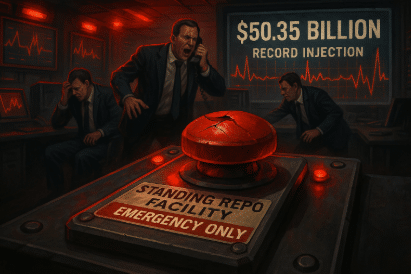

As if to downplay the panic, analysts tossed out platitudes—“just month-end volatility,” they say. But month-end volatility doesn’t usually require the Fed to slam the repo panic button like it’s 2008 all over again.
And here’s the kicker: at the very same moment, financial firms were also stashing $51.8 billion into the Fed’s reverse repo facility. That’s not balance—it’s a contradiction. These institutions are simultaneously begging for cash and hoarding it. That’s not hedging. That’s hoarding in the face of uncertainty.
QT Ends Early—And That’s Not a Good Thing
Just days before this SRF feeding frenzy, Jerome Powell stood at the podium and declared the Fed would end quantitative tightening (QT) on December 1. Translation: they’re halting the long-promised drawdown of their $9 trillion monster balance sheet. Why? Because, according to Powell, "reserves are somewhat above ample."
That’s Fed-speak for “the machine is sputtering.”
QT was supposed to continue into 2026. Instead, it’s being choked off early—another canary in the coal mine. Ending QT early means the Fed fears it’s draining too much blood from the system too fast. They’re afraid of triggering a financial cardiac arrest.
But that ship may have already sailed. Powell's carefully chosen words were followed by signs of market instability and spikes in repo rates. Now even Fed insiders are admitting the truth out loud.
Even the Fed Admits the SRF Isn’t Working
Dallas Fed President Lorie Logan, no stranger to the inner workings of this liquidity circus, said she was “disappointed”in how the SRF has performed. According to her, banks aren't using it as designed—even when rates are screaming for it.
Cleveland Fed’s Beth Hammack doubled down, calling the lack of SRF usage “disappointing.” If you’re reading between the lines, you’ll see what they’re really saying: the banks don’t trust the system. They don’t even trust the Fed’s own tools.
The Standing Repo Facility was meant to be a last-resort liquidity valve. Instead, it’s becoming a grave marker for a system that’s lost control over its own plumbing.
What This Means for You
This isn’t just some Wall Street curiosity—it’s a symptom of a terminally ill system. When the repo market breaks, it doesn’t do so politely. It snaps like a live wire. In 2019, a minor repo spike nearly caused a liquidity freeze. In 2008, repo dysfunction helped ignite the worst financial collapse in modern history.
Today’s record usage isn’t a one-off blip. It’s a pressure release valve in a system creaking under debt, overleveraged institutions, and a central bank that’s quietly reversing course.
If you think your money is safe in the banks, think again.
Your Call to Action
Don't wait for the headlines to catch up. The repo market is the invisible thread holding this whole circus together—and it’s fraying fast. Get ahead of the collapse. Download “Seven Steps to Protect Yourself from Bank Failure” by Bill Brocius right now.
Stay alert. Stay skeptical. Stay free.
—Derek Wolfe