The Market Is Mightier Than the Missile: How Voluntary Exchange Dismantles the War Machine

How Markets Dismantle the War Machine
The Real Unit of Peace: Individuals, Not Nations
Too often we hear of “nation vs nation,” “us vs them,” “the enemy over there.” But scratch the surface and the real story is far humbler—and far more powerful. True cooperation begins not between states but between human beings. Two strangers, in different corners of the world, make a deal—one has something you want, you have something they want. That handshake, that voluntary transaction, is a declaration of peace.
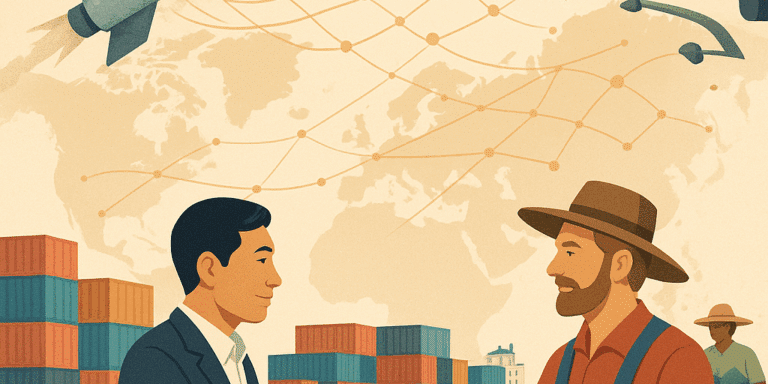
When a craftsman in China trades with a consumer in the United States, when a farmer lets his neighbor buy his produce instead of hoarding it, we see that the foundation of peaceful exchange lies in persons, not in states, ideologies, or armies. The market economy isn’t a sideshow—it’s the stage where everyday human beings prove cooperation beats conflict.
The Engine of Peace: Subjective Value & Comparative Advantage
Here’s the secret most political‑economists won’t admit: trade isn’t about one side winning and the other losing. It’s about difference. Because you value something more than I do, and I value something more than you do, we trade—and both of us walk away ahead. That’s the raw logic that turns strangers into partners.

Introduce the concept of comparative advantage, and it gets even more revolutionary. Even when one person (or one country) is “better” at everything than another, trade can still lift both sides up. It’s not zero‑sum. It’s not exploitation (unless you force it). It’s mutual benefit. Markets turn difference—not as weapon against—into a reason to cooperate.
The Architecture of Freedom: Institutions That Enable Exchange
No, peaceful markets don’t just pop into existence out of thin air. They require serious scaffolding—and most of it the state claims to provide, yet often corrupt or ignore. Key among those supports: private property, rule of law, and contract enforcement.
Why does this matter? Because without property rights, one party fears confiscation. Without enforceable contracts, promises vanish into air. Without the rule of law, bribery, coercion and theft become the game. In societies where these institutional foundations are weak, exchange shrivels. The result: tribes, clans, closed markets, stagnation.
Where institutions protect property and promise alike, peace scales. A sheep farmer in Scotland sells wool. A textile manufacturer in Bangladesh turns it into cloth. An exporter in Peru ships it to an American consumer. They don’t know each other. They didn’t threaten war. They just relied on the system of voluntary exchange—and that system is more formidable than any treaty.
The Outcome We’ve Ignored: Networks of Interdependence
When you reach the stage where nations—or at least cross‑border networks of commerce—become bound together by trade, you get something powerful. You get a state of affairs where initiating conflict becomes irrational. If Germany depends on American markets, and America depends on German engineering, what incentive is there for war? The blowback to your own prosperity becomes too steep.
So the market becomes not just economy, but diplomacy. Each transaction whispers: “Your gain is my gain.” Each export says: “We win when you win.” The resistance to conflict builds quietly—but deeply.
The Vulnerability: Economic Illiteracy
And now the vulnerability. Because this whole dynamic—voluntary cooperation, property rights, interdependence—relies on citizens believing it matters. If people believe trade is exploitation, profit is greed, regulation can fix every wrong, then they’ll vote for policies that cripple the market and open the door to conflict.
Protectionism, heavy‑handed regulation, government‑backed monopolies—they undermine comparative advantage, choke institutions, and shrink interdependence. The very network that deters war begins to unravel because people don’t understand how it works. They celebrate the State as peace‑keeper while dismantling the market as peace‑builder.
The Real Revolution: Ordinary Exchange as Acts of Peace
Here’s your truth bomb: The market revolution is not about billionaires and stock tickers. It’s about the butcher, the baker, the neighbor who trades eggs for milk. Every time someone sells something for the mutual benefit of seller and buyer, they’re saying: “Let’s cooperate, not fight.”
The classical economists of the Austrian school got this. They didn’t fixate on GDP or state planning. They focused on human action, on individuals choosing, on institutions enabling cooperation among strangers. When the system works, people don’t need to love each other. They just need each other to succeed—and in doing so, they protect themselves from conflict.
Why It Matters to You—and Now
In a world where governments spy, digital currencies threaten to centralize control (yes, I’m looking at you FedNow), and the spectre of global conflict looms, understanding the mechanics of free exchange is not optional—it’s essential. The institutions that enable peaceful markets are under assault. Regulation, capture, surveillance, protectionism—all of it chips away at the scaffolding of cooperation.
If you shrug off economics as “boring numbers,” you’re playing right into the hands of those who crave control. But if you understand that every trade is a tiny act of resistance, every voluntary deal a declaration of peace, then you’re armed with more than data—you’re armed with autonomy.
Call to Action
Don’t wait for politicians to hand you freedom. Defend the engine of freedom yourself. Download “Seven Steps to Protect Yourself from Bank Failure” by Bill Brocius with the link below, empower yourself with knowledge, safeguard your autonomy—and keep the market of cooperation alive.