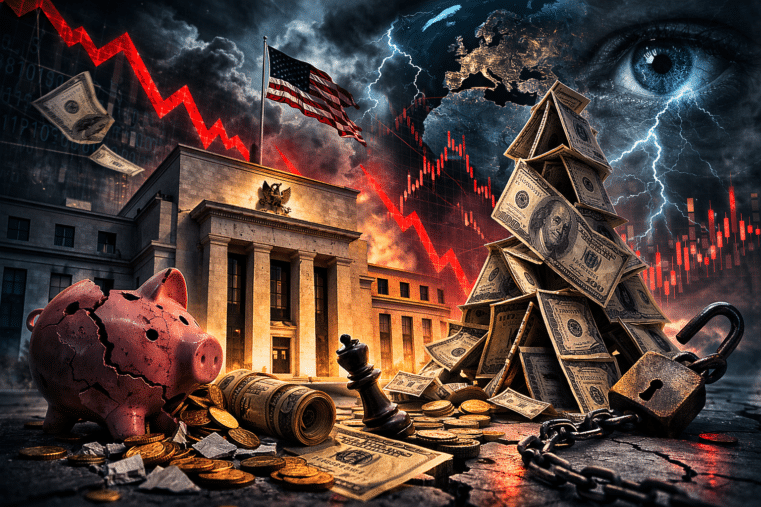
Bitcoin Bloodbath Exposes Fragile Foundations as FedNow Looms: What They’re Not Telling You About the Digital Dollar Collapse

Bitcoin’s Latest Collapse: What Happened?
Bitcoin tumbled over 52% from its all-time high of $126,000, crashing to a low of $60,000 in early February 2026. On paper, there was no clear reason for the bloodbath, which sent shockwaves across the entire crypto market. Ethereum and Solana followed suit, both dropping over 24% for the week.
“There’s nothing going on in the marketplace that should have necessitated this type of a crash,” said Anthony Scaramucci.
Translation? This wasn’t organic market behavior—this was engineered panic.

The “Digital Gold” Narrative Is Cracking
CNBC admits it: Bitcoin has failed to live up to its “digital gold” narrative. While gold is up 72% over the last year, Bitcoin is down nearly 30%.
Why? Because Bitcoin is still treated like a risk-on tech stock, not a safe-haven asset. That’s not a coincidence—it’s the result of targeted institutional de-risking, part of a broader strategy to delegitimize decentralized finance as CBDCs rise.
Institutional Money Is Running for the Hills
Bitcoin ETFs, once hailed as the key to mainstream adoption, are now bleeding capital:
- $3 billion in outflows in January 2026
- $2 billion in December
- $7 billion in November
Wall Street has flipped the script. The same firms that pumped Bitcoin during the 2021–2025 hype cycles are now draining liquidity, creating a vacuum that invites panic. This isn’t just risk management—it’s strategic abandonment.
Bitcoin as a Payment System? Dead in the Water
The article quietly concedes what many of us knew years ago: Bitcoin has failed as a transactional currency. Companies like Compass Coffee and Steak ’n Shake are token outliers. The payment use case is being phased out, replaced by dollar-pegged stablecoins that are far more compatible with financial surveillance infrastructure.
Bitwise’s Ryan Rasmussen puts it bluntly:
“Bitcoin is just a different asset. It’s not meant for that today.”
What he’s really saying? Bitcoin’s original use case is being erased by design. Enter: FedNow, CBDCs, and the programmable financial future you didn’t vote for.
What CNBC Won’t Tell You
Let me spell out the part they left out—the part that matters:
1. This Collapse Is Part of a Controlled Demolition
Bitcoin’s fall isn’t due to weak fundamentals. It’s a psy-op to delegitimize decentralized finance, scare off retail, and pave the way for total digital currency control under central banks. Just like how 2008 set the stage for monetary consolidation, 2026 is the reset year for financial digitization.
2. FedNow Is Already the Backbone of the CBDC Beast
While CNBC chats about ETFs, they ignore the bigger elephant: the FedNow payment system is fully operational, acting as the invisible rails for future digital dollar deployment. Combine FedNow with programmable money and transaction surveillance, and you’ve got a recipe for a financial Panopticon.
3. Stablecoins Are Trojan Horses for CBDCs
Wall Street and legacy financial institutions are pivoting to stablecoins not out of innovation, but because they fit neatly into the existing control grid. They offer a stepping stone to full-blown CBDCs, letting governments gradually kill cash without sparking mass resistance.
The Bigger Threat: Total Financial Enslavement
Bitcoin’s existential crisis is a distraction from the real enemy: the state-sanctioned rollout of programmable, surveilled, and centrally managed money. Once CBDCs dominate:
- Your spending can be geo-fenced.
- Your savings can expire.
- Your access can be shut off for “bad behavior.”
This isn’t theoretical. It’s already happening in China’s social credit CBDC prototype, and the U.S. is laying the same groundwork—quietly, efficiently, and with zero consent.
What You Need to Do—Right Now
Don’t let this crash lull you into complacency. The powers that be want you demoralized, confused, and out of the game so they can usher in their cashless control grid uncontested.
The crash is your warning.
The media spin is your distraction.
And FedNow is already here.
If you’re not preparing, you’re volunteering for financial servitude.
That’s why I urge you to download the Digital Dollar Reset Guide by Bill Brocius. This is more than prep—it’s intel on how to survive the financial coup that’s already underway.
Download the Digital Dollar Reset Guide now before they slam the trapdoor shut.
Stay sharp. Stay sovereign.
—Derek Wolfe