
(Block)Chains of Digital Tyranny: The Threat of Monetary Serfdom

“What underpins a world order is always the financial system.
We are on the brink of a dramatic change where we are about to, and I'll say this boldly, abandon the traditional system of money and accounting and introduce a new one. And the new one is what we call blockchain.
It means digital. It means having an almost perfect record of every single transaction that happens in the economy, which will give us far greater clarity over what's going on. It also raises huge dangers in terms of the balance of power between states and citizens. In my opinion, we're going to need a digital constitution of human rights if we're going to have digital money.

Most people think that digital money is crypto and private, but what I see are superpowers introducing digital currency. The Chinese were the first. The US is on the brink of moving in the same direction. The Europeans have committed to that as well.”
This revolutionary speech about a new financial system, was delivered at the World Government Summit in March 2022 in Dubai, by Philippa "Pippa" Malmgren, a member of the Council on Foreign Relations (CFR) and Chatham House; her father, Harald Malmgren served as a senior advisor to US Presidents Kennedy, Nixon, Ford and others. She’s a technology entrepreneur and economist, who served as Special Assistant to President George W. Bush, for Economic Policy on the National Economic Council and is a former member of the President's Working Group on Financial Markets and Corporate Governance.
Her words about the transition to a new world order that requires a new financial structure correspond well with the words of French President Emmanuel Macron in June 2023 at the Global Finance Summit in Paris: "The world needs a public financial shock to fight global warming, and the current system is not suitable for dealing with the world's challenges." The president of Brazil, Lula da Silva, also called for "a clean slate" and said the Bretton Woods organizations (World Bank, International Monetary Fund) do not serve their goals nor respond to society's needs.
“THE NEW BRETTON WOODS MOMENT”
“A new international monetary system is taking shape, some call it the new Bretton Woods moment that needs to be seized to create a new global financial governance,” says the investigative journalist Whitney Webb in a recent sitdown interview, where she mention that according to Mark Carney, former governor of the Bank of England & Bank of Canada and the UN Special Envoy for Climate Action and Finance, the three pillars of the new multi-polar world are Digital IDs, CBDCs and ESG, through a global carbon market. All world governments are pushing this agenda, that in order for it to succeed, all monetary systems and supporting systems must become digital and rely on digital data.
A good example of this was revealed at an event of the Central Bank of Israel with the Bank for International Settlements (BIS) – which I attended – in September 2023 in Tel Aviv, where the “Genesis Project” was presented. As part of this project, "green" bonds are issued, based on carbon quotas in the CBDC infrastructure. This is how the climate agenda is linked to financial markets.
“DEBT SERFDOM”
“Stablecoins could be the way in which the US is further globalizing the dollar, spreading its adoption directly to the world’s general public in order to continue increasing its debt and encourage uptake and usage of the dollar”, says Mark Goodwin, Editor in Chief of Bitcoin Magazine, in this interview with Whitney Webb. He suggests that the politician’s outcry of de-dollarization and the weakening of the dollar are a distraction from perpetuating the dollar as the world’s reserve currency.
“While CBDCs are what people are becoming fearful and aware of, it may just be the red herring, and the real strategy of the US dollar's survival is highly regulated stablecoins (such as Tether), which can easily be programmable, even more than CBDCs, as well as seized, regulated and controlled indirectly by governments. 100 billion dollars in treasuries were already purchased by Tether, its subsidiaries and owners. Tether is positioned alongside the top 20 nation states buying debt from the US, with around one tenth of China or Japan that have a trillion dollars debt to the US”.
This theory, together with the words of Mark Carney, Pippa Malmgren, Emmanuel Macron & Lula Da Silva, join the calls of global leaders and heads of states, pointing to the replacement of the monetary and financial world order, to introduce a new monetary system. Many experts say that we are reaching the end of the current fiat monetary system experiment, which is destined to collapse. Since world leaders are aware of this, they prefer to engineer a controlled demolition, to maintain control and steer the course, and enter the new era with power firmly within their grasp.
CENTRAL BANK DIGITAL CURRENCY SYSTEM (CBDC)
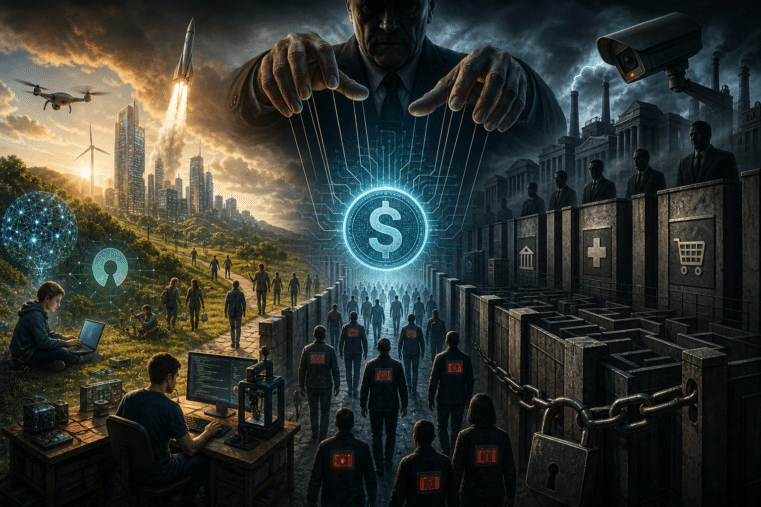
Central Bank Digital Currencies (CBDC), tie the financial freedom of citizens to the government and the banking establishment. The central bank issues its centralized digital currencies, and essentially creates a new monetary system, "fiat on steroids", a system that takes everything that is bad in the fiat system, and adds more of it; surveillance, control, censorship, and enforcement capabilities. A modern prison? Indeed, the CBDC is the ultimate prototype of a prison without physical chains. By connecting CBDCs to digital identity cards, and to government systems such as universal basic income, social credits and more, we get the ultimate control apparatus. This apparatus will dictate to citizens what they’re allowed to purchase, what the permitted quotas are while limiting consumption according to rules and use cases, at programmed times, places and cadences. The system is able to determine the use of a geographic radius (geo-fencing), and to determine expiration dates on the money. Each remote controlled digital wallet can also be switched on and off by its operators. More than 130 countries are in the initial stages of piloting CBDC systems, of which 36 countries are in advanced pilots, and 3 countries have already launched systems (Nigeria, Jamaica and the Bahamas).
WILL RIPPLE (XRP) BE THE CHOSEN PLATFORM FOR CBDC?
Ripple, a digital payment network and transaction protocol that owns the cryptocurrency XRP, is considered one of the most popular cryptocurrencies, and is strategically positioning itself at the heart of government financial innovation, aiming to be the cornerstone of future CBDCs.
The company is in talks with about twenty governments around the world to develop their CBDCs using Ripple's technology. In May 2023, Ripple launched a dedicated CBDC platform to assist central banks, governments and financial institutions around the world in issuing CBDCs and stablecoins. To date, Ripple has partnered with six governments for CBDC pilot projects: Georgia, Colombia, Montenegro, Hong Kong, Bhutan and the Republic of Palau.
The National Bank of Georgia, for example, has chosen Ripple as its technology partner for its CBDC pilot last year, citing Ripple's technical expertise and team capabilities. Its interest in CBDCs is in leveraging modern technologies, such as the programmability aspect of CBDCs, aiming to create a platform with smart contract and programmable token capabilities to stimulate innovation in the financial sector.
In the case of Bhutan, Ripple’s technology was chosen in 2021 for the country’s CBDC project to enable advanced cross-border payments, and assist in “financial inclusion” - in line with Bhutan’s mission to increase financial inclusion in Bhutan to 85% by 2023.
In 2022, Ripple reached the final stage of the G20 Techsprint CBDC Hackathon, hosted by Indonesia and the Bank of International Settlements (BIS), and in August 2023, the Republic of Palau launched a USD-backed digital currency, developed by Ripple.
Ripple encourages the abolition of cash (and a move to a cashless society), and unsurprisingly, it promotes the climate agenda; The company's website presents its commitment to a clean, prosperous and secure low-carbon future, with a plan to reach carbon net-zero by 2030.
Apparently, in line with Ripple’s expansion strategy vis-a-vis governments, the company makes sure to recruit employees who came from central and commercial banks. One of the company's top executives is Andrew Whitworth, policy director at Ripple, who previously worked at the Bank of England. At the same time as his role in Ripple, Whitworth also serves as a Director of the "Digital Pound Foundation", an organization that has declared itself the authority on the Digital Pound; it advises and influences the government's decisions regarding CBDC projects and deployments. Clearly an inside connection such as this might give Ripple an advantage in shaping digital currency policies to fit their platform and solutions. Does this hint a conflict of interests, or at least an unfair play?
Another avenue through which institutional influence and implicit control over Ripple could manifest is via a legal battle with the SEC (U.S. Securities and Exchange Commission) concerning the XRP cryptocurrency. Engaging in such legal disputes inevitably positions Ripple in a scenario where maintaining a positive relationship with institutions becomes crucial. Consequently, it's no surprise that Ripple prioritizes governments, central banks, and financial institutions as its primary target audience in its market strategy.
INTERESTING DEVELOPMENTS IN CBDC
China spent a couple of years rolling out relatively failed CBDC projects without widespread adoption, while injecting 30 million yuan as free money to encourage user adoption. Transactions using the digital yuan hit 1.8 trillion yuan (US$249 billion) in June 2023.
Recently, significant progress has been made: the two main payment services and applications in China - WeChat and Alipay - which have a traffic of about 3-4 trillion dollars per year, integrated the Chinese CBDC service into their applications. The central bank regulator made it clear that digital yuan isn’t meant to compete with the two payments giants. Rather, it’s supposed to play a complementary role.
Elon Musk, who owns, among other things, the Twitter/X platform, has stated that he wants to make the platform an "everything app" like the Chinese WeChat, including payment management. Will X also follow the Chinese route and integrate the CBDC solution into it, or will it try to become a CBDC infrastructure itself with the help of Musk's favorite cryptocurrency, the Dogecoin?
The CBDC pilot in Nigeria didn't exactly take off either, after the citizens took to the streets to protest the abolition of cash in the country, and resented the introduction of an unneeded digital solution, while demanding the return of cash. After a long and painful protest, the cash was returned alongside the new digital currency, which was not canceled and became part of reality. Furthermore, a new stablecoin is in preparation in Sandbox mode in Nigeria. The cNGN is a Naira stablecoin which some claim has more potential than the e-Naira to be widely adopted. “The stablecoin will be more broadly interoperable than the CBDC, which is only available in the central bank’s wallet. At launch, the central bank’s wallet usability was weak, although it is now quite good”, said Bolu Abiodun, a reporter at Techpoint Africa.
The UK saw a strong public backlash to Prime Minister Rishi Sunak last year, with more than 50,000 responses sent to the Bank of England following a public hearing on the Digital Pound, aka the UK's national CBDC.
GERMANY - AWARENESS OF "EXCESSIVE SURVEILLANCE"
In Germany, the technical guidelines document for a digital currency of a central bank was published in January 2024. Below are several quotes from the document, reflecting the tyrannical nature of the new currency, and the awareness of the central bank for trust issues it can create:
- Programmability is the institution’s authority to dedicate your money for certain uses, and to prohibit the use of your wallet when it is "outside the permitted scope".
- "The central bank can revoke CBDC notes, e. g. as an instrument of monetary control. Revocation of CBDC notes is performed by an authorized entity, the revocation authority, controlled and operated by the central bank." This sounds like a technique to confiscate and apply a shelf life to money.
- "Payments permitted under certain restrictions.. if the central bank sees fit to impose them" - the document lists restrictions that can be applied to wallets, depending on the amount of personal information that will be provided. For example, the amount of money in the wallet, the number of payments per day, the amount of money per transaction or per day.
- The good news: The German central bank is aware of the possibility of public opposition to a surveillance system: "Many of these design choices are general decisions on the trade-off between excessive surveillance and legitimate monitoring functions for AML and KYC purposes in conjunction with measures for mitigating fraud and misconduct. These decisions are extremely sensitive in nature and can strongly influence the level of trust that users place into the CBDC”.