CEOs Are Afraid of AI — And That Should Concern Every American Worker

The Boardroom Is Nervous
For years, corporate America told us AI was the future.
Efficiency. Innovation. Growth.
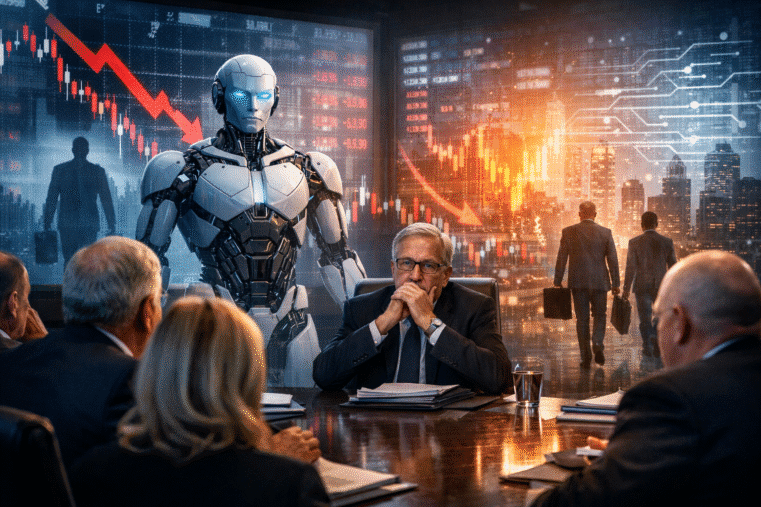
Now? Sixty percent of Fortune 500 CEOs say AI and “new technology” are the top risks to their industries.

Not number three.
Not number two.
Number one.
That’s not hype. That’s hesitation from the very people who’ve been selling this revolution to shareholders and policymakers alike.
If the executives who championed AI are now ranking it as their biggest threat, we should be asking why.
AI Isn’t Just a Tool — It’s a Disruptor
Artificial intelligence doesn’t just improve systems. It replaces them.
It replaces processes.
It replaces departments.
In some cases, it replaces people.
Unlike past waves of automation that primarily affected manufacturing, AI reaches deep into white-collar America:
- Accounting
- Legal research
- Marketing
- Logistics
- Customer service
- Financial analysis
These aren’t abstract roles. These are careers. Mortgages. College tuition payments.
And when executives say they’re worried, it’s not about whether AI works.
It’s about how fast it works — and who gets displaced in the process.
Confidence Is Up. Hiring Is Not.
Here’s the detail that should grab your attention.
CEO confidence recently rose into positive territory. By traditional metrics, that signals optimism about the economy.
But there’s a catch.
The share of CEOs planning to increase hiring slipped.
The share planning to cut jobs also declined.
In other words: low hire, low fire.
Translation? Corporate America feels stable — but not expansive. Profits may be protected. Payrolls are not growing.
That tells you something important.
The boardroom may feel comfortable.
The workforce remains uncertain.
Market Volatility in the Age of Algorithms
The article points out something else worth noting: companies can now be shaken by viral content, AI-generated reports, and rapid-fire online narratives.
Markets move faster than ever.
Reputations rise and fall overnight.
Stock prices react in seconds.
Retirement accounts can feel the impact before most people even understand what happened.
This isn’t about panic. It’s about structural change.
When AI accelerates information cycles — and misinformation cycles — stability becomes harder to maintain. Businesses feel it. Investors feel it. Workers eventually feel it.
Power Is Concentrating
AI development is not evenly distributed.
It’s concentrated among:
- Large tech corporations
- Massive data holders
- Well-capitalized institutions
That concentration matters.
When new technology reshapes industries, those with the computing power, data access, and capital reserves hold the advantage. Smaller businesses often struggle to keep up. Regional firms compete against national platforms with algorithmic leverage.
That shift doesn’t automatically spell disaster. But it does raise legitimate questions:
Who controls the tools?
Who sets the standards?
Who benefits most from the gains?
These are policy questions. Economic questions. And yes — political questions.
Why Southern Workers Should Pay Attention
My readers across the South understand something that coastal commentators often miss: economic shifts hit communities differently.
When automation enters logistics hubs, energy sectors, agricultural supply chains, or regional banks, the ripple effects travel through entire towns.
AI won’t just affect Silicon Valley.
It will touch trucking routes in Tennessee.
Warehouses in Alabama.
Energy grids in Texas.
Small banks in Georgia.
If large corporations use AI to streamline operations, that can mean fewer middle-management roles, fewer administrative jobs, fewer support positions.
That doesn’t mean progress should stop.
It means communities deserve a seat at the table when change accelerates.
Even the Boosters Are Hesitant
The most striking part of this survey isn’t fear.
It’s the shift.
AI was once framed as an unquestioned competitive advantage. Now, it’s viewed as a top-tier risk.
When industry leaders change tone, smart Americans pay attention.
Not because we panic.
But because we prepare.
The Bigger Question: Who Shapes the Future?
Technology itself is neutral. How it’s implemented is not.
Will AI:
- Empower small businesses?
- Or further centralize economic influence?
- Strengthen productivity across communities?
- Or primarily benefit large institutions with scale advantages?
These outcomes aren’t predetermined. They’re shaped by policy decisions, corporate strategies, and civic engagement.
If everyday Americans tune out, those decisions get made without them.
Stay Informed. Stay Ahead.
This isn’t about resisting innovation. It’s about understanding its consequences.
When CEOs say AI is their top risk, that’s not a throwaway line. It’s a signal that the economic landscape is shifting — fast.
And in times of rapid change, informed citizens have an advantage over distracted ones.
If you want deeper analysis on how technology, corporate power, and economic policy intersect — without the spin — join my Inner Circle today.
Right now, it’s available for just $19.95 per month through this special offer.
Stay informed. Stay engaged. The future is being shaped now.