
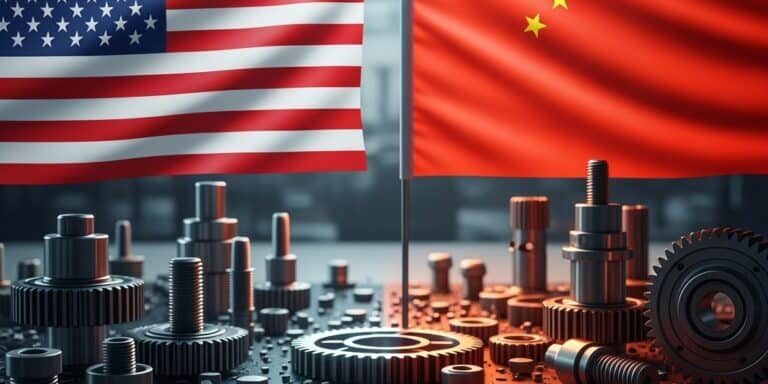
China Controls the Minerals of War – And the U.S. Is Running Out

The CCP Holds the Kill Switch on the U.S. Military-Industrial Complex
The average American has never heard of samarium, dysprosium, or terbium. But in Beijing, those names are tools of statecraft—and weapons of economic war.
These rare earth elements (REEs) are critical to the United States' most advanced military and industrial systems: fighter jets, missile guidance systems, radar technologies, electric vehicles, and satellites. And right now, China controls nearly 100% of the global supply of the most critical among them.
To call this an economic liability would be naïve. This is a full-blown national security crisis.

Let’s start with the numbers. The price of samarium has skyrocketed 6,000% in the last year alone. Why? Because the CCP cut off global supply in retaliation for U.S. tariffs and sanctions. And unlike oil or semiconductors, there’s no strategic reserve of rare earths. We’re not even close to self-sufficient.
The consequences? Immediate and severe.
The U.S. Defense Sector Is Already Bleeding
The Pentagon has mandated that, by 2027, defense contractors must eliminate any reliance on Chinese-sourced REEs. The problem? They can’t. Not yet.
Just this week, the CEO of Leonardo DRS—a major U.S. defense contractor—warned they’re now operating off of “safety stock” of germanium, a rare element used in infrared optics and satellite sensors. Translation: they’re one bad quarter away from halting production on mission-critical systems.
This isn't a warning. It's a canary-in-the-coal-mine moment.
What happens when F-35s can’t fly because China won’t sell the magnets? What happens when missile defense systems go dark because the CCP flips the switch?
You already know the answer. And so does Beijing.
The Supply Chain Is a Weapon – And It’s Pointed at Us
China has spent the last two decades buying up REE mines, perfecting the separation and refining process, and capturing global market share. They didn’t do this for profit. They did it for power.
The rare earth playbook is simple: control the materials, control the outcome. No magnets, no missiles. No dysprosium, no drones. No terbium, no targeting systems.
The U.S., by contrast, shuttered its refining facilities, offshored production, and assumed that the “free market” would magically provide. Now, we’re reaping the bitter harvest of that complacency.
The Pentagon knows it. That’s why they’ve poured over $400 million into MP Materials, one of the only American firms in the game. They've gone as far as guaranteeing price floors to keep U.S. operations from going under. That’s not capitalism—it’s survivalism.
But we're already late. And every day the CCP tightens the spigot, the clock ticks closer to a forced reckoning.
No Time Left for Bureaucratic Fantasy
Let’s be brutally honest: Washington isn’t moving fast enough. Talk of “public-private partnerships” and “transitioning supply chains” is just that—talk. The defense sector needs materials now, not five years from now. If kinetic conflict ever breaks out—or even escalates economically—we are dangerously exposed.
The Chinese Communist Party has shown they are willing to weaponize supply chains, export controls, and market manipulation to get what they want. They've done it with semiconductors. They've done it with cobalt. And now, they’re doing it with rare earths.
If that doesn't terrify you, it should.
Lynas: A Ray of Light in a Darkening Market
There are a handful of companies trying to claw back Western control. One of them is Lynas Rare Earths, an Australian firm with a growing foothold in heavy rare earth production.
Lynas has refining operations in Malaysia and is working to build new infrastructure in the U.S. It’s also the only non-Chinese company producing separated heavy REEs at scale. That makes it uniquely positioned in this geopolitical game of high-stakes resource control.
It’s not a silver bullet, but it’s a start. And it's why I’ve taken a small position personally.
That said, we need dozens of companies like Lynas. We need a Manhattan Project-level push to rebuild Western refining capacity. And we need it yesterday.
Get Ready for the Resource War of the Century
This isn’t about “green energy” or “ESG narratives.” This is about strategic survival. Without control over the raw materials that power our defense and energy sectors, the United States cannot function as a sovereign superpower.
It’s time to stop pretending this is a market story. It’s a military story, an economic story, and ultimately, a freedom story.
If you’ve ever wondered how the next financial crisis starts, it won’t begin on Wall Street. It’ll begin when China weaponizes resource flows, and Washington realizes—too late—that the empire has no supply chain.
Take Action While You Still Can
To understand where this is heading and how to protect your wealth from the cascading fallout, I urge you to read Bill Brocius’ guide, “7 Steps to Protect Your Account from Bank Failure.” It's not just about protecting deposits—it’s about preparing for systemic shocks no one is pricing in yet.
Want deeper analysis? For $19.95, you can join Bill’s Inner Circle newsletter, where you’ll get real-time breakdowns on resource wars, financial suppression, and how to escape the traps the system is setting for the unprepared.
>> Download the 7 Steps Guide Now
>> Get Bill’s Book, End of Banking As You Know It
>> Subscribe to the Inner Circle for $19.95/month
The rare earth war has already begun. The only question left is whether you’re on the losing end—or one step ahead.