
Pax Silica: The Global Tech Cartel Masquerading as an Alliance

What Is Pax Silica?
On December 12, 2025, the U.S. Department of State unveiled Pax Silica, a new international coalition aimed at securing AI-related supply chains. The alliance includes eight nations: Japan, South Korea, Singapore, Netherlands, Israel, UAE, UK, and Australia—a who’s who of tech powerhouses and strategic outposts.
The goal? According to Under Secretary of State Jacob Helberg, Pax Silica exists to secure supply chains from minerals to semiconductors to compute infrastructure, ensuring that no single country can hold the world hostage through technological leverage.
Strategic Context: The Shadow of BRICS
The launch is a direct response to the expanding BRICS bloc, which added Saudi Arabia and Indonesia in 2025 and now accounts for over 41% of global GDP and half the world’s population. Over 50 nations are either interested in joining or have already applied.

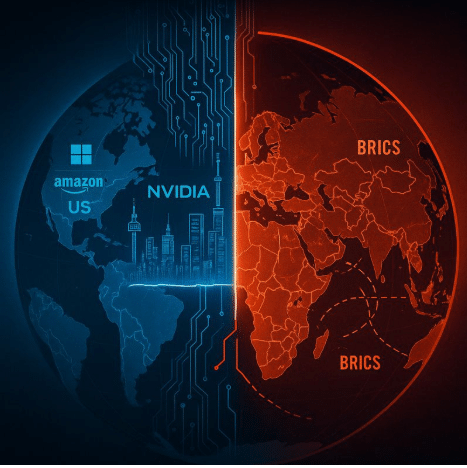
The U.S. is clearly signaling that it won't sit quietly while the dollar gets squeezed and the Belt and Road Initiative continues snapping up ports and logistics corridors across Eurasia and Africa.
Pax Silica’s Official Mission
According to its architects, Pax Silica is about:
- Building trusted technology ecosystems
- Protecting sensitive technologies from "undue influence"
- Collaborating on infrastructure projects across AI, semiconductors, critical minerals, and energy
- Promoting “economic security as national security”
This isn’t just about trade—it’s about building a firewall around the Western AI economy, and it’s being framed as a modern-day equivalent of the G7 for the digital age.
What's Really Going On: A Digital Iron Curtain
Let’s cut through the polite language.
This isn’t a “market alliance.” It’s a state-backed tech cartel, engineered not to promote open competition, but to centralize control over the future of computing, digital infrastructure, and artificial intelligence. It’s a clean room operation for the post-dollar world—sanitized, permissioned, and under tight surveillance.
And while Friedmanites might balk at the idea of governments coordinating markets, the sad truth is the market has already been captured—by data brokers, intelligence contractors, and institutional capital. The private sector isn’t free anymore. It’s franchised.
Avoiding the China Trap—Or Creating a New One?
Yes, Pax Silica is meant to counter China’s Belt and Road and its digital arm, the Digital Silk Road. And yes, there are real concerns about data sovereignty, IP theft, and strategic dependency on adversarial tech ecosystems.
But by replacing one dependency with another—just run through different corporations and allied governments—we’re not freeing markets, we’re redrawing them. The West is erecting its own techno-political fortress, just dressed in democratic branding.
The danger? These coalitions don’t dissolve when the crisis passes. They institutionalize. They bake control into the system. And when AI runs the world, whoever owns the infrastructure owns the narrative.
What Would Milton Friedman Say?
He’d reject the method but sympathize with the motive.
Friedman would see Pax Silica for what it is: industrial policy cloaked in national security language, with governments coordinating supply chains and picking winners across industries. That’s textbook economic distortion.
But where Friedman still believed in the purifying power of free markets, I don’t share that faith. Not anymore. Not in a world where the same entities controlling capital flows are setting tech policy—and funding both sides of a conflict.
Pax Silica Is a Warning Sign, Not a Victory Lap
If you’re watching this play out and thinking, “Good, we're protecting our tech from China,” I get it. But here’s the real question: Are we protecting it for ourselves, or for the same multi-national interests that already gutted Main Street?
Don’t be fooled by the flag-waving. Pax Silica isn’t about keeping you safe. It’s about locking down the chokepoints of tomorrow’s economy—compute power, chips, data centers, AI models—and keeping them in the hands of a few. And those hands? They don’t answer to voters.
Call to Action: What You Can Do
As always, don’t wait for the next collapse to figure out your exit strategy. Every time these elite compacts roll out, they push the system one step closer to full-spectrum digital control.
🔒 Download “Seven Steps to Protect Yourself from Bank Failure” by Bill Brocius — it’s your playbook for staying one step ahead when the system buckles.
👉 Get it here
Stay skeptical. Stay sovereign.
— Derek Wolfe