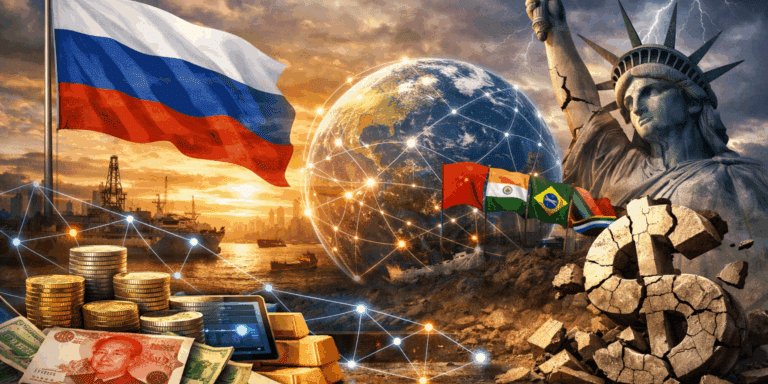
Russia’s BRICS Strategy: Slashing Dollar Dependence to Defend Trade Sovereignty

Russia Reveals the Next Phase of De-Dollarization
Russia has officially confirmed what many of us have anticipated for years: BRICS member states are now actively working to slash the use of the U.S. dollar in their mutual trade. The confirmation came directly from Russian Foreign Ministry spokesperson Maria Zakharova during a December 25th press briefing. She stated that BRICS countries are building the necessary conditions to conduct trade in national currencies, a process that’s already underway and accelerating.
This shift isn’t posturing. It’s protection. Officials have framed this strategy as a defensive response to Western sanctions, not an economic attack on the dollar. But the effect is the same: the dollar is losing its global grip.
A Strategy Rooted in Real Trade Defense
Russia is positioning its use of BRICS national currencies as a shield—designed to protect trade and reinforce financial stability. Zakharova emphasized that while the process is complex and ongoing, every BRICS member remains committed to achieving practical, irreversible results.

Finance Minister Anton Siluanov was even more explicit at a 2024 São Paulo meeting. He described the current Western-led financial system as deeply flawed, increasingly used as a tool of economic and political coercion, and dangerously fragmented. According to Siluanov, these abuses have forced the BRICS bloc to pursue monetary reform.
This is not idealism. It’s survival strategy.
Sanctions Are Accelerating the Escape from the Dollar
Despite Western narratives, Russia has gone out of its way to clarify that this isn’t an anti-dollar campaign. Zakharova stated unequivocally that BRICS “does not oppose the dollar” in principle. But then she explained the real issue: illegitimate, politicized restrictions from the West are pushing countries toward alternatives. De-dollarization, she said, is an objective global trend.
President Putin confirmed this evolution at the 2024 BRICS Summit, revealing that 90% of Russia’s international settlements are now conducted in BRICS or allied national currencies. That number represents a total transformation from just a few years ago.
Put bluntly, the weaponization of the dollar through sanctions has triggered a global rethink—and BRICS is turning that rethink into architecture.
Parallel Systems: The BRICS Financial Firewall
To defend trade from disruption, Russia and its BRICS partners are developing parallel financial systems that don’t rely on SWIFT or other Western-controlled rails. At the center of this effort is the BRICS Cross-Border Payment Initiative (BCBPI)—a mechanism that settles transactions using member currencies.
This system is designed to neutralize the threat of secondary sanctions. For countries under pressure, or merely watching the Western crackdown on dollar dissidents, BRICS offers a new safe harbor. And that’s precisely the point.
Zakharova was careful to describe BRICS trade partnerships as “trustworthy and effective,” built on energy and commodity ties, not antagonism. But make no mistake—these systems are meant to function without Western approval.
National Currencies Gaining Global Traction
What used to be an abstract discussion is now concrete reality: BRICS national currencies are already being used in settlements, and the infrastructure is being rolled out in phases. The move is slow by design, as officials work to build out the technical systems required to replace dollar-based mechanisms.
The key word here is irreversibility. This isn’t about leverage. It’s about permanence—creating a world where trade is no longer vulnerable to U.S. financial warfare.
Russia’s leadership in this transition is about more than national interest. It’s about showing other nations a path out of the dollar trap—a path lined with practical alternatives and cooperative infrastructure.
The Real Story Behind the Headlines
Here’s what matters: BRICS isn’t waiting for Western permission or validation. It’s building a new system in real time. And the more the West tightens its grip with sanctions and coercive trade policy, the faster that system evolves.
Russia isn’t just protecting itself—it’s laying the groundwork for global monetary sovereignty, one BRICS payment system at a time. The dollar was once untouchable. That era is over.
📥 Download the free guide — The Digital Dollar Reset Guide — and discover how to position yourself before these systems become the new standard.
The reset isn’t coming. It’s already started.