EDITOR NOTE: Many investors who proudly display the “woke” banner in their social dealings are now insisting their investments should bear the same moral imperatives. So, they seek companies that tout ESG--short for environmental, social, and corporate governance--metrics as part of their “wokeness.” Though not quite displaying the momentum of a meme, ESG funds are certainly a popular theme, and many mutual funds have jumped on this bandwagon. But does the Wall Street rendition of this narrative has more to do with theater than real activism? According to Eco-Business, a media company, “an industry ‘think tank,’ found that 78% of mutual fund providers offered ESG investments. However, none specifically excluded deforestation risk. Not a single one actively priced climate risk either.” Unless you vet every ESG stock you hold, you may discover that you’re really investing in a “virtue signaling” theme, but nothing that benefits the ecological or social causes you thought you were supporting. There’s another name for this type of investment: it’s called “sucker investing''. I hope you didn’t fall for it.
Wall Street is once again in the midst of a “money heist” from naive investors. This time in the form of “woke activism” called ESG.
ESG refers to the Environmental, Social, and Governance risk theoretically embedded in a business. However, while ESG investing is about taking these risks into account in investment decisions, these are all the things NOT on a company’s balance sheet or earnings statements. Such is the inherent problem.
However, as is also the case, with the recent surge in liberal policies, woke activism, and demand for social justice, Wall Street is more than willing to sell products to fill a need. Not surprisingly, with plenty of media coverage, ESG investing has become an enormous business.
Following the financial crisis, ESG funds had roughly a ZERO market share of total assets under management. Today, ESG-labelled funds in the United States exceed $16 trillion.
The question is whether investors are getting what they are paying for?
In the late ’90s, there was a significant movement by Wall Street to limit investing in “sin” stocks such as gambling, tobacco, etc. Just as it was then, investors initially jumped on board, but when returns failed to match the S&P index, that “fad” died away.
The same occurs today as investors who want to be “woke” are demanding products that make them feel good to purchase. However, there are many problems with ESG outside the labeling.
There are currently no universal rules to analyze ESG risks. Nor are there any clear frameworks to police ESG-labelled investment products. As Eco-Business recently noted:
“For example, deforestation is a major driver of climate change. You would think it’s being used as a filter to ensure companies in ESG-labelled funds are not turning a blind eye to deforestation, but you would be wrong. Carbon Tracker, an industry ‘think tank,’ found that 78% of mutual fund providers offered ESG investments. However, none specifically excluded deforestation risk. Not a single one actively priced climate risk either.”
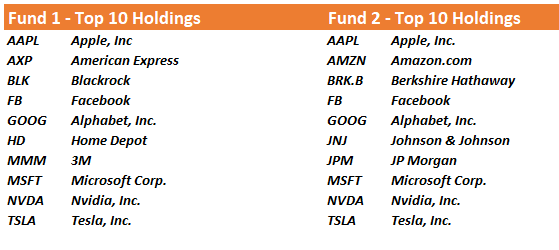
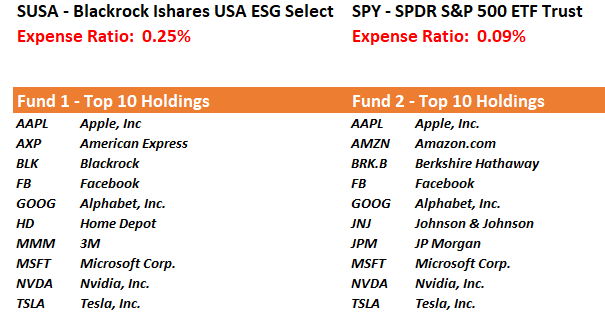
Let me give you an example of the top 10-holdings of two ETF’s. One is specifically labeled an ESG fund; the other is the S&P 500 Index.
So, precisely what are you paying for?
The problem with ESG funds is that Inconsistencies and abuse are rife.
“BNP Paribas, the largest bank in the Eurozone, never wastes an opportunity to boast of its green credentials. It’s also the world’s top banker of offshore oil and gas over the last five years and managed to increase fossil fuels lending since the Paris agreement. Here’s the same BNP on sustainable investing: ‘Why sustainable investing? Quite simply, it is worth it.’ BNP peddles ESG products to its clients with one hand, while its other hand fuels the climate crisis.” – Eco-Business
Another example is the recent Exxon Mobil board seat challenge by Engine No. 1. With the backing of Blackrock and several pension funds with close ties to Blackrock, Engine No. 1 secured three board seats for the company.
“And guess what? BlackRock backed this no-name cadre of woke activists, even as Exxon persuasively argued that Engine No. 1 wasn’t qualified to help run an oil company. With BlackRock on the fund’s side, ExxonMobil eventually folded like a cheap tent.”
The NY Post made an interesting point.
“Now with Engine No. 1 likely to occupy three seats on Exxon’s board, it isn’t too much of a stretch to see the company passing Fink’s ESG screens for his ETFs with flying colors.”
If you think investment managers are doing it for the “good of the environment,” think again.
“Investment managers and banks are taking advantage of our collective willingness to help fight climate change because the ESG space is, to put it mildly, a zoo.
Epic greenwashing is everywhere: Out of 253 funds that switched to an ESG focus in 2020 in the US, 87 per cent of them rebranded by adding words such as ‘sustainable’ or “ESG” or ‘green’ or ‘climate’ to their names.
None changed their stock or bond holdings at that point.” – Eco-Business
Why would they change their name and not their holdings? Good question.
“Complete fraud, a joke, jargon, so ridiculous” were among the choice words Social Capital founder and CEO Chamath Palihapitiya used to describe the growing ESG movement.
“These are useful statements. It’s great marketing. But again it’s a lot of sizzle, no steak.”
With ESG now the rage, the “demand” drives product development. However, there is also an understanding of why large asset managers have embraced the strategy so readily – higher fees.
Let’s revisit the table of the two funds above, now fully disclosed.
Yes, you too can own an ESG fund that is almost three times as expensive as the S&P 500 index, all for the sake of “feeling good about yourself.”
According to The Wall Street Journal:
“Citing ETF data from FactSet, it found the ESG funds’ ‘average fee was 0.2% at the end of last year, while standard ETFs that invest in U.S. large-cap stocks had a 0.14% fee on average. A firm managing $1 billion in a typical ESG fund, for example, would garner $2 million in annual fees versus managing the standard ETF’s $1.4 million.”
Look again at the table above. Furthermore, there are virtually no significant differences in the ESG ETF except that Blackrock put their company stock in the lineup. But, of course, there is “no self-serving purpose” in doing that except that as billions pour into the ETF, it boosts Blackrock’s stock price.
“The kicker, of course, is that ESG strategies aren’t any more expensive to run than their more-traditional counterparts.” – Wall Street Journal
Oh, and by the way, while you are complaining about how Wall Street has created a “wealth gap” in America, remember every time you buy their funds, you are increasing THEIR wealth more than yours.
“If governance is a hard quality to measure, rating a company’s environmental and social impact – the other two-thirds of hot investment style ESG – is even more challenging. But where the money flows, accusations of fraud follow and in 2020 there has been no shortage of examples of businesses claiming high ESG credentials with little merit.” – Investors’ Chronicle
The problem with ESG, while the concept is undoubtedly well-intentioned, is that where money flows, greed always follows.
“There probably aren’t that many companies in the ESG universe that actually make a positive contribution to society, I suspect the vast majority of the money [being invested in ESG] is going to be misallocated.” – Carson Block, founder of short activist Muddy Waters
Here is something else for investors to consider.
ETFs are supposed to carry lower fees than regular funds because they mirror a typical basket of stocks like the S&P 500, as shown above. However, by “claiming” to have ESG screening methods, Wall Street found a way to inflate management fees of a simplistic investment.
“In fact, studies show that management fees on ESG funds are more than 40 percent higher than other ETFs. BlackRock currently manages about $200 billion in ESG client money, which means that number is likely to grow and add to BlackRock’s profits.” – NY Post
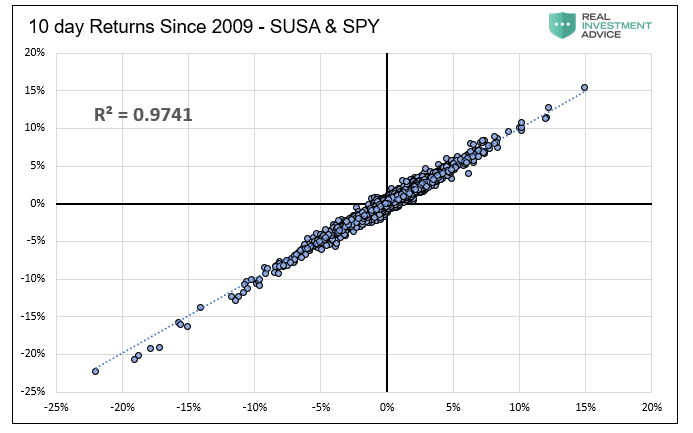
Unfortunately, for investors, while these funds cost much more to own, their performance isn’t any better than just holding the substantially cheaper index fund. As shown, the correlation between Blackrock’s USA ESG fund and the S&P 500 Index is almost perfect.
Chart courtesy of Michael Lebowitz, CFA
“These funds lately haven’t beat indices that are simply created to make you money and only do so when they pack themselves with high-flying tech names. Sounds good on paper — until you drill down.
For starters, such investing methods are highly political and veer far to the left. Companies often get good grades for supporting lefty causes such as Black Lives Matter. Oil companies like Exxon will get higher marks for building wind farms that produce energy inefficiently.
But here’s where Larry Fink and BlackRock still come out ahead: They have sensed that with all the media hype of ESG investing as the next frontier, they can also make a lot of money creating a new type of fund dedicated specifically to ESG — and then charge more for it.” – NY Post
In short, while Wall Street pushes out products to make “you” feel like you are socially responsible, they laugh all the way to the bank.
“Will the rest of the investors make money? Quibbles.” – NY Post
Original post from RIA
Energy officials are downplaying it. Analysts say “it’s too early.” But behind closed doors, contingency…
A year of aggressive tariff swings, legal reversals, and rising economic pressure has done more…
Wall Street is celebrating. The headlines say “peace,” the markets surge, and the talking heads…
You’re being told this is just another Middle East conflict and rising tensions in Asia—but…
While headlines focus on war and inflation, central banks around the world are quietly stacking…
The headlines say rising grocery prices are an unfortunate side effect of war. That’s not…
This website uses cookies.
Read More