
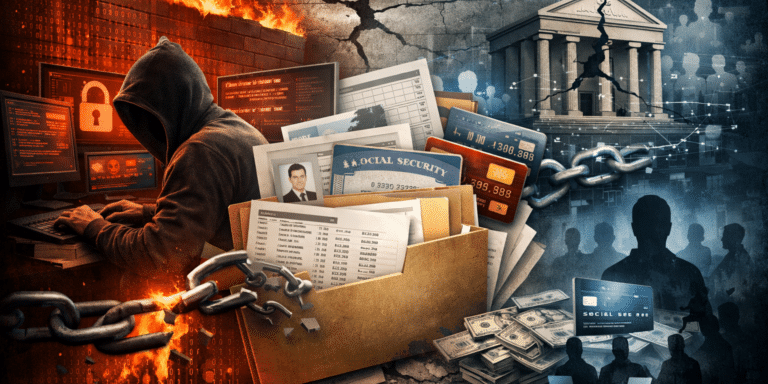
Banking System Collapse: 672K Americans Exposed In Ransomware Attack

The Breach That Should Shake Your Confidence
More than 672,000 Americans just had their financial and personal data exposed in a ransomware attack.
Not through their bank directly.
Through a third-party tech company most of them didn’t even know existed.

That alone should tell you everything you need to know about how modern banking actually works.
Because your data?
It doesn’t just sit inside your bank.
It’s copied, analyzed, transferred, and stored across an entire ecosystem of companies operating behind the scenes.
And when one of them fails…
You’re the one left exposed.
The Company You Never Heard Of—Holding Everything
The breach traces back to a Texas-based fintech firm called Marquis.
They don’t manage your money.
They manage your data about money.
Banks use companies like this to:
- Analyze customer behavior
- Improve services
- Optimize internal systems
But to do that, they’re given access to:
- Names and addresses
- Dates of birth
- Bank account details
- Credit and debit card numbers
- Social Security numbers
In other words:
Everything needed to reconstruct your financial identity from scratch.
And now, that data is out in the wild.
How One Weak Link Opened the Door
This wasn’t some random smash-and-grab hack.
It was precise.
Calculated.
And it exploited something most people don’t even think about:
Infrastructure behind the infrastructure.
According to reports, attackers gained access through compromised firewall configuration data—essentially a blueprint of the system’s defenses.
Think of it like this:
You didn’t leave your front door unlocked.
But someone stole the master key system used to secure the entire neighborhood.
Once they had that?
Getting in wasn’t hard.
The Real Problem: You Don’t Know Where Your Data Lives
Here’s the part that should concern you most:
You didn’t choose to trust this company.
You probably didn’t even know it existed.
But your bank trusted them.
And that automatically put your data in their hands.
That’s how the modern financial system operates:
- Layered access
- Shared data environments
- Third-party dependencies everywhere
Which means your security is only as strong as the least secure company in the chain.
Not the biggest.
Not the most trusted.
The weakest.
What Happens After a Breach Like This
Once data like this is exposed, the damage doesn’t happen all at once.
It unfolds over time.
Your information can be used to:
- Open credit lines in your name
- Drain accounts
- File fraudulent tax returns
- Create highly convincing scams targeting you directly
And here’s what makes it worse:
This data doesn’t expire.
It gets stored, sold, traded, and reused across different criminal networks.
Meaning this isn’t just a short-term problem.
It’s a long-term vulnerability.
The Illusion of Security Is Breaking Down
Banks spend billions telling you your data is safe.
Encryption. Monitoring. Advanced security systems.
But incidents like this reveal something uncomfortable:
The system isn’t centralized. It’s fragmented.
And fragmentation creates risk.
Because no matter how secure one institution is…
It still relies on dozens—sometimes hundreds—of external vendors.
Each one with its own vulnerabilities.
Each one a potential entry point.
Accountability Is Getting Murky
The aftermath of this breach raises another issue most people overlook:
Who’s actually responsible when something like this happens?
The fintech company blames its firewall provider.
The firewall provider hasn’t responded publicly.
Meanwhile, your data is already gone.
This is what happens in complex systems:
Responsibility gets distributed.
Blame gets diluted.
And the individual—you—absorbs the consequences.
This Isn’t an Isolated Incident
This is part of a pattern.
More breaches.
More third-party failures.
More exposure of sensitive financial data.
Because the system has become:
- More connected
- More dependent
- More complex
And with that complexity comes a simple reality:
More points of failure.
Final Thought: You’re in the System—Whether You Like It or Not
Most people still think of their bank as the place where their financial life exists.
But that’s outdated.
Your financial identity now lives across a web of companies, platforms, and systems you’ll never see.
And you don’t control any of them.
So when one breaks?
You don’t get to opt out.
You deal with the fallout.
Call to Action: Understand the System Before It Understands You
If this breach tells you anything, it’s that the financial system is changing—and not in ways that increase your control.
You need to understand:
- How systems like FedNow are reshaping how money moves
- What central bank digital currencies (CBDCs) mean for your financial autonomy
- How financial surveillance expands as systems become more interconnected
- What steps you can take right now to protect yourself
This isn’t theoretical.
It’s already happening.
Download the Digital Dollar Reset Guide by Bill Brocius Now
Because once everything is fully integrated…
You won’t just be using the system—you’ll be dependent on it.