
Living on the Edge: How Financial Stress Is Reshaping American Life—and Why It’s No Accident

From Stability to Survival Mode: How Everyday Financial Stressors Took Over
There was a time when Americans planned ahead.
Built savings. Took vacations. Looked forward.
That time is fading fast.
Today, millions are operating in survival mode.

- Confidence is gone
- Caution is constant
- Every dollar has a job
This isn’t just a mood shift.
It’s a lifestyle shift—forced by rising costs and shrinking financial breathing room.
Cutting Back Isn’t a Choice—It’s a Warning Sign
Look around. You see it everywhere.
- Restaurants emptier
- Travel plans canceled
- Subscriptions cut
Americans are pulling back—hard.
This isn’t simple frugality.
This is defensive living.
People are:
- Trading down to cheaper brands
- Eliminating anything non-essential
- Stretching every paycheck to the breaking point
Why? Because the system is squeezing them from both sides.
Costs go up.
Savings don’t keep up.
That’s the quiet force most people never hear about:
Financial Repression: The Silent Wealth Killer
It sounds technical. It’s not.
Financial repression means your money loses power while you’re told everything is fine.
- Interest on savings stays low
- Inflation eats away at value
- Real wealth declines over time
You save responsibly—and still fall behind.
That’s not an accident. That’s policy.
Skipping the Doctor: The Most Dangerous Trade-Off
Here’s where it gets serious.
Americans aren’t just cutting luxuries.
They’re cutting healthcare.
- Routine checkups? Delayed
- Specialist visits? Avoided
- Procedures? Postponed
Even people with insurance are saying no to care.
Why?
Because the math doesn’t work.
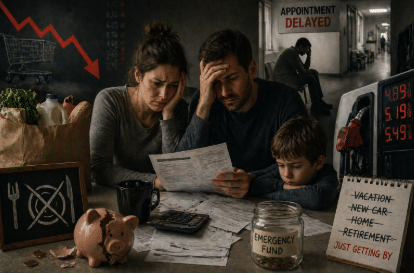
Short-term survival wins over long-term health.
And that creates a ticking time bomb:
Skip care now → pay more later → fall deeper behind
Living on the Edge: Everyday Financial Stressors and the One-Emergency Reality
Let’s be blunt.
Millions of Americans are walking a financial tightrope.
- Little to no emergency savings
- Rising reliance on credit
- No margin for error
One car repair.
One medical bill.
One job disruption.
That’s all it takes.
And suddenly:
- Debt piles up
- Stability disappears
- Stress skyrockets
This is what happens in a system where saving is punished and costs never stop rising.
The Psychological Toll: A Nation Under Pressure
This crisis doesn’t stay in your wallet.
It gets in your head.
- Constant anxiety about bills
- Exhaustion from daily trade-offs
- A fading belief in the future
People aren’t just broke.
They’re burned out.
Financial stress reshapes how you think:
- You stop planning long-term
- You focus only on getting through the month
- You lower expectations
That’s not the American Dream.
That’s managed decline.
Families and Communities Are Feeling It Too
This pressure doesn’t stop at the individual level.
It spreads.
- Couples argue more about money
- Families delay buying homes or having kids
- Communities become less connected
When everyone is stretched thin, everything weakens.
Opportunity shrinks.
Mobility stalls.
The social fabric starts to fray.
And all the while, the same forces keep tightening the screws.
A Behavioral Economy in Retreat
Here’s the big picture.
When millions of Americans:
- Spend less
- Save less effectively
- Live more cautiously
The entire economy shifts.
Growth slows.
Risk increases.
Fragility spreads.
This is what happens when people are pushed to the edge for too long.
And in a system shaped by financial repression, that pressure doesn’t ease—it lingers.
The Bottom Line: This Isn’t Random—It’s Engineered Pressure
Let’s call it what it is.
Americans didn’t suddenly become bad with money.
They were put in a system where:
- Costs rise relentlessly
- Savings lose value
- Stability becomes harder to achieve
And then they’re told to “adjust.”
They are adjusting.
By cutting back. By delaying. By surviving.
But survival isn’t prosperity.
The Choice Ahead: Stay Reactive or Take Control
You can keep reacting.
Cutting. Delaying. Hoping things improve. But as everyday financial stressors continue to build, that cycle becomes harder to escape and easier to normalize.
Or you can start understanding the forces working against you—and position yourself accordingly.
Because this isn’t temporary.
It’s structural.
And the longer you ignore it, the tighter the squeeze becomes.
Join the Inner Circle Before the Next Shock Hits
If you want real insight into what’s happening—and how to protect yourself—you need information the mainstream won’t give you.
Because living on the edge isn’t sustainable.
And the people who act early are the ones who stay standing when the system shakes.