Indonesia’s De-Dollarization Surge: The Quiet Blueprint for a Global Shift Away from the U.S. Dollar

Indonesia Didn’t Just Talk About Change—It Executed It
While most governments drag their feet behind committees and “framework discussions,” Indonesia flipped the switch.
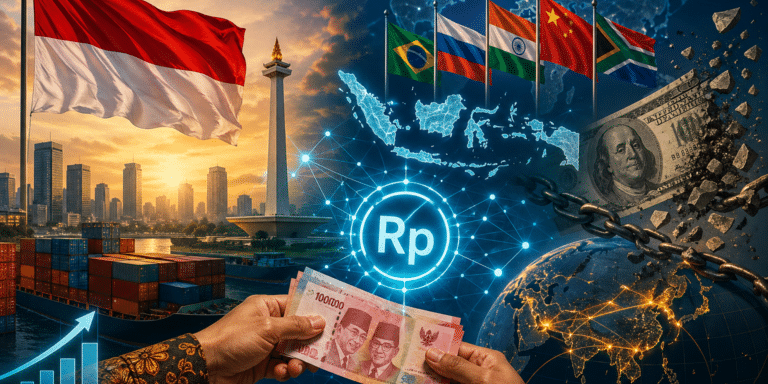
In 2025, they rolled out a Local Currency Transaction (LCT) system, pushing businesses and consumers to settle trade in rupiah instead of relying on the U.S. dollar. That’s not a theoretical policy—it’s boots-on-the-ground execution.
And the results?

- Transactions under the system surged 163% year-over-year
- Volume hit $8.45 billion in early 2026
- User adoption exploded well beyond projections
That’s not experimentation. That’s proof of concept.
Indonesia didn’t just flirt with the idea to de-dollarize—they operationalized it.
Why This Matters More Than You’re Being Told
Here’s where things get interesting—and where most mainstream coverage conveniently stops.
When a country successfully reduces dependence on the dollar, three things happen:
Transaction Power Shifts Locally
By cutting out the dollar, Indonesia reduced conversion costs and friction. That means more efficient trade and tighter economic control.
External Leverage Weakens
The dollar has long been a tool of influence. When countries step outside that system, they reduce exposure to external pressure—economic or political.
Confidence Becomes Contagious
Success breeds imitation. Other nations—especially those watching from the sidelines—start asking the same question: Why are we still tied to this system?
BRICS Is Watching—and Taking Notes
Indonesia isn’t operating in a vacuum. It just handed BRICS something far more valuable than theory: a working model.
For years, BRICS nations have talked about reducing reliance on the dollar. The problem was never intent—it was execution.
Indonesia solved that problem.
Now imagine this playing out across multiple countries:
- Bilateral trade deals bypassing the dollar entirely
- Regional currencies gaining strength through repeated use
- A gradual normalization of non-dollar settlements
This isn’t a collapse scenario. It’s a slow realignment—and those are harder to detect until they’re already well underway.
The Domino Effect of De-Dollarization
The real story isn’t Indonesia. It’s what happens next.
When one country proves it can successfully de-dollarize:
- Others follow to stay competitive
- Trade alliances begin to shift internally
- The global demand structure for the dollar starts to erode
Not overnight. Not dramatically. But steadily.
And that’s how systemic change actually happens—not through loud announcements, but through quiet adoption curves.
The Hidden Incentive No One Talks About
Let’s strip away the diplomatic language.
Countries aren’t doing this out of ideology—they’re doing it out of self-interest.
Trading in local currencies means:
- Lower costs
- Faster settlements
- Greater control over monetary flows
Once those benefits become measurable—as Indonesia just demonstrated—it stops being a political decision and becomes an economic inevitability.
What This Signals Going Forward
Indonesia just showed the world that de-dollarization isn’t just possible—it’s scalable.
That changes the conversation entirely.
We’re now looking at:
- A multipolar currency environment
- Increased fragmentation of global finance
- A steady decline in dollar exclusivity in trade
And here’s the part most people miss:
By the time this becomes obvious to the public, the transition will already be deep in motion.
Final Word: Pay Attention to the Pattern, Not the Headlines
Indonesia isn’t an outlier. It’s an early indicator.
The real story is the pattern forming behind it—a pattern of nations quietly stepping outside the old system and building alternatives that actually work.
You don’t need dramatic announcements to understand what’s happening. You just need to follow the incentives.
And right now, the incentives are pointing in one direction:
Away from dependence. Toward control.
Take Action Before the System Shifts Further
If you’re starting to see where this is heading—rising de-dollarization, shifting global alliances, and the early stages of a financial system transformation—then you need to understand what comes next.
Because while countries are restructuring trade, parallel systems are being developed that introduce new forms of financial control—including central bank digital currencies, FedNow infrastructure, and programmable money frameworks that could redefine how transactions are monitored and managed.
This isn’t theory. It’s already unfolding.
Get ahead of it.
Download the Digital Dollar Reset Guide by Bill Brocius—a direct, no-nonsense breakdown of what’s coming and how to prepare for it before these systems are fully locked in.
This isn’t optional reading. It’s critical intelligence for anyone who intends to stay financially independent in a system that’s rapidly changing under their feet.