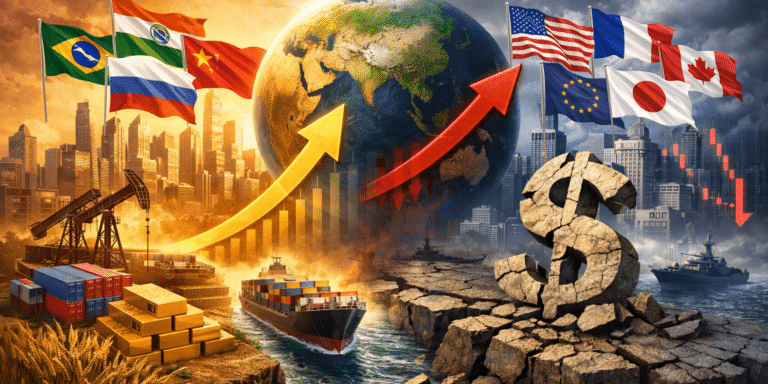
Global Power Shift Accelerates: BRICS Surges Past 40% GDP as G7 Decline Signals Cracks in U.S. Economic Dominance

The Balance of Power Has Shifted—And It’s Not Temporary
The latest IMF purchasing power parity data confirms what many analysts dismissed for years:
BRICS now accounts for roughly 40% of global GDP.
Meanwhile, the G7—long considered the backbone of Western economic dominance—has slipped to just 28–29%.
This isn’t a short-term fluctuation. It’s the result of two decades of compounding growth, resource consolidation, and strategic alignment among emerging economies.

The implications are profound:
- The global economic center of gravity is shifting east and south
- U.S.-led financial influence is weakening at the margins
- Alternative systems are no longer theoretical—they’re operational
Growth Rates Tell the Real Story
The divergence becomes even clearer when you look at growth trajectories:
- BRICS average growth (2026): 3.7%
- G7 average growth (2026): 1.1%
That’s more than a threefold difference.
India is expanding at over 6%, China near 5%, while key Western economies like Germany struggle to reach even 1%.
This isn’t just a gap—it’s a structural divergence.
And over time, growth compounds into dominance.
Resources, Population, and Strategic Leverage
BRICS isn’t just growing faster—it’s operating from a position of increasing leverage:
- 48.5% of the global population
- 72% of rare earth reserves
- 43% of global oil production
- 42% of global wheat supply
These are not abstract figures. These are the foundational inputs of modern economies—energy, food, and industrial materials.
Control over these resources translates directly into pricing power, trade influence, and geopolitical leverage.
The Quiet Rise of Non-Dollar Trade
Perhaps the most underreported development is this:
BRICS trade without the U.S. dollar has already surpassed $1 trillion.
This is no longer a political talking point—it’s a functioning system.
Examples are stacking up:
- India settling energy purchases in yuan and UAE dirhams
- Iran requiring oil transit fees in yuan
- Cross-border payment systems operating outside traditional Western channels
Even more telling:
China’s CIPS network processed the equivalent of $245 trillion in transactions in 2025.
That’s not experimentation—that’s scale.
The Strait of Hormuz: A Glimpse of the Future
Roughly 20% of the world’s oil flows through the Strait of Hormuz—a critical chokepoint in global energy markets.
What’s happening there now should raise eyebrows:
- Tankers aligned with Western interests face restrictions
- BRICS-aligned shipments move—with fees paid in non-dollar currencies
- Iran is actively pushing for yuan-based settlement
This represents a fundamental shift:
Energy—the backbone of the global economy—is increasingly being priced and settled outside the dollar system.
For decades, the petrodollar framework reinforced U.S. financial dominance.
That framework is now showing visible cracks.
The Slow Erosion of Dollar Dominance
Since 2008, the U.S. dollar’s share of global reserves has dropped from 71% to 56.3%.
That’s not a collapse—but it is a clear downward trend.
At the same time:
- Central banks have been accumulating gold for 15 consecutive years
- Major energy producers are diversifying settlement currencies
- Strategic alliances are forming outside Western influence
Even Saudi Arabia’s decision not to renew its longstanding petrodollar agreement marked a turning point.
Piece by piece, the system that supported U.S. monetary dominance for half a century is being restructured.
This Isn’t Anti-American—It’s Strategic Reality
Let’s be clear:
This shift isn’t driven by ideology—it’s driven by incentives.
Countries are responding to:
- Sanctions risk
- Currency volatility
- The desire for greater monetary independence
When global participants begin to view the dollar as a tool of policy enforcement, they naturally seek alternatives.
That’s not speculation—it’s rational behavior.
My Take: America Is Entering a New Economic Era—Whether It Admits It or Not
After years in currency markets, I can tell you this:
Dominant systems rarely collapse overnight—but they do lose ground gradually until a tipping point is reached.
What we’re seeing now is that gradual shift.
The United States still holds enormous advantages:
- Deep capital markets
- Institutional strength
- Innovation capacity
But those advantages are being challenged by:
- Slower growth
- Rising debt burdens
- Increasing global competition
The real risk isn’t immediate collapse—it’s relative decline.
And relative decline has consequences:
- Reduced global influence
- Higher borrowing costs
- Less control over international trade flows
In short, America is moving from a unipolar financial world to a multipolar one.
And that transition is rarely smooth.
The Bottom Line
BRICS surpassing 40% of global GDP is more than a headline—it’s a signal.
A signal that:
- Economic power is shifting
- Financial systems are evolving
- The rules that governed global trade for decades are changing
The question is no longer whether this transition is happening.
The question is:
How prepared are you for what comes next?
Take Action While You Still Can
The trends are clear—shifting global power, weakening dollar dominance, and the rise of alternative financial systems.
Bill Brocius has been warning about this transition for years. In his Digital Dollar Reset Guide, he breaks down exactly how these global shifts tie into the rollout of centralized financial systems, increased transaction monitoring, and the emergence of programmable money tied to the FedNow payment system.
This is about preserving your financial autonomy in a system that is rapidly changing.
Because once the system fully transitions, your options may be far more limited than they are today.