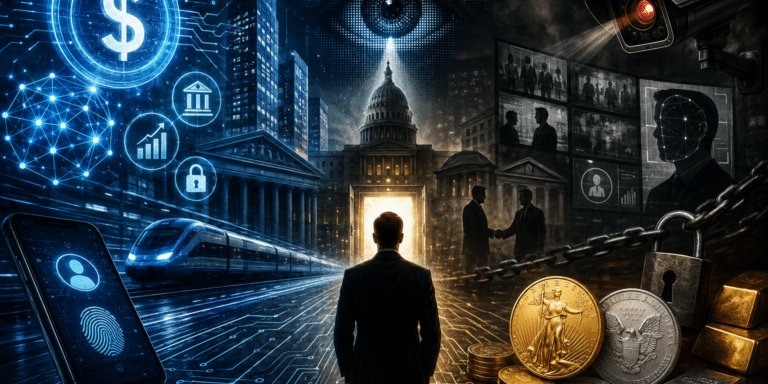
The Quiet Financial Overhaul: Stablecoin Laws, Tokenized Markets, and the Fast-Track to a Cashless Surveillance Economy

The Clarity Act Isn’t About “Clarity”—It’s About Control
Let’s cut through the polished language.
When politicians start throwing around terms like “clarity” in financial legislation, what they usually mean is control—defined rules that lock in who gets to operate, who gets squeezed out, and who gets watched.
The proposed Clarity Act is being framed as a necessary step toward regulating digital assets and stablecoins in the United States. On the surface, that sounds reasonable. Markets need structure, right?

But look closer.
This isn’t just about protecting investors. It’s about building a permissioned system where innovation can only exist under regulatory oversight—and where every transaction can be tracked, flagged, and potentially restricted.
Banks aren’t speaking loudly about it. That silence should tell you everything.
Tokenized Assets: The Financial System’s Trojan Horse
Regulators and institutions are now openly exploring tokenized assets—stocks, bonds, and other financial instruments converted into blockchain-based representations.
Sounds efficient. Faster settlement. Lower costs. More accessibility.
That’s the pitch.
But here’s what they’re not advertising:
Tokenization doesn’t just digitize assets—it centralizes control over them.
When assets live on regulated digital infrastructure:
- Ownership can be monitored in real time
- Transfers can be restricted or reversed
- Access can be conditioned on compliance rules
This isn’t theoretical. The SEC and global financial bodies are already laying the groundwork for these systems.
Once everything is tokenized, the gatekeepers don’t disappear—they become more powerful.
Faster Settlement = Less Friction… and Less Privacy
One of the biggest selling points right now is faster settlement.
Trades that used to take days can now clear almost instantly. Payments can move in seconds instead of hours or days.
Efficiency is the keyword being pushed hard.
But speed comes with trade-offs.
When transactions settle instantly on integrated digital rails:
- There’s less room for anonymity
- More data is captured per transaction
- Monitoring becomes continuous, not periodic
Think about that.
Every movement of money becomes a data point—logged, analyzed, and potentially acted upon.
This isn’t just about convenience. It’s about visibility.
Banks and Regulators Are Finally Aligned—That Should Concern You
Historically, banks and regulators have had a complicated relationship.
Now? They’re moving in sync.
The OCC is guiding banks on integrating digital payment systems. Fintech firms are partnering with traditional institutions. Lawmakers are pushing frameworks that legitimize and standardize these technologies.
It’s a coordinated evolution of financial infrastructure.
And when coordination reaches this level, it’s rarely accidental.
What you’re seeing is the early-stage buildout of a system where:
- Financial activity is fully digitized
- Oversight is embedded into the infrastructure itself
- Participation is conditional, not guaranteed
That’s not speculation. That’s direction.
The Real Risk: Gradual Normalization
Here’s how major systemic shifts actually happen:
Not overnight.
Not with a dramatic announcement.
But through gradual normalization.
First, it’s optional.
Then, it’s incentivized.
Eventually, it’s unavoidable.
We’ve seen this pattern before—in surveillance tech, in online platforms, in data collection.
Finance is just the next frontier.
People adapt because it’s easier. Faster. More convenient.
Until one day, there’s no alternative left.
Why Privacy Is the First Casualty
Every evolution in financial infrastructure comes with a hidden cost.
This time, it’s privacy.
When systems are designed for:
- Real-time monitoring
- Identity-linked transactions
- Regulatory oversight at every layer
Privacy isn’t just reduced—it’s engineered out.
And once it’s gone, getting it back is nearly impossible.
Gold and Silver: Old Tools in a New Battlefield
While the financial system races toward digitization, tangible assets like gold and silver are being quietly repositioned.
Not because they’re trendy—but because they exist outside the system.
Physical assets:
- Don’t require permission to own
- Can’t be digitally restricted
- Don’t rely on third-party infrastructure
That’s why American Eagles and similar hard assets are being talked about again—not as collectibles, but as strategic hedges.
When financial systems evolve, capital doesn’t sit still. It moves.
The question is: are you moving with it—or reacting after the fact?
Final Word: This Isn’t a Theory—It’s a Transition
You’re not watching random developments.
You’re watching alignment:
- Legislation shaping digital asset rules
- Institutions building new infrastructure
- Regulators embedding oversight into the system
Each piece looks harmless on its own.
Together, they point in one direction:
A fully digital, highly monitored financial environment where control is built into the rails themselves.
Ignore that if you want.
But don’t say you weren’t warned.
Take Action Before the Window Closes
If you’re starting to see the pattern—if you understand where this is heading—then you need to get ahead of it now.
The shift toward centralized digital finance isn’t slowing down. With systems like FedNow, the rise of central bank digital currency (CBDC) frameworks, and the broader push toward a digital dollar, the foundation for programmable money and financial surveillance is already being laid.
This is exactly why the Digital Dollar Reset Guide by Bill Brocius exists.
It breaks down:
- How programmable money works
- The real risks behind CBDCs and FedNow
- What financial surveillance means for your freedom
- Practical steps to protect your wealth and autonomy
This isn’t optional reading.
It’s critical intelligence for anyone who refuses to get blindsided by the next phase of financial control.
Download the guide now—while you still have the freedom to act.