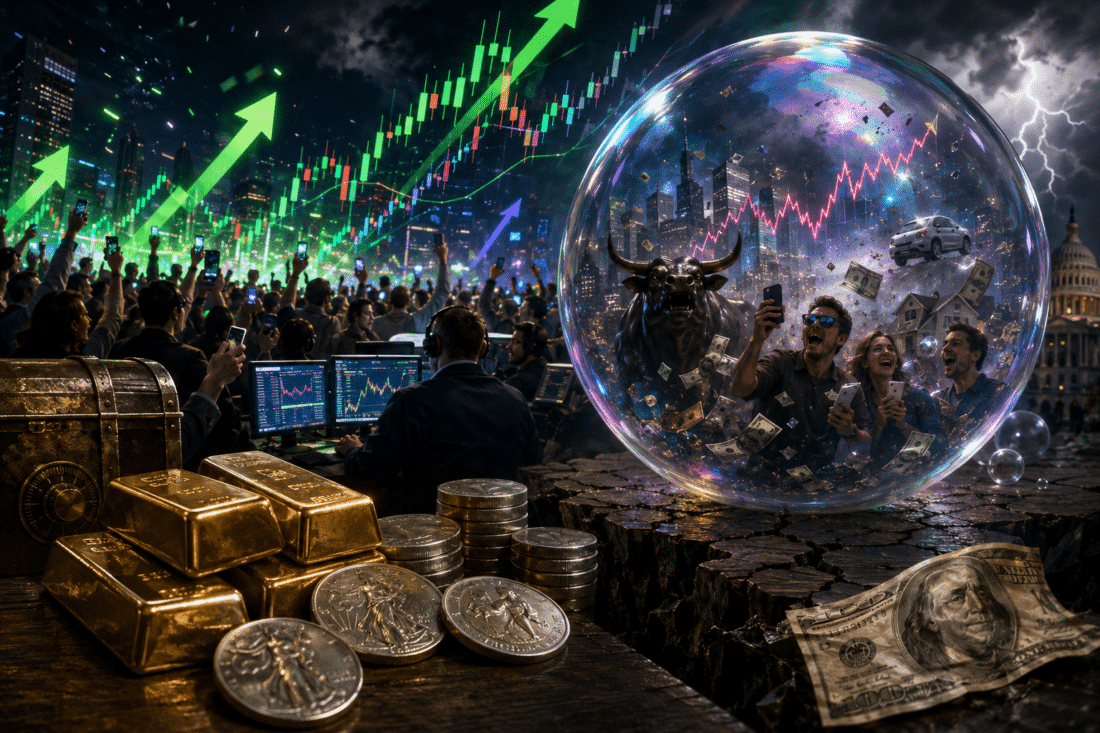
Record-Shattering FOMO Market as America’s Paper Wealth Bubble Enters “Semi-Irrational Chase Mode”
America’s Financial System Is Once Again Entering Full-Blown FOMO Mode
When markets become detached from economic reality, the public always hears the same message:
“This time is different.”
Today, that message is being repackaged through artificial intelligence hype, nonstop momentum chasing, and record-breaking options speculation. But underneath the headlines about booming equities and unstoppable rallies lies a much uglier truth:
This market is increasingly behaving like a liquidity-driven casino sitting on top of a debt-ridden monetary system.
The surge in stock market speculation is being fueled by leverage, momentum algorithms, and widespread fear of missing out rather than underlying economic strength.
Institutional traders are reportedly warning that markets have entered “semi-irrational chase mode” — a phrase that should concern anyone paying attention to financial history.
Because when professionals inside the system begin warning about irrational behavior, it usually means the speculative machinery has already gone too far.
Record Call-Options Frenzy Signals Extreme Stock Market Speculation
Wall Street analysts love to frame rising markets as evidence of economic strength.
But explosive call-options activity often signals something very different:
A desperate public chasing fast money in an increasingly distorted financial environment.
Millions of traders are piling into short-dated call options, betting stocks will continue accelerating higher. These leveraged bets force market makers to purchase shares as hedges, mechanically driving prices upward and creating self-reinforcing momentum.
The result is not natural price discovery.
It is synthetic upward pressure fueled by leverage.
This is how speculative melt-ups form.
And historically, these periods rarely end with smooth landings.
Gold and Silver Investors Have Seen This Movie Before
Readers who follow precious metals and hard assets understand something mainstream financial media rarely discusses honestly:
Artificial liquidity can create the illusion of prosperity for long periods of time.
But eventually, reality catches up.
Gold and silver investors tend to view markets through the lens of monetary history rather than quarterly hype cycles. They understand that when central banks flood systems with liquidity, speculative excess follows naturally.
That is exactly what appears to be happening now.
Years of near-zero interest rates, money printing, emergency stimulus programs, and government debt expansion have conditioned markets to believe risk no longer matters.
Every dip gets bought.
Every correction gets rescued.
Every bubble gets rationalized.
But underneath the optimism sits an uncomfortable reality:
The global financial system is more leveraged, more debt-dependent, and more structurally fragile than ever before.
“Spot Up, Vol Up” Is Flashing a Dangerous Signal
Under healthy market conditions, volatility typically falls when stocks rise.
But today, stocks are climbing while volatility simultaneously rises — a phenomenon institutional traders call “spot up / vol up.”
That matters because it signals emotional speculation rather than confident investing.
Investors are not cautiously accumulating value.
They are aggressively chasing upside exposure with leverage.
That distinction is critical.
Stable bull markets are built on confidence.
Speculative melt-ups are built on fear of missing out.
And fear-based rallies eventually become unstable because they depend on constant inflows of new speculative money to survive.
Once that flow slows down, the unwind can become violent.
This Is What Fiat Euphoria Looks Like in the Late Stages
Modern financial markets no longer operate like traditional capital markets.
They operate like liquidity transmission systems.
Cheap money enters the system.
Leverage multiplies it.
Algorithms amplify it.
Media narratives normalize it.
Retail traders chase it.
And politicians celebrate rising asset prices as proof of economic success, even while ordinary Americans struggle with inflation, debt burdens, housing costs, and declining purchasing power.
This is one of the defining contradictions of the modern era:
Paper wealth rises while real-world financial pressure intensifies.
The stock market becomes disconnected from the lived reality of the average citizen.
That disconnect is often a warning sign rather than a strength.
Historically, declining empires and unstable monetary systems frequently experience speculative booms before periods of severe financial stress.
Why FOMO Destroys More Wealth Than Bear Markets
Bear markets do not usually destroy the most wealth.
FOMO does.
Because euphoric periods convince ordinary people to abandon discipline precisely when risk becomes most extreme.
People begin believing:
- markets only go higher
- central banks will always intervene
- valuations no longer matter
- leverage is manageable
- liquidity is permanent
That mindset is dangerous.
Especially for middle-class investors entering speculative trades late in the cycle.
Professional institutions often front-run these momentum waves and quietly reduce exposure while retail participation peaks. By the time financial television begins portraying speculation as “normal,” the smartest money may already be positioning defensively.
That is how bubbles transfer wealth upward.
The public buys narratives.
The system sells liquidity.
The AI Narrative Is Becoming the New Dot-Com Psychology
Artificial intelligence may eventually transform industries.
But transformative technology and speculative bubbles are not mutually exclusive.
The dot-com era proved that legitimate technological revolutions can still produce catastrophic market collapses when valuations become disconnected from reality.
Today, AI optimism is increasingly being used as a blanket justification for excessive valuations, euphoric sentiment, and speculative risk-taking.
That should concern investors.
Because once markets stop asking:
“What are these assets worth?”
And start asking:
“How much higher can they go?”
The psychology has already shifted from investing to gambling.
Why Precious Metals Investors Distrust These Rallies
Gold and silver investors understand counterparty risk.
They understand that paper systems depend on confidence.
And confidence can disappear quickly.
That perspective creates skepticism toward euphoric rallies driven primarily by derivatives, leverage, and central-bank-conditioned liquidity behavior.
Hard-asset investors tend to ask uncomfortable questions:
- What happens if liquidity dries up?
- What happens if sovereign debt stress accelerates?
- What happens if inflation re-emerges aggressively?
- What happens if geopolitical instability shocks markets?
- What happens if confidence in fiat systems weakens further?
Those questions matter because speculative bubbles often ignore macroeconomic risk until the moment the market can no longer ignore it.
The Most Dangerous Part of This Market Is Psychological
Every financial mania eventually reaches the same stage:
People stop believing downside risk is real.
That is where danger becomes systemic.
Today, social media, trading apps, financial influencers, and institutional momentum strategies are all reinforcing the same emotional behavior:
Buy the dip.
Chase momentum.
Don’t miss the rally.
Stay fully exposed.
This creates a powerful psychological trap.
Investors become conditioned to associate caution with failure.
But financial history repeatedly shows that periods of maximum optimism often arrive closest to major reversals.
America Is Becoming Addicted to Asset Inflation
The deeper issue extends far beyond stocks.
The U.S. economy itself has become increasingly dependent on rising asset prices to maintain confidence.
Retirement systems depend on markets rising.
Consumer spending depends on perceived wealth.
Politicians depend on market performance for public confidence.
Banks depend on stable collateral values.
That creates enormous systemic pressure to keep financial assets inflated regardless of underlying economic weakness.
But there is a difference between real prosperity and liquidity-driven asset inflation.
One creates productive wealth.
The other creates temporary illusions.
And illusions eventually collide with reality.
Final Thoughts: FOMO Is the Last Stage Before Financial Gravity Returns
Markets can remain irrational longer than many expect.
Speculative manias can continue climbing long after warning signs become obvious.
But history is remarkably consistent on one point:
The more emotionally driven a rally becomes, the more fragile it usually is underneath.
Record call-options activity, rising volatility, leveraged speculation, and euphoric momentum chasing are not signs of healthy price discovery.
They are signs of a financial system increasingly dependent on psychological momentum and liquidity engineering.
For investors focused on preserving wealth rather than chasing headlines, this moment deserves caution — not blind participation.
Because when financial gravity finally returns, the people most damaged are usually the ones who were convinced risk no longer existed.