RUSSIA IS SELLING GOLD TO SURVIVE: Why Americans Should Pay Attention Before the U.S. Faces the Same Crisis

Russia Selling Gold to Survive Signals Growing Global Debt Crisis Risks
For decades, Russia aggressively accumulated gold.
They bought thousands of tonnes.
Month after month.

Year after year.
Why?
Because governments understand something ordinary citizens are rarely told:
Gold is what nations turn to when trust in paper systems begins eroding.
That’s why the latest news coming out of Russia matters far more than most Americans realize.
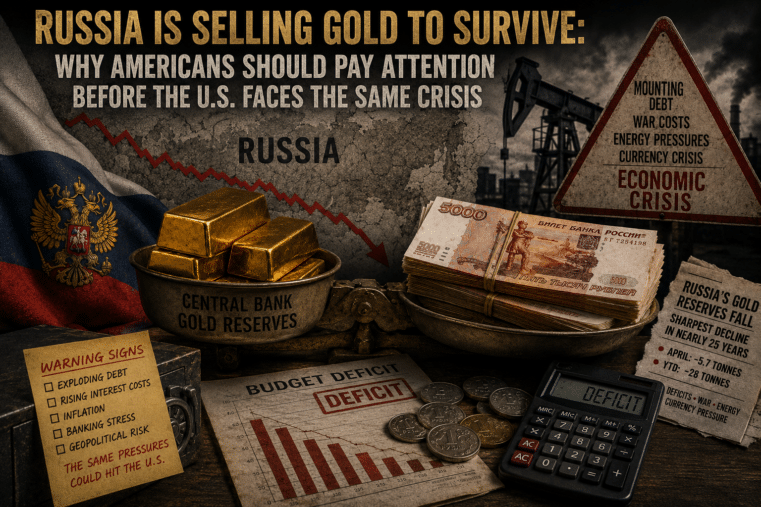
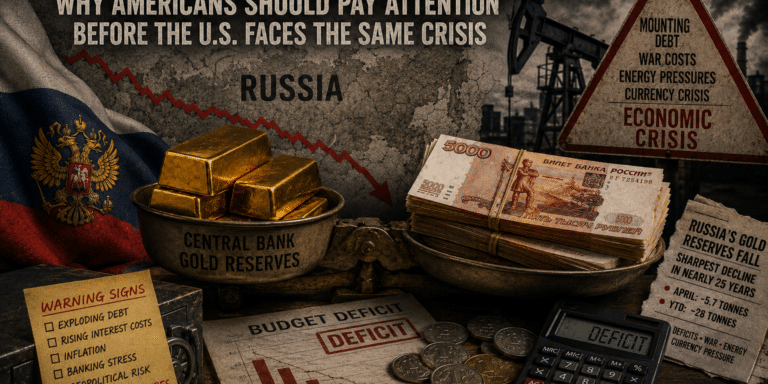
According to recent reports, Russia’s central bank just recorded its sharpest sovereign gold reserve decline in nearly a quarter century.
In April alone, Russia’s gold reserves fell by roughly 5.7 tonnes.
Since the beginning of the year, Russia has liquidated nearly 28 tonnes of sovereign gold reserves.
And the reason behind those sales tells us everything.
Mounting deficits.
Weak energy revenues.
Currency pressure.
War spending.
Liquidity shortages.
In other words, the exact same financial pressures now quietly building across much of the global economy.
Including the United States.
Why Sovereign Gold Sales Matter More Than Most People Think
Most people assume governments only sell gold if they believe prices are going lower.
That’s not usually true.
Governments often sell gold because they are desperate for liquidity.
That’s a very different story.
Russia isn’t liquidating reserves because gold “failed.”
They’re liquidating reserves because budget deficits are exploding while economic pressures intensify.
Think about that for a second.
One of the world’s largest gold-accumulating nations is now being forced to tap hard assets to stabilize its financial system.
That should serve as a warning sign to everyone.
Because once governments begin burning reserve assets to maintain short-term stability, it usually means deeper structural problems are developing underneath the surface.
Why the US Debt Crisis Could Follow the Same Path as Russia
This is where the story becomes very relevant to everyday Americans.
Because while the media frames Russia as a unique situation, many of the underlying financial pressures are now appearing globally.
Including in the U.S.
America is currently dealing with:
- Exploding national debt
- Massive interest expenses
- Persistent inflation
- Banking fragility
- Rising geopolitical tensions
- Unsustainable deficit spending
- Weakening consumer strength
- Growing dependence on financial engineering
The only real difference is that the United States still controls the global reserve currency.
For now.
But even reserve currency systems are not immune to debt mathematics forever.
History proves that repeatedly.
The Debt Spiral Is Becoming Impossible to Ignore
One thing I’ve learned after decades around financial markets is this:
Debt systems always look stable… until suddenly they don’t.
The United States is now paying staggering amounts just to service interest on its debt.
Not to build infrastructure.
Not to improve lives.
Just to pay interest.
That is a dangerous sign in any financial system.
Because once interest expenses begin crowding out productive economic activity, governments eventually face difficult choices:
- Inflate away debt
- Raise taxes
- Cut spending
- Print money
- Revalue assets
- Or liquidate reserves
Russia is already being forced into parts of that equation.
And many Western governments may eventually face similar pressures if deficits continue spiraling out of control.
Gold Is Becoming Monetary Insurance Again
One of the biggest takeaways from this story is that gold is quietly reclaiming its historical role.
Not as a speculative asset.
But as monetary insurance.
That’s why central banks globally spent years accumulating gold reserves.
Because deep down, governments understand fiat systems become vulnerable during periods of:
- War
- Sanctions
- Debt crises
- Currency instability
- Energy shocks
- Geopolitical fragmentation
Gold sits outside political promises.
That’s exactly why it matters.
And ironically, the fact that Russia is being forced to liquidate gold reserves during crisis conditions may actually reinforce gold’s long-term importance globally.
Because it demonstrates what happens when sovereign systems come under extreme pressure.
Gold becomes emergency collateral.
The U.S. Financial System Is More Fragile Than People Realize
Most Americans still believe the financial system is fundamentally stable because markets continue functioning day to day.
But stability can be deceptive.
Remember:
- Banks looked stable before 2008
- Tech stocks looked unstoppable before 2000
- Housing looked bulletproof before the crash
Today, the U.S. economy faces multiple overlapping risks:
- Record sovereign debt
- Commercial real estate weakness
- Banking sector stress
- Persistent inflation pressures
- Global de-dollarization efforts
- Rising entitlement costs
- Military spending expansion
And unlike previous generations, today’s financial system is heavily dependent on digital liquidity, central bank intervention, and perpetual borrowing.
That creates enormous fragility beneath the surface.
China Is Quietly Watching Everything
One of the most important parts of this entire story is what’s happening between Russia and China.
As Russia sells more precious metals into China, Beijing continues strengthening its strategic commodity position.
That matters because China understands the long game.
China knows:
- Physical assets matter
- Commodity control matters
- Energy security matters
- Monetary diversification matters
This is not just about gold prices.
This is about preparing for a more fragmented global financial order.
And while Washington focuses heavily on short-term politics, countries like China are positioning strategically for long-term systemic change.
Why Americans Are Buying More Gold and Silver Too
Something else buried inside this story deserves attention.
Russian citizens themselves are buying record amounts of physical gold.
Why?
Because ordinary people lose confidence when currencies weaken and uncertainty rises.
Sound familiar?
Americans are increasingly facing many of the same fears:
- Rising living costs
- Declining purchasing power
- Banking concerns
- Retirement insecurity
- Inflation anxiety
That’s why interest in physical gold and silver continues growing globally.
People instinctively move toward tangible assets when trust in institutions begins deteriorating.
And frankly, after the past few years, can you really blame them?
This Is Bigger Than Russia
Most media coverage will frame this as:
“Russia has economic problems.”
True.
But the bigger story is this:
Governments everywhere are struggling under rising debt burdens and increasingly unstable financial conditions.
Russia is simply exposing what financial stress looks like earlier than others.
And the same pressures now appearing globally could eventually force major changes across:
- Monetary policy
- Banking systems
- Currency structures
- Reserve management
- Asset pricing
- Gold valuation
That’s why this story matters to Americans.
Because once sovereign debt systems begin straining worldwide, nobody remains isolated from the consequences.
My Response: Physical Precious Metals Still Make Sense
I’ve spent decades watching governments promise stability while quietly preparing for instability behind the scenes.
That’s why I continue believing physical gold and silver deserve serious attention.
Not because I expect the world to end tomorrow.
But because history repeatedly shows that debt-heavy systems eventually face moments of monetary stress.
And during those moments:
- Real assets matter
- Liquidity matters
- Counterparty risk matters
- Purchasing power matters
Gold and silver are not magic solutions.
But they have survived every fiat system in human history.
That matters.
Especially now.
The Global Financial System Is Entering a Dangerous Phase
Russia’s gold liquidation is not an isolated event.
It is part of a much larger global story:
- Sovereign debt stress
- Energy instability
- Currency fragility
- Geopolitical fragmentation
- Central bank repositioning
- Growing distrust in fiat systems
The world is changing quickly.
And most people will not fully understand the risks until the consequences are already sitting in front of them.
That’s how financial transitions usually work.
Quietly at first.
Then suddenly all at once.
Join the Dedollarize Inner Circle Before the Next Financial Shock Hits
Inside the Dedollarize Inner Circle, we monitor the accelerating global monetary reset, sovereign debt risks, central bank gold activity, currency instability, and the growing pressures reshaping the financial system.
If you want deeper analysis on:
- Gold and silver markets
- Sovereign debt crises
- Central bank policy
- Global de-dollarization
- CBDCs and financial surveillance
- Banking instability
- Wealth protection strategies
then now is the time to stay informed before the next phase of the monetary shift unfolds.
Join the Dedollarize Inner Circle today and prepare before the system changes around you.