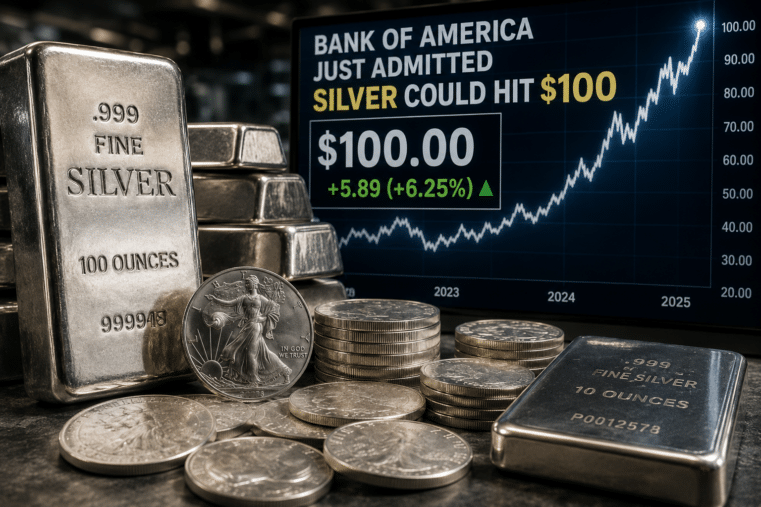
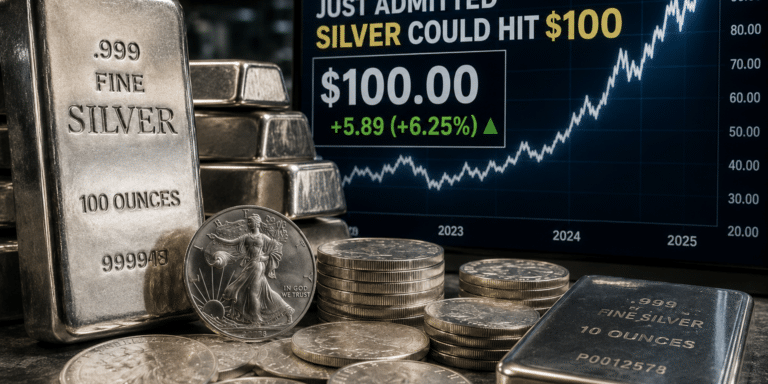
BANK OF AMERICA JUST ADMITTED SILVER COULD HIT $100

Silver Price Forecast: Why Bank of America Says Silver Could Hit $100
When one of the largest banks in the world publicly says silver could hit $100 an ounce, people ought to pay attention.
But Bank of America’s latest silver forecast came with a warning attached. Their analysts believe silver prices may spike higher this year, possibly reaching triple digits, before eventually falling back as industrial demand weakens.
At first glance, that sounds bearish.

But after spending decades watching how Wall Street operates, I can tell you something important: sometimes the most bullish signals are hidden inside cautious language.
And that’s exactly what’s happening here.
Because beneath the surface of this report is a much bigger story about physical silver shortages, trade wars, inflation pressure, industrial panic, and a growing loss of confidence in fiat currencies.
That’s the story everyday Americans need to understand.
Why Silver Prices Are Exploding Higher
Bank of America admits silver has been outperforming gold largely because of one major issue:
There simply isn’t enough silver available.
That’s a serious problem.
Silver has now faced multiple consecutive years of supply deficits. Industrial demand remains extremely high, especially from:
- Solar panel manufacturing
- Electric vehicles
- Military technologies
- Medical equipment
- Electronics
- Artificial intelligence infrastructure
Most people still think of silver as “poor man’s gold.”
That’s outdated thinking.
Silver is now both:
- A monetary metal
- A critical industrial resource
That combination is extremely powerful.
Unlike fiat currency, governments cannot print silver out of thin air. It has to be mined, refined, transported, and physically delivered.
And when supply chains start breaking down, prices can move violently.
That’s exactly what we’ve been witnessing.
The Real Reason Wall Street Is Nervous About Silver
Here’s the key takeaway most media outlets are ignoring:
Bank of America isn’t saying silver is weak.
They’re saying silver has become so expensive that manufacturers are trying to engineer it OUT of products.
Think about that for a second.
If companies are desperately searching for substitutes, that means silver scarcity is already affecting global industry.
That’s not bearish.
That’s evidence of a market under stress.
I grew up in a working-class family where you fixed things instead of replacing them. If meat prices doubled overnight, families started stretching meals further. Same concept here.
Manufacturers don’t “thrift” silver because everything is fine.
They do it because costs are spiraling.
And when industries start panicking over access to raw materials, volatility follows.
Silver Is Becoming A Monetary Metal Again
One of the most important parts of the Bank of America report barely received attention.
Their analysts admitted investor demand could soon become the primary driver of silver prices.
That changes everything.
Because industrial demand alone is powerful…
…but investor fear is explosive.
When confidence in the financial system starts cracking, investors historically rush into hard assets like:
- Physical silver
- Gold bullion
- Mining shares
- Real assets outside the banking system
We’ve already seen this behavior begin.
People are exhausted:
- Inflation keeps crushing purchasing power
- Debt levels are spiraling
- Interest payments are exploding
- Banks remain fragile
- Geopolitical tensions are escalating
- Governments continue expanding surveillance and digital financial controls
At some point, people stop trusting paper promises.
That’s when precious metals move from “investment” to “financial protection.”
The Silver Supply Squeeze Could Get Worse
Another major issue highlighted in the report is the growing strain on physical silver inventories.
According to Bank of America, trade tensions involving the United States, Canada, and Mexico are creating massive uncertainty because Canada and Mexico are among America’s largest silver suppliers.
This matters more than most people realize.
The global silver market is relatively small compared to other major commodities.
That means even modest disruptions can create oversized price swings.
And here’s where things get dangerous:
It doesn’t take much investor demand to overwhelm available supply.
If institutional investors, retail buyers, and industrial users all start competing for the same shrinking physical inventory, silver prices could move dramatically higher very quickly.
We already saw glimpses of this earlier in the year when prices briefly surged amid fears of tightening supply.
Wall Street calls this volatility.
I call it a warning signal.
Why Gold Still Matters More Than Ever
Now let’s address the elephant in the room.
Some analysts argue rising interest rates weaken gold because gold doesn’t pay yield.
That’s technically true in the short term.
But history shows something very different during periods of monetary instability.
Gold performs best when:
- Confidence in governments deteriorates
- Currency purchasing power collapses
- Debt becomes unsustainable
- Financial systems lose credibility
Look around.
Does any of this sound familiar?
The Federal Reserve is trapped.
Governments are drowning in debt.
Banks are overloaded with unrealized losses.
Consumers are maxed out.
And central planners continue pushing toward digital financial systems that give authorities greater control over spending, savings, and transactions.
That’s why gold ownership is quietly accelerating globally among central banks and ordinary citizens alike.
People are preparing for uncertainty.
Why Precious Metals Matter During Economic Uncertainty
Most financial headlines treat gold and silver like ordinary investments.
That’s the mistake.
Precious metals are not merely trades.
They’re monetary insurance.
You don’t buy physical silver because you expect a straight line upward every single month.
You buy it because history repeatedly shows what happens when governments overspend, currencies weaken, and financial systems become unstable.
Fiat currency behaves like a used car:
- Every year it loses value
- Every year it buys less
- Every year maintenance costs rise
Gold and silver behave differently.
They preserve purchasing power over long periods when paper systems begin cracking under pressure.
That’s why smart investors don’t wait until panic arrives.
They prepare before everyone else notices the exits.
Could Silver Prices Really Reach $100 Per Ounce?
Absolutely.
And frankly, under the right conditions, it could overshoot well beyond that temporarily.
Here’s what could accelerate prices:
- Physical shortages
- Trade disruptions
- Renewed investor panic
- Central bank instability
- Currency devaluation
- Recession fears
- Geopolitical escalation
- Banking stress
Remember: silver is a relatively tiny market.
It does not take enormous capital inflows to create explosive price movements.
That’s why silver historically experiences violent upside moves during monetary uncertainty.
And based on current global conditions, uncertainty is growing — not shrinking.
The Bigger Picture Nobody Wants To Talk About
The real issue isn’t whether silver pulls back after hitting $100.
The real issue is why investors are flooding into hard assets in the first place.
People sense something is wrong with the system.
They may not fully understand central banking, sovereign debt markets, or monetary policy…
…but they understand their groceries cost more.
They understand housing is unaffordable.
They understand their savings buy less every year.
And they understand the people running the system always seem to benefit while ordinary workers fall further behind.
That’s why gold and silver ownership continues spreading outside traditional investment circles.
This is no longer just about profits.
It’s about protection.
Final Thoughts: This May Be The Calm Before A Much Bigger Storm
Bank of America may believe silver eventually cools off after a major rally.
Maybe.
But even their own report reveals enormous stress building beneath the surface of the global financial system.
Physical shortages.
Trade war disruptions.
Industrial strain.
Investor uncertainty.
Currency instability.
These are not signs of a healthy system.
They’re warning lights flashing on the dashboard.
And when warning lights start appearing everywhere at once, smart people prepare early.
Not later.
Join The Inner Circle Before The Next Financial Shock Hits
The financial system is changing rapidly, and most Americans are dangerously unprepared for what’s coming next.
That’s why thousands of readers are joining the Dedollarize Inner Circle to stay ahead of:
- Precious metals trends
- Banking risks
- Inflation threats
- CBDC developments
- Wealth protection strategies
- Gold and silver buying opportunities
If you want real-world financial insights without the Wall Street spin, now is the time to get connected.
Join the Inner Circle today and start protecting your wealth before the next crisis unfolds.