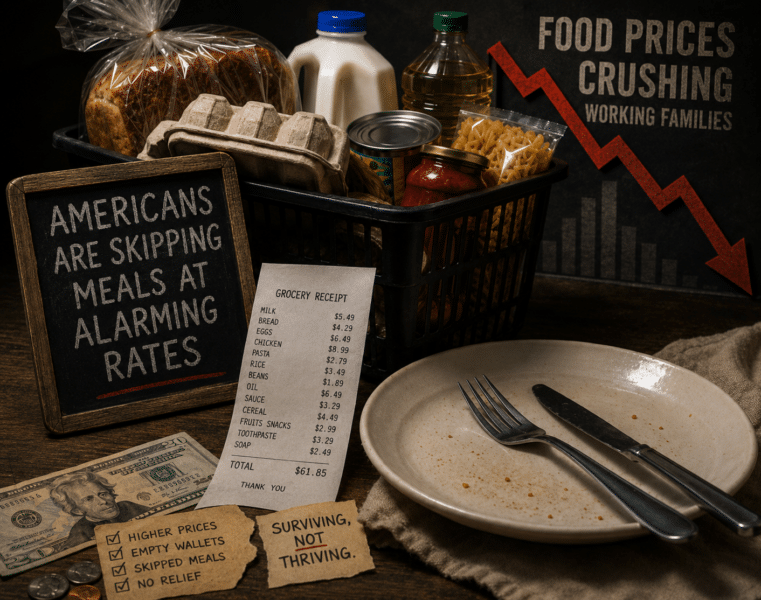

Americans Are Skipping Meals at Alarming Rates as Food Prices Crush Working Families

Federal Reserve Report Shows Rising Food Costs Are Leaving Americans Unable to Afford Groceries
The Federal Reserve finally said the quiet part out loud.
A newly released report from the Federal Reserve Bank of New York reveals a stunning surge in food insecurity across the United States, with millions of Americans now struggling to afford basic groceries, relying on food donations, and draining their savings simply to survive.
Despite years of politicians claiming the economy is “strong,” the data paints a much darker picture: working families are being financially suffocated by inflation, rising living costs, and an economy that increasingly rewards asset holders while punishing ordinary people.

And for many Americans, the breaking point has already arrived.
Fed Report Reveals Sharp Rise in Americans Unable to Afford Food
According to the New York Fed’s latest Survey of Consumer Expectations, the percentage of households reporting they did not have enough food jumped from just 4% in June 2020 to 10% in February 2026.
That is not a small increase.
That is a financial alarm bell.
The report also found:
- More Americans are relying on food donations
- SNAP enrollment has surged
- Families are rapidly burning through savings
- Parents with young children are among the hardest hit
- Lower-income households are experiencing severe financial pessimism
More than one-third of respondents said they are now dipping into savings to cover monthly expenses.
Think about that for a second.
The so-called “strong economy” now requires millions of Americans to cannibalize their savings accounts just to buy groceries and pay bills.
That is not stability. That is economic deterioration hidden beneath manipulated headlines and carefully massaged government statistics.
Inflation Never Really Went Away
The media keeps pretending inflation cooled down because the rate of increase slowed.
But Americans understand the truth every time they walk into a grocery store.
Prices didn’t go back down.
They stayed elevated.
Eggs, meat, rent, utilities, insurance, gasoline, and household necessities all remain dramatically more expensive than they were just a few years ago. For working-class Americans already living paycheck to paycheck, the cumulative damage has been devastating.
The Fed’s own research confirms what millions already know firsthand:
The cost of living crisis is crushing households faster than wages can keep up.
And unlike wealthy Americans with investment portfolios and appreciating assets, average workers don’t have financial buffers large enough to absorb years of elevated prices.
The “K-Shaped Economy” Is Tearing America Apart
One of the most important takeaways from the Fed report is the growing divide between economic winners and losers.
Economists refer to this as a “K-shaped economy.”
One side moves upward.
The other collapses downward.
Americans with stocks, real estate equity, and high-income careers largely benefited from years of monetary stimulus, rising asset prices, and easy money policies.
Meanwhile, working families got hit with:
- Higher food costs
- Rising rent
- Exploding insurance premiums
- Increasing debt burdens
- Declining purchasing power
- Vanishing savings
The result is an economy that looks healthy on paper while millions quietly slide into financial desperation.
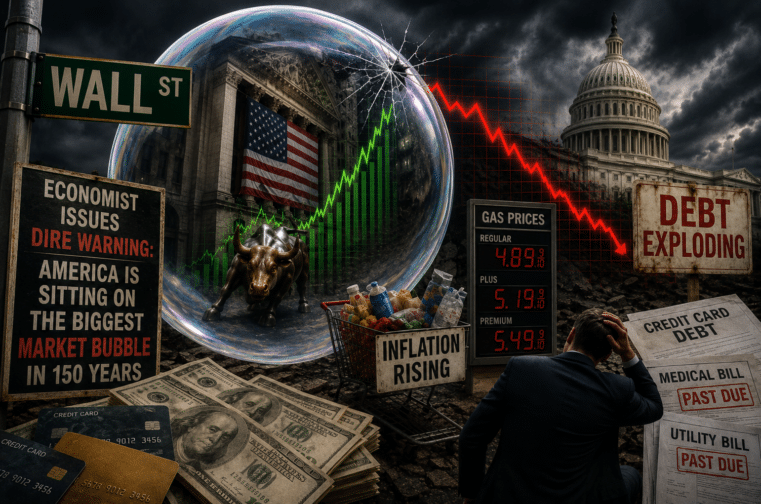
That disconnect explains why consumer sentiment remains historically weak even while Wall Street celebrates record highs.
People don’t judge the economy by stock market charts.
They judge it by whether they can afford dinner.
Why Consumer Confidence Is Collapsing
For years, economists and media pundits seemed confused about why Americans felt pessimistic despite supposedly “good” economic numbers.
The Fed report may have just answered that question.
People are exhausted.
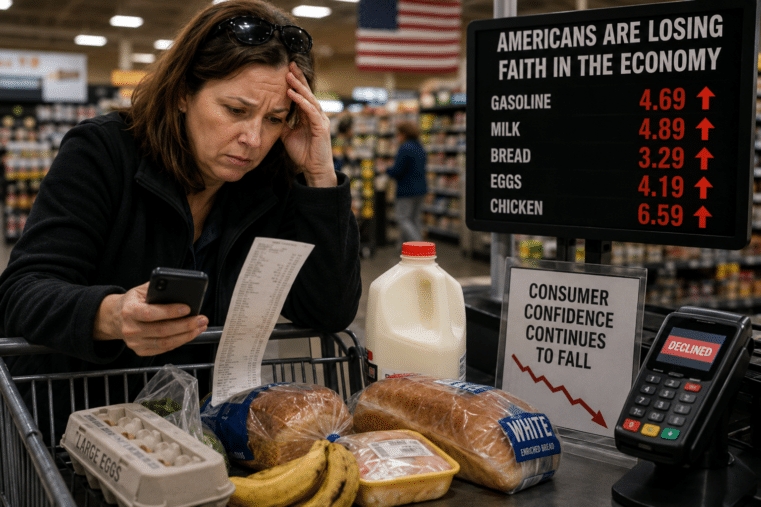
They’re tired of being told the economy is booming while their grocery bills double.
They’re tired of watching corporations report massive profits while ordinary families cut meals to survive.
They’re tired of hearing inflation is “under control” while every monthly expense continues climbing.
The psychological effect of prolonged financial pressure is enormous.
When people consistently struggle to meet basic needs, optimism disappears.
That’s exactly what the Fed is now documenting.
And the situation may worsen.
Millions of Americans Turn to Food Banks as Rising Food Costs Surge
One of the most disturbing trends in the report is the growing reliance on food donations and assistance programs.
Food banks across America are seeing increased demand from people who never imagined they would need help.
These are not just unemployed individuals.
Many are working full-time jobs.
Some are dual-income households.
Others are retirees watching fixed incomes evaporate under inflation pressure.
This is what economic decline looks like in real life—not abstract charts, but families quietly standing in food lines while government officials insist everything is fine.
The Savings Cushion Is Disappearing Fast
During the pandemic years, many households built temporary savings thanks to stimulus checks, paused obligations, and expanded assistance programs.
That cushion is now largely gone.
Americans are increasingly relying on credit cards and savings withdrawals to survive monthly expenses.
The Fed’s findings confirm that financial stress is accelerating among lower-income households and families with children.
Once savings disappear entirely, the next stage is debt dependency.
And once debt maxes out, the consequences become much more severe:
- Missed payments
- Housing instability
- Food insecurity
- Utility shutoffs
- Financial collapse
For millions of Americans, that edge is getting dangerously close.
Rising Oil Prices Could Make Everything Worse
The report’s data was collected before Middle East tensions triggered fresh oil supply disruptions and rising gasoline prices.
That matters.
Energy costs ripple through the entire economy.
When fuel prices rise:
- Grocery transportation costs rise
- Utility bills increase
- Consumer prices climb
- Household budgets tighten even further
In other words, many Americans may still be underestimating how bad affordability pressures could become over the next year.
The warning signs are everywhere.
Americans Are Beginning to Realize the System Isn’t Built for Them
The biggest takeaway from this report isn’t just that food insecurity is rising.
It’s that the official economic narrative is collapsing.
For years, Americans were told:
- Inflation was temporary
- The economy was strong
- Recovery was working
- Consumer resilience remained high
Now the Fed’s own data reveals millions are skipping meals, seeking food aid, and running out of savings.
That’s not a healthy economy.
That’s managed decline.
And people are starting to feel it in every corner of daily life.
Final Thoughts on Rising Food Costs and America’s Economic Struggle
A nation where working people cannot consistently afford food is not economically stable—no matter how polished the headlines look.
The Federal Reserve’s latest findings expose the widening fracture between official economic narratives and the lived reality of ordinary Americans.
This isn’t just about inflation anymore.
It’s about survival.
Families are cutting back, draining savings, and relying on assistance at levels that should deeply concern anyone paying attention to where the economy is headed next.
And historically, periods of widespread financial stress often lead to major structural changes in how money, banking, and financial systems operate.
That’s why understanding what’s coming next matters now more than ever.
Prepare Before the Financial System Changes Again
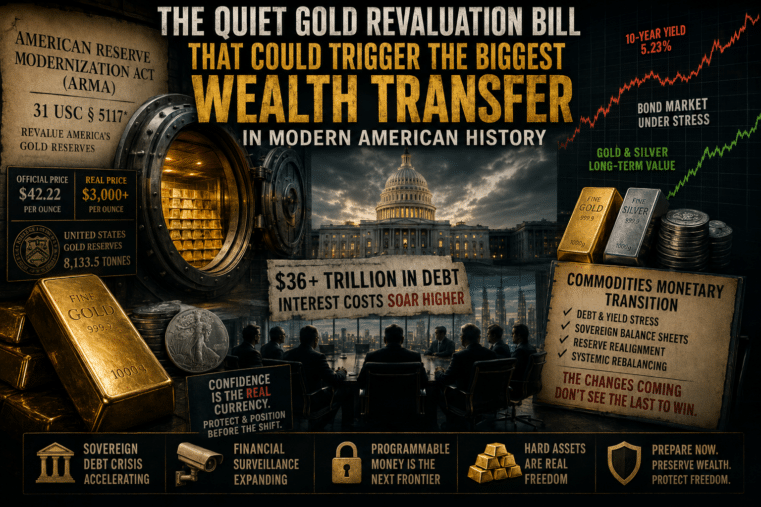
The same institutions that oversaw inflation, economic instability, and declining purchasing power are now rapidly expanding digital financial infrastructure systems like FedNow while governments around the world openly explore Central Bank Digital Currencies (CBDCs).
These systems could fundamentally reshape how money is tracked, controlled, and potentially restricted in the future.
If you want to understand:
- How programmable money works
- Why financial surveillance is expanding
- The risks tied to CBDCs and cashless systems
- How to protect your financial autonomy before major changes accelerate
Then you need to read the Digital Dollar Reset Guide by Bill Brocius.
This isn’t theory anymore. The warning signs are already here.