GOLD TO $5,400? Major Bank Warns the Dollar Is Weakening as Central Banks Rush Into Gold

Why the Gold Price Forecast Keeps Getting More Bullish
While most financial headlines are obsessing over short-term market volatility, one major European private bank is focused on something much bigger.
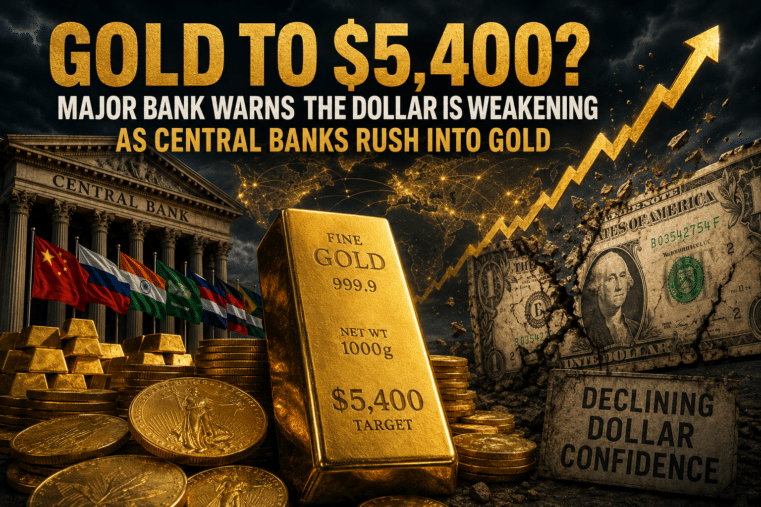
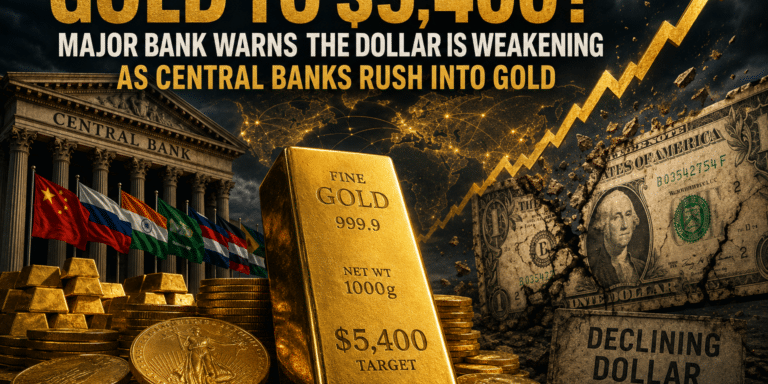
Lombard Odier — one of Switzerland’s oldest and most respected financial institutions — says gold could climb back to $5,400 per ounce within the next 12 months.
That’s an eye-popping forecast.

And importantly, the bank says the recent decline in gold prices does not change the long-term bullish case for precious metals.
According to Lombard Odier strategist Kiran Kowshik, the recent pullback was largely driven by:
- temporary geopolitical volatility,
- stronger energy prices,
- investor positioning,
- and short-term market reactions to the Iran conflict.
But underneath all that noise, the structural forces driving gold higher remain firmly in place.
And frankly, I believe this is the part investors need to pay the closest attention to.
The Real Story Is the Slow Death of Confidence in Fiat Currency
Most people think gold only rises because of fear or war.
That’s only part of the story.
The bigger issue is something much deeper:
Confidence in paper currencies is slowly eroding around the world.
Lombard Odier openly acknowledged this.
The bank pointed directly to:
- persistent fiscal uncertainty,
- inflation concerns,
- declining confidence in institutions,
- massive government debt,
- and long-term erosion of U.S. dollar purchasing power.
That’s exactly what many of us in the precious metals world have been warning about for years.
The modern financial system runs on confidence.
Once people start questioning whether governments can responsibly manage debt, deficits, inflation, and monetary policy, they begin searching for assets outside the traditional system.
That’s where gold enters the picture.
Why Central Bank Gold Buying Signals Long-Term Dollar Weakness
One of the biggest developments happening right now is largely ignored by mainstream media.
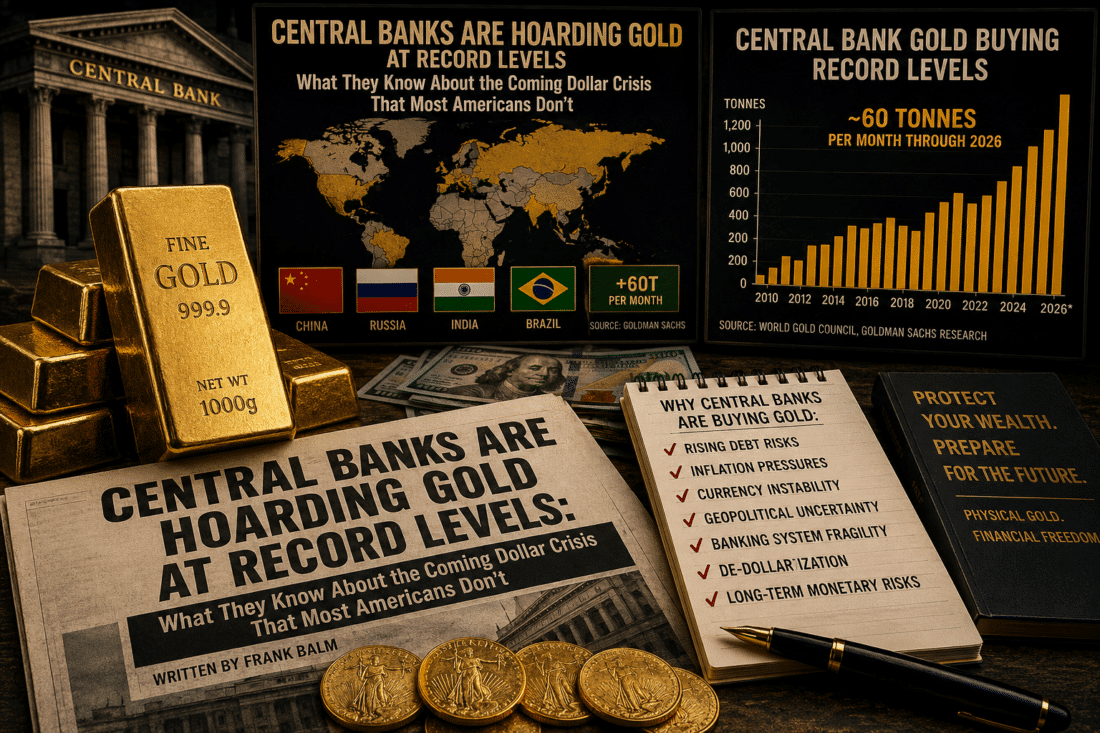
Central banks around the world are aggressively accumulating gold.
Why?
Because many countries no longer fully trust a dollar-dominated system that can be weaponized through sanctions and geopolitical pressure.
Lombard Odier specifically highlighted how sanctions against Russia accelerated the global push toward reserve diversification.
In simple terms:
- countries are reducing dependence on the U.S. dollar,
- increasing gold reserves,
- and searching for neutral reserve assets.
That’s a massive long-term trend.
And it’s one of the clearest signs that de-dollarization is no longer a fringe theory.
It’s already happening.
According to the report, central bank demand remains extremely strong, especially among emerging economies that still hold relatively low percentages of gold compared to developed nations.
That suggests there may still be enormous room for additional buying.
And unlike retail investors, central banks typically aren’t buying gold for short-term speculation.
They’re buying for long-term protection.
That matters.
Why Physical Gold Demand Remains So Strong
Another major takeaway from the report is that physical gold demand continues rising even while ETF flows fluctuate.
That’s incredibly important.
Because it tells us many investors are no longer satisfied with paper exposure alone.
They want physical ownership.
Lombard Odier noted that China accounted for roughly 40% of physical gold demand recently, helping offset weaker ETF flows.
That’s a huge signal.
Around the world, people appear increasingly interested in owning tangible assets rather than relying entirely on financial products tied to the banking system.
And honestly, can you blame them?
Over the past several years, investors have watched:
- inflation surge,
- banks fail,
- governments print trillions,
- debt explode,
- and purchasing power steadily decline.
People are looking for stability in an increasingly unstable world.
Gold Is Not Just a Commodity — It’s Financial Insurance
This is where many mainstream analysts still miss the point.
Gold isn’t just another trade.
For many people, physical gold and silver are forms of financial insurance.
You hope you never need insurance.
But you’re grateful to have it when things go wrong.
That’s why gold has historically performed well during periods of:
- inflation,
- monetary instability,
- banking stress,
- geopolitical conflict,
- and declining trust in governments.
Unlike fiat currency, gold cannot be printed endlessly by central banks.
And unlike many financial assets, physical precious metals carry no counterparty risk when held directly.
That distinction is becoming increasingly important as global debt levels spiral higher.
Why Silver Could Benefit Alongside Gold
While most headlines focus on gold, silver may also benefit significantly if this long-term trend continues.
Historically, silver tends to follow gold during major precious metals bull markets.
But silver also has industrial demand tied to:
- solar energy,
- electronics,
- electric vehicles,
- and advanced manufacturing.
That creates a unique dynamic where silver can benefit from both monetary fear and industrial growth.
And because silver remains far below gold in relative valuation historically, many precious metals investors believe it may still have substantial upside potential if gold continues climbing.
The Federal Reserve Is Cornered
One reason the long-term gold outlook remains strong is because central banks — especially the Federal Reserve — are running out of easy solutions.
If the Fed keeps rates elevated:
- economic growth slows,
- debt stress worsens,
- and recession risks rise.
If the Fed cuts rates aggressively:
- inflation risks return,
- the dollar weakens,
- and confidence in fiat currency could erode further.
That’s why many analysts believe we’re entering a prolonged era of monetary instability rather than a short-term cycle.
And historically, gold tends to thrive during periods of uncertainty surrounding monetary policy and government debt.
Why the Dollar’s Purchasing Power Matters More Than Gold’s Price
One thing I always tell readers is this:
Don’t just focus on the dollar price of gold.
Focus on the purchasing power of the dollar itself.
Because over time, fiat currencies are designed to lose value.
Governments print more money.
Debt expands.
Prices rise.
And slowly, purchasing power deteriorates.
Gold simply reflects that reality.
In many ways, gold isn’t becoming more valuable.
The dollar is becoming less valuable.
That’s a critical distinction.
And more investors are starting to understand it.
Smart Investors Are Preparing for a Different Financial Future
The smartest investors I know are not waiting for the next crisis to begin preparing.
They’re:
- diversifying outside traditional paper assets,
- reducing exposure to debt-heavy systems,
- holding physical precious metals,
- and focusing on long-term wealth preservation.
Because once confidence breaks inside a financial system, events can move very quickly.
History has shown that repeatedly.
And right now, the warning signs are becoming harder to ignore.
Final Thoughts: Gold’s Pullback May Be Temporary — But the Bigger Trend Looks Far From Over
Lombard Odier’s forecast isn’t based on short-term panic.
It’s based on structural global changes:
- rising debt,
- declining confidence in fiat currencies,
- central bank gold accumulation,
- de-dollarization,
- inflation concerns,
- and growing geopolitical instability.
Those trends are not disappearing anytime soon.
If anything, they appear to be accelerating.
And that may explain why so many investors, institutions, and central banks continue turning toward physical gold and silver despite temporary market volatility.
Because in uncertain times, hard assets tend to matter more.
Join the Dedollarize Inner Circle Before the Next Major Gold Surge
If you want deeper insights into gold, silver, inflation, central bank activity, and the future of the U.S. dollar, now is the time to stay informed.
Join the Dedollarize Inner Circle for exclusive market analysis, precious metals education, wealth protection strategies, and updates the mainstream financial media often ignores.
The people who prepare before the next financial shift are usually the ones who preserve the most wealth afterward.