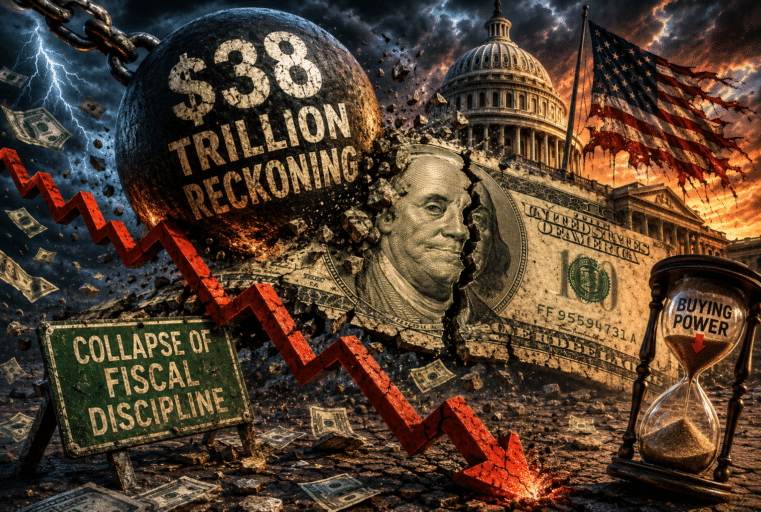
America’s $38 Trillion Reckoning: Why the Collapse of Fiscal Discipline Is Destroying the Dollar and the Middle Class

America’s Debt Explosion Is No Longer Just an Economic Problem
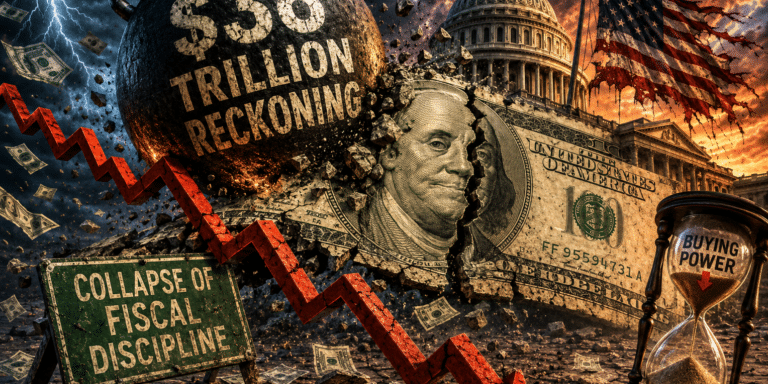
The United States government now carries more than $38 trillion in national debt, with annual deficits approaching levels once considered unthinkable outside wartime.
Yet Washington continues spending at a pace that suggests there are no limits anymore.
Republicans spend.
Democrats spend.
The Federal Reserve intervenes.
The debt grows.
The dollar weakens.
The American middle class absorbs the damage.

This cycle has become permanent.
For years, Americans were told deficits did not matter because the United States controls the world’s reserve currency. Politicians and central bankers insisted America could endlessly borrow, print, and inflate without serious consequences.
Reality is finally catching up.
Prices continue rising faster than wages. Household debt is exploding. Retirement savings buy less every year. Younger generations increasingly cannot afford homes, raise families, or build long-term wealth without taking on crushing debt burdens.
This is what monetary decline looks like in real time.
The Destruction of Sound Money Changed Everything
America’s modern debt crisis did not begin yesterday.
The foundation was laid decades ago when the United States severed the final restraints on government money creation.
Before fiat currency systems dominated the global economy, gold imposed discipline on political leaders. Governments could not endlessly print money without risking a loss of confidence in the currency itself.
That restraint disappeared when the dollar was completely detached from gold.
Once that happened, deficits became easier to finance, government expansion accelerated, and monetary inflation became a permanent feature of the economic system.
Since the early 1970s:
- The monetary base has exploded exponentially
- Federal debt has surged from billions into the tens of trillions
- The purchasing power of the dollar has steadily eroded
- Asset bubbles have become routine
- Americans have become increasingly dependent on credit to survive
This is not a coincidence.
A debt-based fiat system rewards borrowing, speculation, and political expansion while punishing savers and productive workers.
The people closest to the money creation machine benefit first.
Everyone else pays later through inflation.
Inflation Is Quietly Devouring the American Standard of Living
Washington officials continue claiming inflation is “under control,” but ordinary Americans know the truth every time they visit the grocery store or pay monthly bills.
Food prices remain elevated.
Housing affordability has collapsed.
Insurance premiums continue climbing.
Energy costs remain volatile.
Healthcare expenses are crushing families.
Meanwhile, the official economic narrative insists the economy is “strong.”
Strong for whom?
Certainly not for millions of working Americans forced to rely on credit cards simply to cover basic expenses.
Inflation acts as a hidden tax.
Unlike direct taxation, inflation quietly transfers wealth without requiring public approval. Currency debasement reduces purchasing power while allowing governments to finance deficits indirectly through monetary expansion.
This is one reason politicians prefer inflationary systems.
Most people feel the pain but struggle to identify the mechanism causing it.
The result is a population that becomes poorer slowly enough to avoid immediate revolt but steadily enough to fundamentally weaken long-term financial independence.
Government Dependency Has Replaced Financial Self-Reliance
One of the most damaging cultural shifts in modern America has been the erosion of personal financial responsibility.
Previous generations understood principles that are rarely discussed today:
- Live within your means
- Save consistently
- Avoid excessive debt
- Prepare for hardship
- Build family stability
- Maintain financial independence
Today, many Americans are trapped inside systems that encourage the exact opposite behavior.
Easy credit.
Permanent debt.
Government dependency.
Consumption over savings.
Short-term gratification over long-term security.
Massive entitlement expansion fundamentally changed the relationship between citizens and the state. Programs originally presented as supplemental protections gradually evolved into primary financial lifelines for millions of people.
As dependency expanded, government spending accelerated.
As spending accelerated, debt exploded.
As debt exploded, money printing intensified.
And as money printing intensified, inflation quietly consumed the purchasing power of ordinary Americans.
This is the cycle now defining the American economy.
The Welfare-Warfare Economy Is Draining the Nation
One of the clearest takeaways from America’s debt crisis is that the political system has become incapable of restraint.
Domestic welfare spending continues expanding.
Military spending continues expanding.
Interest payments on the debt continue exploding.
No serious effort exists to reverse course.
Politicians from both parties promise new programs, new subsidies, new spending packages, and new interventions because short-term political survival depends on keeping the machine running.
The long-term consequences are ignored.
But history is filled with examples of empires that collapsed under unsustainable debt burdens, currency debasement, and endless military expenditures.
Rome.
Weimar Germany.
Argentina.
Zimbabwe.
The details differ.
The pattern remains remarkably consistent.
Governments overspend.
Currencies weaken.
Inflation accelerates.
Public trust erodes.
Economic instability spreads.
Eventually, reality imposes limits politicians refuse to acknowledge voluntarily.
Foreign Nations Are Quietly Preparing for a Different Monetary Future
While Washington continues drowning itself in debt, other global powers appear to be preparing for major monetary realignments.
Countries like China and Russia have steadily increased gold reserves for years while reducing dependence on the US dollar system in international trade.
That matters.
Gold historically re-emerges during periods of monetary instability because it cannot be created out of thin air by central banks or political decree.
Nations accumulating hard assets understand an uncomfortable truth:
Confidence in fiat currency systems is not permanent.
Once trust begins eroding, the process can accelerate rapidly.
This is especially dangerous for heavily indebted nations whose economic stability depends entirely on continued confidence in government-issued paper currency.
The United States is now dangerously close to testing those limits.
The Financial System Is Becoming More Fragile by the Year
America’s economy increasingly resembles a system held together by intervention rather than productivity.
Whenever markets stumble, central banks intervene.
Whenever debt markets weaken, policymakers increase spending.
Whenever financial institutions wobble, liquidity floods the system.
The economy has become addicted to artificial support.
That dependency creates enormous systemic risk.
A system requiring endless intervention eventually loses the ability to function normally without constant monetary stimulus. Debt grows faster than economic output. Asset prices become disconnected from reality. Citizens lose confidence in long-term stability.
The result is social tension, political division, and declining trust in institutions.
Many Americans feel this instability instinctively even if they cannot fully explain it economically.
They know something is wrong.
They see prices rising.
They see savings shrinking.
They see debt everywhere.
They see uncertainty growing.
And they increasingly understand that the people managing the system are not offering real solutions.
Why Americans Must Take Financial Independence Seriously Again
The biggest mistake Americans can make right now is assuming the current system will stabilize itself automatically.
History offers no evidence supporting that belief.
Economic resilience has always depended on individuals willing to prepare before crises become obvious to everyone else.
That means:
- Reducing dependency on debt
- Building tangible savings
- Understanding monetary history
- Preserving purchasing power
- Prioritizing financial sovereignty
- Paying attention to long-term structural risks
The era of blind trust in institutions is ending.
Americans who ignore the warning signs may discover too late that decades of reckless monetary policy have permanently changed the economic landscape.
Those who prepare early will have far more flexibility when instability intensifies.
The Warning Signs Are Already Here
The debt crisis is not theoretical anymore.
It is visible in:
- The declining purchasing power of the dollar
- The explosion of federal deficits
- Rising consumer debt
- Banking instability
- Persistent inflation
- Economic anxiety across all income levels
Washington created this system through decades of overspending, monetary expansion, and political short-termism.
Now ordinary Americans are paying the price.
Bill Brocius has spent years warning readers about the dangers of uncontrolled monetary expansion, centralized financial power, inflationary policy, and the growing risks tied to the modern banking system.
If you want to understand where this economic transformation is heading—and how to protect yourself before the next phase unfolds—you need to study the warning signs now, not after the crisis fully arrives.
That’s why thousands of readers are turning to Bill Brocius’ Digital Dollar Reset Guide, which breaks down the expanding risks surrounding FedNow, centralized financial surveillance systems, CBDCs, and the accelerating push toward a fully controlled digital monetary system.