“DE-BANKED BY THE ELITES?” — JPMorgan’s Move Against Trump Sparks Alarms About Financial Control in America

The Bombshell: 50+ Accounts Shut Down
Let’s start with the facts.
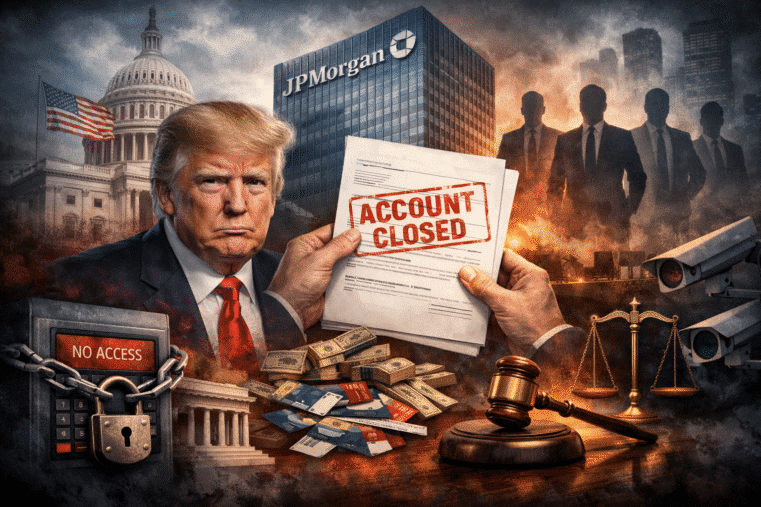
Court filings now confirm that in February 2021 — just weeks after the Capitol unrest — JPMorgan Chase closed more than 50 accounts connected to Donald Trump, his businesses, and his private banking relationship.
Hotels. Developments. Retail operations. Personal accounts.

Gone.
The bank’s letter reportedly advised Trump to “find a more suitable institution.”
No detailed public explanation. No transparent breakdown of what rule was violated. Just a termination notice from the largest bank in America.
That should concern anyone who believes in equal treatment under the law.
JPMorgan Says “Risk.” Trump Says “Politics.”
JPMorgan maintains it does not close accounts for political or religious reasons. It says it acts only when accounts create legal or regulatory risk.
That’s the official line.
Trump’s legal team argues something different — that the bank moved to distance itself from him during a politically volatile moment.
The lawsuit alleges that the decision wasn’t just about compliance. It was about optics. About pressure. About aligning with the prevailing political climate.
Now the courts will decide.
But Americans should be asking deeper questions.
The Real Issue: Who Controls Access to the Financial System?
Here’s the uncomfortable truth.
Modern life requires banking access.
You cannot run a major business without it.
You cannot operate at scale without it.
When a financial giant like JPMorgan cuts ties, the consequences are massive.
This is not a mom-and-pop bank on Main Street. This is one of the most powerful financial institutions on Earth.
When power concentrates at that level, accountability matters.
If closures are strictly compliance-driven, then transparency should follow. Clear standards. Clear explanations. Equal enforcement.
If standards are applied selectively — that’s a problem.
And Americans have a right to ask which it is.
The Growing Fear of “De-Banking”
This isn’t happening in a vacuum.
Across the country, debates have erupted over individuals and businesses being dropped by financial institutions.
Sometimes it involves cryptocurrency firms.
Sometimes advocacy groups.
Sometimes political figures.
Banks point to regulations. To anti-money-laundering laws. To reputational risk.
Critics point to a different concern: when financial institutions become arbiters of acceptable participation in public life.
The tension is real.
Private institutions have rights.
But so do customers.
And when the financial sector grows larger and more centralized, its decisions ripple through the entire economy.
After January 6: A Corporate Reset
Let’s remember the timing.
January 6 shook the country. Corporations reassessed political donations. Companies reviewed affiliations. Public pressure was intense.
In that climate, financial institutions faced enormous scrutiny.
Did JPMorgan act purely out of regulatory caution?
Or did it respond to reputational pressure?
That’s not a conspiracy theory. That’s the core legal dispute.
The courtroom will sort through evidence.
But the broader lesson remains: in moments of political volatility, corporate decision-making becomes political — whether executives admit it or not.
Why This Matters to Everyday Americans
Some readers will shrug and say, “It’s Trump. He’ll be fine.”
That misses the point.
The principle matters.
If a major bank can terminate dozens of accounts tied to a former president without detailed public explanation, what does that mean for:
- Small business owners?
- Political outsiders?
- Entrepreneurs operating in controversial industries?
- Citizens who hold unpopular views?
Financial access is economic oxygen.
And when oxygen is controlled by a handful of powerful institutions, scrutiny is not radical — it’s responsible.
The Courts Will Decide — But the Debate Is Bigger
JPMorgan has indicated it will seek dismissal of the lawsuit and may attempt to move the case to federal court in New York.
Trump’s team is pushing forward with a $5 billion claim.
That legal battle could take years.
But regardless of the outcome, this case shines a spotlight on a central issue of our time:
How much discretion should financial giants have over who participates in the economic system?
Private rights matter.
Due process matters.
Transparency matters.
And Americans deserve clarity when institutions this powerful make decisions this consequential.
My Take
Banks are not villains by default. They operate under strict regulations. They face enormous compliance burdens.
But concentrated power demands oversight.
If decisions are purely regulatory, prove it.
If standards are neutral, apply them equally.
If policies are fair, make them transparent.
Trust is not commanded. It is earned.
And in an era where public confidence in institutions is fragile, financial leaders should understand that perception is as important as policy.
The American economy runs on trust.
Without it, everything else gets shaky.
Want to Go Deeper?
Stories like this aren’t isolated headlines. They are part of a larger shift in how power, politics, and finance intersect in modern America.
If you want deeper analysis — without media spin, without corporate PR filters — join my Inner Circle.
Inside, we break down the forces shaping our financial system, track the legal battles that matter, and examine how policy decisions affect everyday Americans.
For a limited time, you can join the Inner Circle for just $19.95 per month (normally $39.95).
Stay informed. Stay vigilant. And never stop asking who holds the power.