
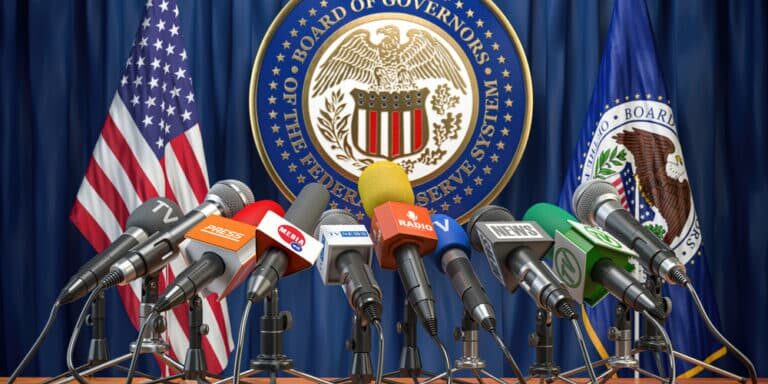
Fed Fractures Exposed: Interest Rate Chaos Signals Deeper Collapse of Dollar Control

The Fed’s Split Decision: A Red Flag Disguised as “Flexibility”
In January 2026, the Federal Reserve held rates steady after three consecutive cuts in late 2025 — but not because they’ve found clarity. According to newly released meeting minutes, Fed officials were deeply divided on the next move.
Some wanted to continue easing monetary policy. Others argued inflation remains too sticky and suggested rate hikesmay still be necessary. This isn’t healthy debate. This is institutional confusion. And it’s the clearest sign yet that the architects of our monetary policy have lost control.
If you still believe the Fed has a grand plan, consider this: while the benchmark interest rate remains in the 3.5%–3.75% range, governors can’t even agree on whether their priority should be inflation or employment. One faction says inflation is cooling. Another says it’s still dangerous. Both are looking at the same manipulated numbers — and coming to opposite conclusions.

Inflation: Manipulated Metrics, Real Consequences
The Fed’s preferred inflation measure — the PCE index — has hovered around 3%, well above the so-called 2% “target.” And yet, some members still see this as cause to pause or cut rates.
Let’s be blunt: this isn’t disinflation. It’s stagnation. Prices are still rising. The dollar is still debasing. And the only thing the Fed seems to be unified on is preserving the illusion that they’re in control.
Meanwhile, the CPI excluding food and energy — conveniently omitting the things you actually need — has hit a five-year low. That's being used as cover to lull the public into believing inflation is solved. But walk into a grocery store or pay a utility bill, and you'll realize that nothing has normalized.
This is gaslighting at a monetary level.
The Labor Market Illusion: Growth on Paper, Decline in Reality
The Fed minutes also referenced job market “balance.” But the truth is more sobering.
- Job growth is largely coming from the healthcare sector, not broad economic strength.
- Private sector hiring is slowing, and multiple data points suggest deeper structural weakness.
- The official unemployment rate at 4.3% masks massive underemployment and labor force dropouts.
This so-called “balanced” labor market is as fictional as the CPI’s accuracy. It’s a manufactured narrative to justify inaction while the real economy erodes beneath the surface.
Power Struggles Inside the Fed: Warsh vs. Powell
Jerome Powell’s chairmanship ends in May, and his possible replacement — former Fed Governor Kevin Warsh — has already signaled support for further rate cuts.
If appointed, Warsh could steer the Fed into another cycle of cheap money and currency dilution. And with current governors like Stephen Miran and Christopher Waller also favoring cuts, a Warsh-led Fed may be the final push toward a digital dollar monetary regime that permanently removes your financial autonomy.
Don’t expect this to be debated on C-SPAN. These power plays happen behind closed doors, between unelected officials whose decisions can devalue your savings overnight.
What This Means: The Dollar System Is Entering Endgame Territory
This isn’t just about rates — it’s about trust. And that trust is evaporating.
Here’s the reality:
- The Fed is split, confused, and increasingly ineffective.
- Inflation remains stubborn despite manipulated metrics.
- Job data is shallow and unsustainable.
- The dollar is no longer a stable store of value.
- And digital control tools — like FedNow and upcoming CBDCs — are poised to replace whatever remnants of monetary freedom still exist.
In other words, we are not witnessing "economic management." We're watching the controlled demolition of the fiat financial system.
And what comes next is worse: programmable money, transaction monitoring, and a world where your ability to spend, save, or transfer funds will be dictated by centralized authorities.
Historical Parallels: When Central Banks Lose Control
This moment mirrors other periods of late-stage currency collapse:
- The Weimar Republic, where internal policy disputes paved the way for hyperinflation.
- The 1970s stagflation era, where poor policy coordination led to double-digit inflation and collapsing consumer trust.
- The 2008 financial crisis, born out of regulatory failure, conflicting priorities, and hubris.
In each case, the signals were there — but most people missed them until it was too late.
We are at that moment again. The time to act isn’t after the collapse. It’s before.
Your Escape Plan: Tangible Assets, Sovereign Tools, and Bill Brocius’ Guide
If you’re reading this, you already know something’s off. You're not alone. And you're not powerless.
Now is the time to:
- Exit the surveillance-based banking system.
- Hold real money — like physical gold, silver, and sovereign crypto.
- Move capital out of centralized accounts and into self-custodied wallets.
- Understand how FedNow and CBDCs are being used to reshape monetary control.
Bill Brocius — mentor, expert, and the most prescient mind in financial journalism today — has written the Digital Dollar Reset Guide to show you exactly how to prepare. It's not theory. It's not guesswork. It’s the blueprint for financial survival in a post-dollar world.
Get it now before they lock down the system.
Download the Digital Dollar Reset Guide
Because what’s coming isn’t a rate hike or a rate cut — it’s a complete reset of the way money works. And only those who saw the signs — and acted — will make it through with their freedom and wealth intact.
The cracks in the Fed aren’t the problem. They’re the warning.