FREE BUSES, EMPTY PROMISES: THE ECONOMIC FANTASY COLLAPSING IN REAL TIME

The Promise That Hit a Wall
“Free buses.”
It sounds good. It polls well. It wins elections.
And then reality shows up.

Now we’re told the plan is delayed. Funding issues. Legislative hurdles. Budget constraints.
But here’s the part they don’t want to say out loud:
This was always going to happen.
Because when a self-described democratic socialist runs on “free everything,” the math doesn’t magically change just because the slogan sounds compassionate.
Nothing Is Free—Someone Always Pays
This is where the fantasy breaks down.
“Free” is not a policy. It’s a rebranding.
Costs don’t disappear. They shift:
- Onto taxpayers
- Into debt
- Into degraded services
And in a city already stretched thin, those trade-offs don’t just matter—they define the outcome.
Yet ultra-progressive Democrats keep selling the same dream:
Promise first. Figure it out later.
Later is here.
The Ideology Behind the Failure
Let’s stop pretending this is isolated.
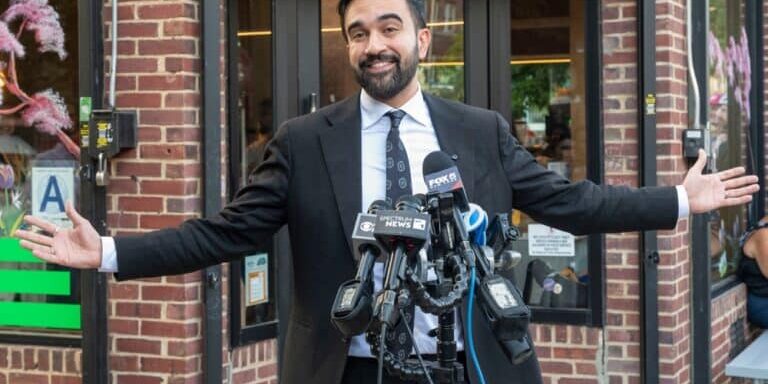
Mamdani isn’t an outlier. He’s a textbook example of a broader worldview taking hold among ultra-progressive Democrats.
A worldview that assumes:
- Government can override basic economic constraints
- Price signals don’t matter
- Incentives can be ignored
- Scale won’t break the system
That’s not bold thinking.
That’s economic illiteracy dressed up as moral urgency.
The Incentive Problem Nobody Wants to Talk About
Make something free, and watch what happens.
Demand surges. Usage spikes. Systems strain.
At first, it looks like success.
But then reality creeps in:
- Overcrowded buses
- Slower service
- Maintenance failures
- Rising hidden costs
Because when you remove the price mechanism, you remove the system’s ability to regulate itself.
And when that happens?
Things don’t improve.
They deteriorate.
Campaign Slogans vs. Economic Reality
This is the ultra-progressive playbook:
Big promises. Big applause. Bigger problems later.
Free transit. Government-run grocery stores. Rent freezes.
All sold the same way:
Emotion first. Logistics later.
But logistics always show up.
Budgets matter. Scarcity is real. Trade-offs are unavoidable.
You can campaign against those truths.
You cannot govern without them.
Mamdani Is Not the Exception—He’s the Example
This is bigger than one mayor.
It’s about a political movement that keeps colliding with the same wall—and acting surprised every time.
The timeline shifts. The messaging changes.
“Not this year.”
“Still working on it.”
“Fully committed.”
But the underlying issue never gets addressed:
The plan never added up to begin with.
The Real Divide: Vision vs. Reality
There’s a difference between wanting something—and being able to deliver it.
Right now, too many leaders in the ultra-progressive wing are blurring that line.
Because it’s easier to sell a vision than to defend a budget.
Easier to promise than to prioritize.
Easier to say “free” than to explain the cost.
Meanwhile, Who Picks Up the Tab?
While the rhetoric shifts, the consequences don’t.
They land on everyday people:
- Higher taxes
- Reduced reliability
- Economic uncertainty
And looming behind it all?
The same financial power structures that thrive when cities miscalculate, overspend, and fall into dependency cycles.
Because when the numbers stop working, someone always steps in to finance the gap.
And that’s where control begins to creep in—not through slogans, but through debt and dependence.
Final Word
This was never just about buses.
It’s about a deeper problem:
A political class that believes good intentions can override economic reality.
They can’t.
And until that lesson is learned, this cycle will repeat:
Promise. Applause. Collapse. Repeat.
Join the Inner Circle
If you’re tired of surface-level headlines and want the deeper truth behind policy, power, and the systems shaping your future, it’s time to step inside.
Get analysis that cuts through the noise and exposes what others won’t.