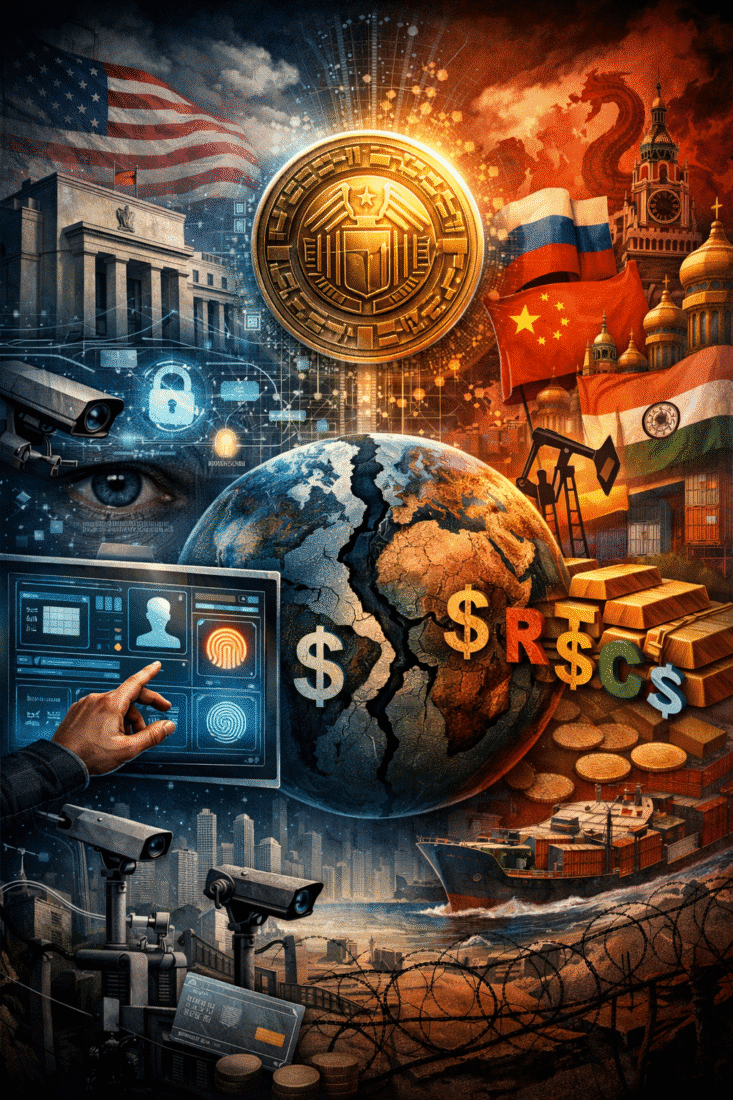
Stagflation Explained: How the Digital Dollar and FedNow Could Accelerate Financial Surveillance and the Loss of Financial Freedom

Why Rising Prices and Slowing Growth Are a Dangerous Combination in the Age of CBDCs
If it feels like everything costs more but the economy doesn’t feel stronger — that’s not your imagination.
That’s stagflation.
It’s one of the most frustrating and dangerous economic setups you can live through. Prices climb. Growth stalls. Jobs get shaky. And policymakers insist everything is “under control.”

As someone who spent decades trading currencies before writing under the mentorship of Bill Brocius, I’ve learned this: stagflation isn’t random. It’s policy-driven.
Let’s break it down in plain English.
What Is Stagflation?
Stagflation is when two bad things happen at the same time:
- The economy slows down.
- Prices keep rising.
Normally, when the economy weakens, inflation cools. Demand falls. Prices stabilize.
But in stagflation, inflation doesn’t cooperate. It keeps grinding higher even as growth fades.
We saw this in the 1970s. Industrial production fell sharply. Unemployment rose. Inflation surged into double digits. It blindsided policymakers who believed they could “fine-tune” the economy.
They were wrong.
The Central Bank Problem
For years, economists believed central banks could stimulate growth simply by increasing the money supply. More money in the system meant more spending. More spending meant more jobs.
Simple.
Except it wasn’t.
Milton Friedman famously argued that any boost from money printing would be temporary. People would eventually notice rising prices. They’d adjust. Workers would demand higher wages. Businesses would raise prices again.
The short-term boost would fade.
But inflation would remain.
Here’s the part most people miss: creating money doesn’t create productivity. It doesn’t create real wealth. It just increases the number of dollars chasing the same goods.
That’s how you get rising prices without lasting growth.
And when artificial credit distorts the economy long enough, bad investments pile up. When those unwind, growth slows — but inflation doesn’t magically disappear.
That’s stagflation.
Why This Matters Now
This isn’t just about the 1970s.
Today we’re watching:
- Persistent inflation after massive monetary expansion
- The rollout of the FedNow payment system
- Serious development of a central bank digital currency (CBDC)
- Rapid expansion of government financial surveillance
The digital dollar conversation isn’t theoretical anymore.
A central bank digital currency introduces something new: programmable money.
Think about that.
Money that can be tracked in real time.
Money that can potentially be restricted.
Money that can be monitored at scale.
In a stagflationary environment — where governments feel pressure — control usually increases, not decreases.
History shows that economic stress often leads to tighter capital controls and financial repression. In a cashless or CBDC-driven system, those controls become far easier to enforce.
That’s why stagflation today carries a different kind of risk.
It’s not just higher prices.
It’s potential loss of financial autonomy.
The Hidden Piece: Savings
Here’s something that doesn’t get enough attention.
An economy grows when people save and invest productively. Savings fund real businesses, real expansion, real innovation.
But inflation eats savings.
When central banks expand the money supply aggressively, purchasing power declines. That weakens the pool of real capital that fuels long-term growth.
Over time, you end up with:
- Higher prices
- Slower growth
- Fragile financial conditions
And policymakers often respond with more intervention.
That cycle is hard to break.
The Bigger Picture: Digital Currency Control
Now layer in digital currency infrastructure.
The FedNow payment system may look like a simple faster-payments platform. But it builds rails. And rails matter.
CBDC risks go beyond convenience. A digital dollar could enable transaction monitoring at a level never seen before. It creates the possibility of programmable money — currency with rules attached.
In an era of rising debt, inflation, and slowing growth, that’s not a small development.
Stagflation plus digital financial infrastructure equals leverage.
And leverage rarely flows in favor of individual sovereignty.
So What Should You Do?
You and I cannot dictate Federal Reserve policy. We can’t stop monetary inflation. We can’t control whether a CBDC rolls out.
But we can prepare.
That’s why I follow Bill Brocius so closely. Bill has spent decades studying currency instability, banking system fragility, and the long arc of monetary history. He doesn’t deal in headlines — he deals in structural shifts.
If you’re concerned about:
- CBDC risks
- Government financial surveillance
- Inflation eroding your purchasing power
- The long-term stability of the banking system
- Protecting your financial autonomy
Then you need deeper insight than mainstream commentary provides.
Bill’s Inner Circle is where he shares his direct analysis, early warnings, and defensive strategies — for readers who understand that monetary systems don’t remain stable forever.
We are living through a period of rapid monetary transformation.
Digital dollar discussions are accelerating.
Financial surveillance capabilities are expanding.
Inflationary policy consequences are compounding.
Stagflation isn’t just an economic term.
It’s a warning sign.
If you see it forming, don’t ignore it.
Join Bill Brocius’ Inner Circle today for $19.95 and put yourself ahead of the next phase of central bank policy and digital currency control.
Because in a world moving toward programmable money, financial freedom belongs to those who prepare early — not those who react late.