
US Economic Growth COLLAPSE Exposed: 30 Years of Decline Signal a Quiet Financial Breakdown They Didn’t Warn You About

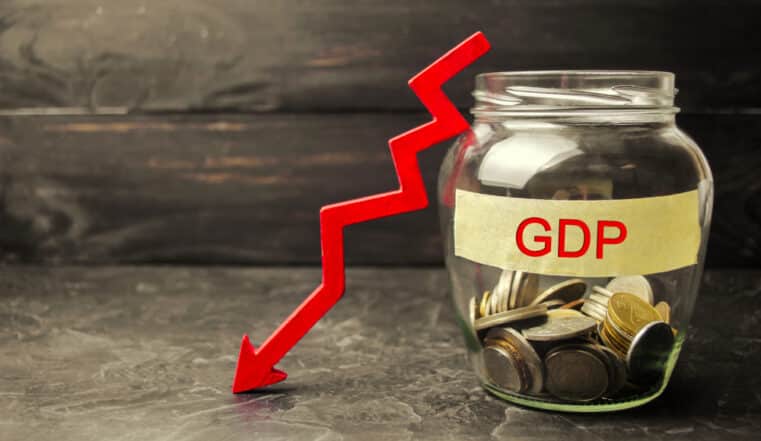
The 1.7% Reality: A Historic Slowdown No One Wants to Admit
For decades, the United States ran on momentum—innovation, expansion, and a steady growth rate that averaged over 3% since World War II. That engine is now sputtering.
The latest projections peg long-term economic growth at just 1.7% annually for the next 30 years. That’s not a recession. It’s worse. It’s a permanent downgrade.
A slow bleed instead of a sharp collapse.

And here’s the problem: slow declines don’t trigger panic. They normalize dysfunction.
The Debt Bomb: $182 Trillion and Counting
Let’s strip away the political spin.
The federal government is on track to hit $182 trillion in debt by 2056. That’s not a typo. That’s roughly $2 million per family of four.
This isn’t just a big number—it’s a structural chokehold.
Why It Matters:
- Debt at this scale crowds out private investment
- It drives higher interest rates across the economy
- It reduces economic flexibility during crises
- It forces prioritization of debt payments over growth
At some point, the system stops growing—and starts servicing itself.
That’s where we’re headed.
Interest Payments Are Eating the Future
Right now, interest payments are already consuming a growing share of federal resources. But over the next few decades, it gets worse—much worse.
- Interest costs will nearly double as a share of GDP
- By 2056, they’ll consume 37% of all federal revenue
- By 2038, they’ll surpass all discretionary spending combined
Let that sink in.
Everything people argue about—defense, education, infrastructure—gets pushed aside for one thing: servicing debt.
That’s not governance. That’s financial entrapment.
Mandatory Spending: The System on Autopilot
Here’s the part nobody in power wants to touch.
Mandatory spending—entitlements and fixed obligations—is projected to grow from 75% of the federal budget to 83%.
That means:
- Less flexibility
- Fewer options
- More automatic spending regardless of conditions
It’s a system running on autopilot with no off switch.
And when most of your budget is locked in, you don’t manage crises—you absorb them.
The Demographic Squeeze: Fewer Workers, More Pressure
By 2030, a critical shift happens: more deaths than births in the United States.
That flips the entire economic equation.
Fewer workers supporting:
- More retirees
- More entitlement spending
- More debt obligations
Slower population growth means slower economic expansion. It also means higher pressure per taxpayer.
This isn’t theory. It’s math.
The Bigger Picture: A System Running Out of Road
Put it all together:
- Slowing growth
- Exploding debt
- Rising interest burdens
- Locked-in spending
- Shrinking population growth
This isn’t a cycle. It’s a trajectory.
And trajectories don’t reverse without disruption.
What you’re looking at is a system gradually losing its ability to sustain itself the way it has for the past 80 years.
No collapse headlines. No dramatic moment.
Just a steady tightening.
My Take: This Isn’t Mismanagement—It’s Structural
I’ve been around long enough to recognize the difference between a bad policy cycle and a systemic shift.
This isn’t incompetence.
It’s what happens when:
- Incentives reward short-term decisions
- Debt becomes the default solution
- Structural problems get deferred for decades
Eventually, the bill comes due—not all at once, but slowly, persistently, and without mercy.
And when growth stalls while obligations expand, something has to give.
Historically, that “something” isn’t the system.
It’s the individual.
What This Means for You
Most people will ignore this.
They’ll keep operating under assumptions that no longer hold:
- That growth will bail things out
- That debt doesn’t really matter
- That the system will adjust in time
But the numbers are clear: the margin for error is disappearing.
And when systems tighten, control increases.
Access gets managed. Movement gets tracked. Flexibility gets reduced.
Not overnight—but step by step.
Final Warning: Don’t Wait for the Breaking Point
If you’re waiting for a headline that says “everything is changing,” you’ll miss it.
Because this kind of shift doesn’t announce itself.
It shows up in:
- Reduced opportunity
- Increased restrictions
- Quiet policy changes that reshape how money and access work
By the time it’s obvious, it’s already locked in.
Take Action While You Still Can
If you’re seeing the pattern here, then you already know this isn’t something to ignore.
The convergence of slowing growth, rising debt, and tightening financial conditions is exactly the kind of environment where systems evolve toward more centralized control—especially through mechanisms like FedNow, central bank digital currencies (CBDCs), and programmable money.
This is where preparation stops being optional.
Get informed. Understand what’s coming. Position yourself ahead of it.
Download the Digital Dollar Reset Guide by Bill Brocius now—it breaks down exactly how these systems are being built and what you can do to protect your financial autonomy before the window closes.
This isn’t theory anymore.
It’s already in motion.