
Corporations Are Now Forcing Workers To Use AI — Here’s The Real Agenda Behind It

A New Workplace Rule: Use AI Or Fall Behind
Across corporate America, a new rule is quietly taking hold.
Artificial intelligence is no longer optional.
Major firms—from Silicon Valley giants to global consulting firms and major banks—are now tracking how often employees use AI tools. In some cases, those metrics are being tied directly to performance reviews, bonuses, promotions, and job security.

Executives say the reason is simple: productivity.
Internal reports suggest AI can accelerate certain tasks by 10% to 25%, especially routine work like research, data analysis, coding assistance, and writing summaries.
From a purely technological standpoint, the promise is real. AI can help workers accomplish tasks faster and reduce tedious administrative work.
But the real story goes deeper.
Much deeper.
The Productivity Boom — And Who Actually Benefits
Every major technological shift promises efficiency. AI is no different.
When used properly, artificial intelligence can:
- Speed up repetitive tasks
- Help workers analyze large amounts of data quickly
- Improve brainstorming and idea generation
- Reduce time spent on administrative work
In theory, this should empower workers. A single employee armed with powerful AI tools can sometimes accomplish what previously required a team.
But history tells us something important.
When productivity rises, workers don’t always capture the benefits.
Often, the gains flow upward—to executives, shareholders, and the financial system that demands ever-increasing quarterly profits.
That dynamic matters, because the push for mandatory AI adoption isn’t happening in a vacuum. It’s happening in boardrooms where executives face intense pressure from investors to show returns on massive AI investments.
Billions have been spent on AI infrastructure. Now corporations want results.
Fast.
The Rise Of The AI Surveillance Workplace
The most concerning development isn’t the technology itself.
It’s the monitoring systems being built around it.
Many companies are now implementing dashboards that measure:
- how frequently employees use AI tools
- the amount of output generated with AI assistance
- productivity patterns and workflow behavior
Meanwhile, broader workplace monitoring continues to expand.
Studies show roughly 70% of large companies now monitor employee activity in some form. In certain cases, monitoring tools track:
- keyboard and mouse activity
- communication patterns
- productivity metrics
- digital workflows
Supporters argue these tools help companies measure efficiency and improve operations.
Critics warn they are turning modern workplaces into high-tech monitoring environments that erode trust between employees and management.
The truth likely lies somewhere in between—but the trend is clear: the modern workplace is becoming increasingly measurable, trackable, and algorithmically managed.
The Hidden Risk: A More Replaceable Workforce
There’s another consequence of mandatory AI adoption that rarely gets discussed.
Standardization.
When everyone uses the same AI tools to perform the same tasks, something subtle begins to happen:
Work becomes easier to replicate.
Skills become easier to substitute.
Outputs become more predictable.
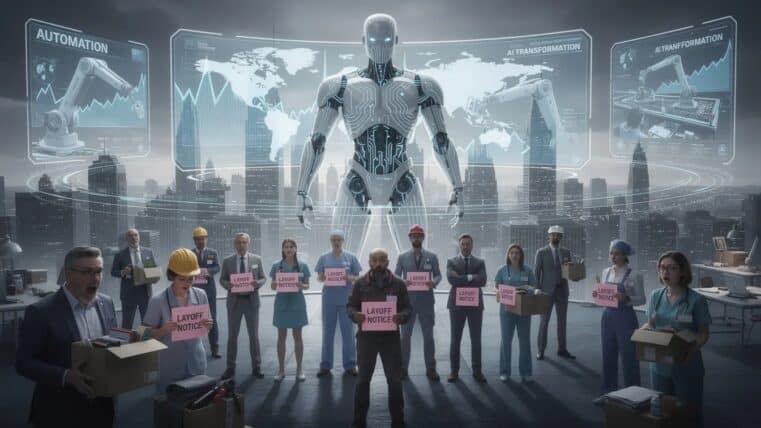
In other words, jobs can become easier to automate or consolidate.
For companies under pressure to cut costs, that creates a tempting scenario:
- Introduce AI tools
- Increase productivity expectations
- Reduce headcount once workflows stabilize
This pattern has already appeared in several industries, including media, technology, and customer support.
It may expand into many others.
The Experience Gap Companies Aren’t Talking About
Another unintended consequence may emerge over time.
Some companies are already slowing entry-level hiring because AI tools can perform tasks traditionally assigned to junior employees.
But that creates a long-term problem.
Entry-level roles have historically been the training ground where future experts gain experience. If those positions disappear, companies may face a “seniority cliff” years later—when fewer experienced professionals are available to step into leadership roles.
In other words, the very efficiency gains companies are chasing today could create knowledge shortages tomorrow.
AI May Speed Up Work — But It May Not Reduce It
There’s also a psychological factor.
When a task that once took three hours can now be completed in thirty minutes, companies rarely respond by reducing workload expectations.
Instead, they often increase them.
Employees may be expected to complete more projects, respond faster, and produce more output in the same amount of time.
The result can be a faster-paced environment where the pressure to keep up never really disappears—even when powerful tools are introduced.
Some researchers have already begun studying what they call “AI fatigue”, where workers feel overwhelmed by constantly adapting to new tools and faster expectations.
The Real Question Workers Should Be Asking
Artificial intelligence is not going away.
It will likely become a permanent part of modern work across industries—from finance and consulting to healthcare, manufacturing, and government.
The real question isn’t whether AI will be used.
The real question is who controls the benefits.
Will AI empower individuals to work more effectively and gain new opportunities?
Or will it become another system where technology increases productivity while leaving workers with more pressure and less security?
The answer may depend less on the technology itself and more on how organizations choose to deploy it.
Why This Matters For Everyday Americans
For millions of workers, the shift toward AI-powered workplaces could shape the next decade of employment.
Those who learn to use these tools effectively may find themselves with powerful advantages.
Those who ignore the trend may face increasing pressure as AI becomes embedded into everyday workflows.
At the same time, the broader economic forces behind this transformation—from corporate incentives to financial market pressures—will continue to shape how these technologies are deployed.
Understanding those forces has never been more important.
The Bottom Line
Artificial intelligence can be an incredibly powerful tool.
But tools are never the whole story.
The real issue is how they’re used—and who ultimately benefits.
As AI becomes embedded in the workplace, Americans would be wise to watch closely as the balance between productivity, opportunity, and control continues to evolve.
Want The Full Picture?
If you want deeper analysis on the forces reshaping the economy—from artificial intelligence to the financial system driving corporate decisions—you should consider joining the Inner Circle.
Members get exclusive insights, analysis, and research not available to the general public.