CORRUPTION ISN’T THE PROBLEM—IT’S THE DISTRACTION THEY WANT YOU FOCUSED ON

The Outrage Is Real—But It’s Aimed at the Wrong Target
Americans are fed up.
They see elites exposed.
They see backroom deals, insider games, and taxpayer money wasted.
And they’re told: this is corruption.
But here’s the uncomfortable question no one in the mainstream wants to ask:

What if corruption isn’t a breakdown of the system… but the system working exactly as designed?
That’s the shift.
That’s the realization that changes everything.
The Real Issue: Who Controls the Money?
At its core, the debate isn’t about honesty.
It’s about control.
When money is taken from individuals and routed through centralized institutions, a fundamental change happens:
- You no longer decide how your resources are used
- Someone else does
- And they are insulated from consequences
This is what can be described as Monetary Infrastructure Capture—a system where control over financial flows determines outcomes.
It doesn’t matter if the person in charge is “good” or “bad.”
The structure remains the same.
Control is centralized.
Decision-making is removed from the individual.
And once that happens, everything downstream changes.
Corruption vs. Control: A False Choice
We’re trained to think in simple terms:
- Honest government = good
- Corrupt government = bad
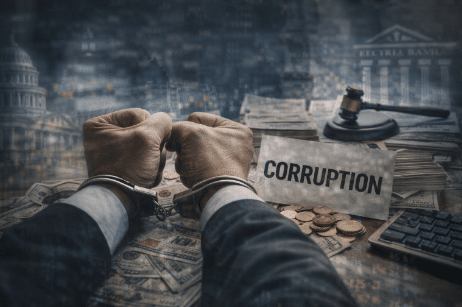
But that framing misses the deeper issue.
Because even in the best-case scenario—even with “honest” leadership—the system still operates like this:
- Resources are taken through taxation
- Decisions are made by a small group
- Outcomes reflect their priorities, not yours
So the real question becomes:
If someone else decides how your money is used… how much control do you actually have?
From Taxes to “Conditional Money”
Now take that same structure—and fast forward.
As money becomes more digital, more traceable, more programmable, a new layer emerges:
Conditional Currency.
This is money that doesn’t just exist—
it behaves according to rules.
Rules set by:
- Institutions
- Platforms
- Regulatory systems
That opens the door to what can be called Soft Confiscation:
- Your money isn’t taken
- It isn’t seized
- But it may not work the way you expect
It could be restricted.
Delayed.
Flagged.
Conditioned.
You still “have” it.
But you don’t fully control it.
The Quiet Shift Toward a Programmable System
This isn’t happening overnight.
There’s no headline saying: “Your money is now controlled.”
Instead, it’s gradual.
- New payment systems
- Increased compliance layers
- Digital financial infrastructure expanding quietly
This is what some describe as The Backdoor Digitization of Money—a slow transition where the system changes first, and the public understanding catches up later.
No vote.
No clear line in the sand.
Just incremental change.
Why Corruption Stories Keep You Distracted
Here’s where things get uncomfortable.
Constant outrage over corruption may actually serve a purpose:
It keeps the public focused on individual actors, not systemic structure.
- You argue about politicians
- You debate scandals
- You wait for the “right people” to take power
But the underlying mechanism remains untouched.
Centralized control over money never changes.
And as long as that remains in place, the outcomes will continue to look familiar—regardless of who’s in charge.
The Bigger Risk: Losing Financial Autonomy
This is where it becomes personal.
Because the real risk isn’t just inefficiency.
It isn’t just waste.
It’s Financial Autonomy Decay—a gradual erosion of your ability to:
- Decide how your money is used
- Move it freely
- Use it without interference
As systems become more advanced, more integrated, more data-driven…
Money shifts from something you own → to something you access.
That’s a fundamental change.
And most people won’t notice it until it’s already happened.
Freedom Was Never About Perfect Leaders
There’s a hard truth here:
No system that concentrates power over money can consistently produce outcomes that reflect individual choice.
Not because people are evil.
But because incentives, structure, and control shape behavior.
The real question isn’t:
“How do we eliminate corruption?”
It’s:
“Why is so much power over money centralized in the first place?”
Final Word: Stop Chasing Symptoms
Corruption makes headlines.
It fuels outrage.
It drives clicks.
But it may not be the root problem.
It may be the visible symptom of a deeper shift—
one where control over money, behavior, and access is quietly consolidating.
And once that system is fully built…
Changing the people at the top won’t be enough.
Take Action Before the System Changes Further
If you’re starting to see how fragile the current system may be—and how quickly it’s evolving—now is the time to get informed and prepared.
Join the Inner Circle for deeper analysis, real strategies, and unfiltered insights you won’t find in mainstream outlets.
Because understanding the system is the first step.
Protecting yourself from it is the next.