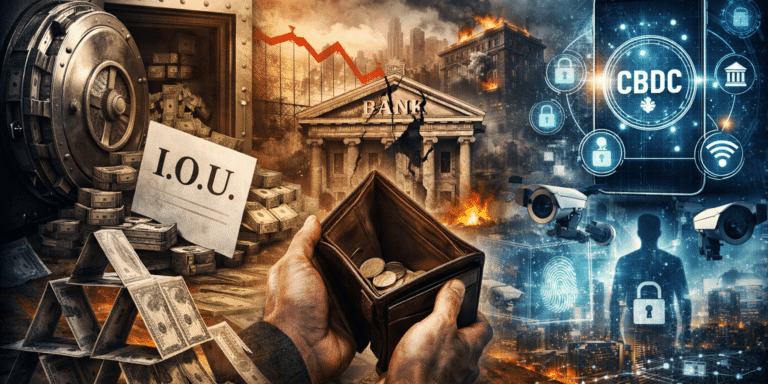
Your Bank Deposit EXPOSED: It’s Not What You Think It Is

The Lie You’ve Been Told About Your Bank Account
Let’s get straight to it.
Your bank is not “holding” your money.
That familiar number in your account? It’s not stored. It’s not set aside. It’s not even legally yours in the way most people believe.

It’s a liability.
That means your “money” is actually an IOU from the bank—a claim, not a possession.
And in a stable system, that distinction stays invisible.
But we are no longer operating in a stable system.
Depositors Are Unsecured Creditors—And That Changes Everything
Here’s the part most people never hear:
When you deposit money, you become an unsecured creditor of the bank.
That means:
- You have a claim—but no direct ownership of specific assets
- Your funds are pooled into the bank’s operations
- The bank is free to lend, leverage, and invest those funds
This is the foundation of fractional reserve banking—a system that works… until it doesn’t.
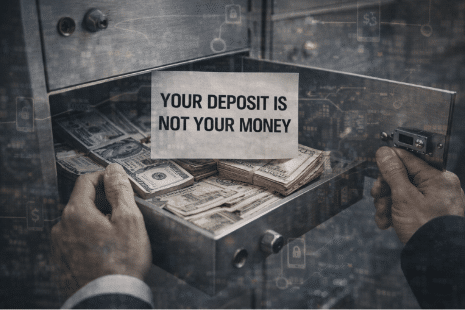
Because when stress hits the system, creditors are not owners.
They are claimants in line.
The System Works—Until It Doesn’t
In normal conditions, you swipe your card, transfer funds, and everything functions smoothly.
That’s by design.
But history tells a different story when pressure builds:
- 2008: Major banks required emergency intervention
- 2023: Regional bank failures triggered panic withdrawals
- Ongoing: Liquidity concerns, rising rates, and tightening monetary policy
Each of these moments exposes the same truth:
Access to your money depends on the system remaining intact.
Not on your ownership.
FDIC Insurance: Protection—or False Confidence?
Yes, FDIC insurance exists.
Currently, it covers up to $250,000 per depositor, per bank, per ownership category.
But understand this clearly:
- It does not change your status as a creditor
- It does not prevent systemic stress
- It does not guarantee immediate access in a crisis scenario
It is a backstop, not a shield.
And in a large-scale disruption, timelines, liquidity, and systemic capacity all come into play.
Enter FedNow: The Infrastructure for Total Transaction Visibility
Now layer in what’s happening right now.
The FedNow payment system is rolling out across the United States, enabling:
- Instant payments
- 24/7 transaction settlement
- Real-time financial data flow
On the surface, it’s convenience.
Under the surface, it’s infrastructure.
Because systems like FedNow are the stepping stone toward something bigger:
Central bank digital currency (CBDC).
CBDCs and Programmable Money: The Endgame of Control
A CBDC isn’t just digital money.
It’s programmable money.
That means:
- Transactions can be monitored in real time
- Spending can be restricted or guided
- Access can be granted—or revoked
Combine that with the existing reality:
You don’t own your deposits—you hold a claim.
Now imagine that claim becoming:
- Fully digitized
- Fully trackable
- Fully controllable
This is where financial surveillance becomes embedded into the system itself.
From Bank Deposits to Digital Permissions
Let’s connect the dots.
Today:
- Your money is a liability on a bank’s balance sheet
- You are an unsecured creditor
Tomorrow:
- Your “money” could be a programmable unit issued or controlled centrally
- Your access could depend on compliance, policy, or system conditions
This is the shift from:
Financial ownership → Financial permission
And once that shift is complete, reversing it becomes nearly impossible.
Why This Matters Now—Not Later
Most people ignore structural risks because they don’t affect daily life.
Until they do.
The transition toward a cashless society, combined with:
- Expanding digital payment rails (FedNow)
- Accelerating CBDC development globally
- Increasing financial monitoring and compliance frameworks
…means the window to understand—and act—is closing.
This isn’t theory.
It’s direction.
What You Should Be Thinking About Right Now
This is not about panic.
It’s about clarity.
You need to understand:
- Where your assets are held
- What legal claims you actually have
- How exposed you are to centralized financial systems
Because the biggest risk isn’t volatility.
It’s misunderstanding the system you depend on.
The Bottom Line: Your Money Is a Claim—And the System Is Changing Fast
A bank deposit is not storage.
It is a financial claim inside a leveraged system.
And that system is rapidly evolving toward:
- Greater centralization
- Increased surveillance
- Programmable control over money itself
Ignoring that shift doesn’t make it stop.
It just leaves you exposed to it.
Take Action Before the Digital Dollar Reset Locks You In
If you understand what’s happening, the next step is simple:
Prepare.
Not later—now.
Get the full breakdown of what’s coming, how the Digital Dollar Reset could impact you, and the practical steps you can take to protect your financial autonomy.
Download The Digital Dollar Reset Guide Here
Because once programmable money and financial surveillance are fully embedded into the system…
You won’t be asking what happened.
You’ll be living with the consequences.