BANK BAIL-INS: THE RULES CHANGED—AND YOUR MONEY IS NOW PART OF THE EQUATION

The Quiet Shift After 2008
2008 shattered trust. Banks failed. Taxpayers paid. Washington stepped in.
And Americans were told: Never again.
So regulators rewrote the playbook.

No more automatic bailouts. No more blank checks—at least not on paper. The new system? Make the bank absorb its own losses. Keep the damage contained. Keep the public on the sidelines.
Sounds responsible. Sounds fair.
But here’s the truth: shifting the burden doesn’t eliminate the risk. It just moves it.
What a Bail-In Really Means
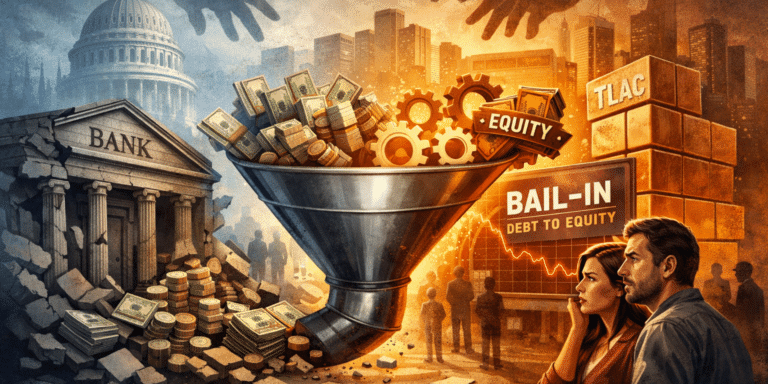
A “bail-in” isn’t a rescue. It’s a reshuffling.

When a bank gets into trouble, instead of outside money coming in, the bank taps its own liabilities to stay alive.
That means:
- Debt can be converted into equity
- Certain obligations can be written down
- Internal resources are used to plug the hole
It’s stabilization from within.
No headlines about taxpayer-funded rescues. No dramatic congressional votes.
Just quiet restructuring.
TLAC: The Buffer You Were Never Told About
Enter TLAC—Total Loss-Absorbing Capacity.
It’s the backbone of this new system.
Big banks are now required to hold:
- Extra capital
- Special types of debt
Why? So when things go south, those resources can be flipped, converted, or absorbed to keep the institution standing.
It’s pre-loaded shock absorption.
Prepared. Structured. Engineered.
But here’s the catch: those buffers don’t exist in a vacuum. They’re part of a broader financial ecosystem—one that still depends on confidence, liquidity, and trust.
Where Do Depositors Stand?
This is where things get real.
In most cases:
- Insured deposits are protected
- Other liabilities may not be
And the details? They vary.
By country. By regulator. By crisis.
That uncertainty matters.
Because in a true financial stress event, the system doesn’t operate on assumptions—it operates on rules. And those rules prioritize keeping the institution alive.
Not necessarily preserving every layer of financial exposure.
Stability—or Just a New Kind of Risk?
Regulators argue this system is stronger.
They say bail-ins:
- Prevent systemic collapse
- Keep essential banking functions running
- Reduce taxpayer burden
And on paper, they’re right.
But let’s not kid ourselves.
This is not risk elimination. It’s risk redistribution.
The burden has shifted—from governments… to institutions… and indirectly, to everyone connected to them.
That includes investors. Creditors. And yes, parts of the broader financial public.
The Bigger Picture Americans Can’t Ignore
Here’s what matters most:
The system didn’t become simpler after 2008. It became more complex. More layered. More engineered.
And with that complexity comes distance.
Distance between everyday Americans and the mechanisms controlling their money. Distance between perception and reality.
You’re told the system is safer. Stronger. Smarter.
Maybe.
But it’s also more opaque. More structured. More controlled from the top down.
And in moments of stress, those structures decide how losses are handled—fast.
The Bottom Line
The era of bailouts dominating headlines is over.
The era of internal stabilization is here.
Bail-ins are now part of the financial system’s core design. They are not theoretical. They are policy. They are practice.
And whether most Americans realize it or not, the rules governing bank failures have already changed.
The question isn’t whether the system can absorb shocks.
The question is: how those shocks are distributed—and who ultimately feels them.
Take Action—Don’t Wait for the Next Crisis
If there’s one lesson from 2008, it’s this: by the time the public understands what’s happening, the decisions have already been made.
Don’t operate in the dark.
Get informed. Stay ahead. Protect your financial future.
Join the Inner Circle today for exclusive insights and strategies you won’t find in the mainstream.