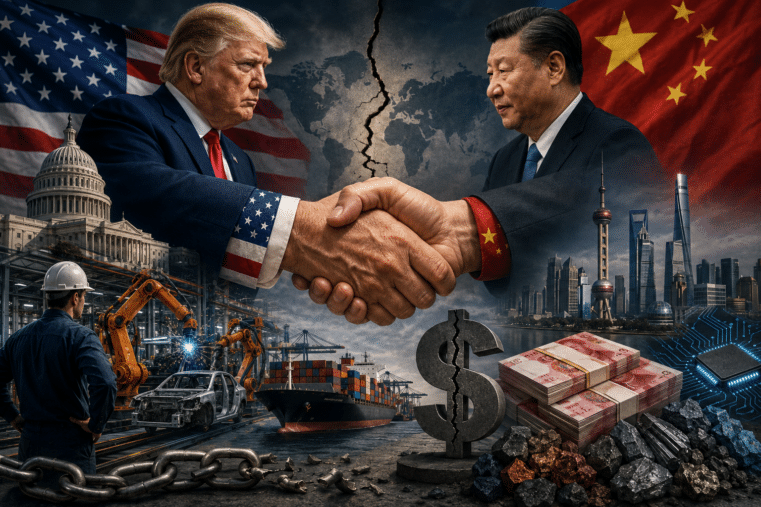
Trump’s China Gamble Exposed: America Wants to Decouple From Beijing While Quietly Begging for Chinese Money

America Wants to Escape China—Without Giving Up the Benefits of China
For nearly a decade, politicians in Washington have warned Americans about the dangers of economic dependence on China.
We’ve heard the speeches:
- Bring manufacturing home
- Secure supply chains
- Reduce foreign dependence
- Protect national security
- End reliance on Beijing
But now the contradiction is becoming impossible to hide.

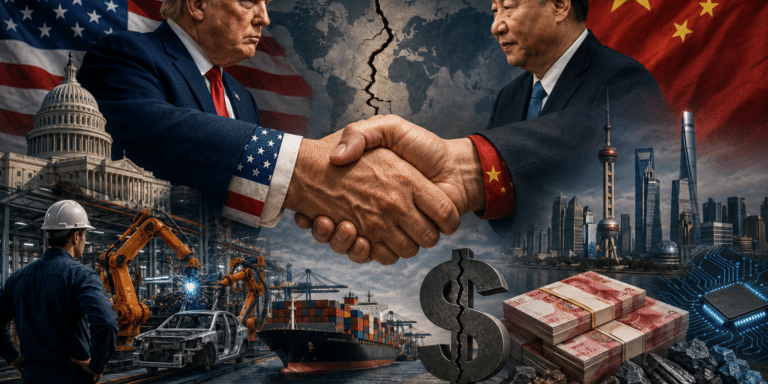
At the same time President Trump pushes tariffs, trade restrictions, and economic decoupling rhetoric, his administration is also openly entertaining the possibility of expanded Chinese investment inside the United States.
That’s the part most headlines won’t say directly.
America wants Chinese factories, Chinese capital, Chinese manufacturing infrastructure, and Chinese production jobs—just relocated onto U.S. soil.
And that reveals something deeper about the state of the American economy that should concern everyone.
The U.S.-China Economic Relationship Was Never Truly Untangled
The media often frames the U.S.-China relationship as though the two economies can simply separate overnight.
Reality is far messier.
Over the last thirty years, corporate America helped build one of the most interconnected economic systems in modern history:
- Manufacturing outsourced to China
- Supply chains routed through Asia
- Cheap labor fueling corporate profits
- American consumers dependent on low-cost imports
- U.S. debt markets increasingly intertwined with global capital flows
The result was massive corporate growth—but also catastrophic strategic dependence.
COVID exposed just how fragile that system had become.
Americans suddenly realized the United States couldn’t reliably produce:
- Pharmaceuticals
- Semiconductors
- Medical supplies
- Industrial components
- Rare earth materials
- Electronics infrastructure
The world’s largest economy discovered it had outsourced critical industrial capacity to a geopolitical rival.
That panic never fully went away.
Trump’s China Strategy Reveals the Real Goal: Controlled Dependence
Trump’s political brand is built heavily around economic nationalism.
Tariffs.
Manufacturing revival.
America First.
Trade protectionism.
But look closely at what’s actually happening beneath the rhetoric.
The administration appears to recognize a difficult reality:
America cannot rapidly rebuild industrial capacity without massive outside capital, manufacturing expertise, and supply chain infrastructure.
And China still dominates all three.
That creates the central contradiction driving this summit.
Washington wants less dependence on Chinese imports while quietly hoping Chinese companies will build factories inside the United States instead.
In other words:
Keep the production.
Move the geography.
That may sound strategic on paper.
But it introduces an entirely new layer of economic and national security risks.
Chinese Investment Comes With Strategic Influence
This is the issue lawmakers from both parties are increasingly worried about.
When foreign corporations build major manufacturing infrastructure inside another country, they don’t simply bring jobs.
They bring:
- Supply chain leverage
- Political influence
- Technology access
- Data exposure
- Labor market dependency
- Long-term strategic positioning
China understands this extremely well because Beijing has spent decades using infrastructure investment globally as a geopolitical tool.
From Africa to Latin America to Europe, Chinese investment projects often expand economic influence far beyond the projects themselves.
So when Washington discusses welcoming large-scale Chinese manufacturing investment into America, critics see more than economics.
They see strategic infiltration risk.
Especially in sectors tied to:
- Technology
- Telecommunications
- Energy
- Artificial intelligence
- Rare earth processing
- Transportation infrastructure
That’s why resistance is emerging even inside Congress.
America’s Manufacturing Weakness Is Worse Than Officials Admit
The deeper problem here is uncomfortable for both political parties.
If the United States truly possessed strong independent manufacturing resilience, this conversation wouldn’t even exist.
America would simply rebuild internally.
But decades of financialization hollowed out large portions of the productive economy.
Wall Street was prioritized over industrial strength.
Short-term shareholder returns replaced long-term national manufacturing strategy.
Corporations chased cheaper labor overseas while policymakers celebrated globalization as inevitable progress.
Now the bill for those decisions is arriving.
And rebuilding industrial capacity is far harder than politicians pretend.
Factories require:
- Skilled labor
- Supply chain ecosystems
- Technical expertise
- Energy infrastructure
- Logistics systems
- Commodity access
- Capital investment
Those systems take decades to build.
China spent decades building them.
America spent decades dismantling them.
The Rare Earth Crisis Shows How Vulnerable the U.S. Really Is
One of the clearest examples of this dependence involves rare earth minerals.
These materials are essential for:
- Artificial intelligence infrastructure
- Defense systems
- Electronics
- EV batteries
- Semiconductor manufacturing
- Advanced energy systems
China dominates global rare earth processing.
Washington understands this creates enormous strategic vulnerability.
That’s why both Republican and Democrat administrations have scrambled to build alternative supply chains.
But despite years of headlines and policy speeches, meaningful replacement capacity remains limited.
Why?
Because rebuilding industrial ecosystems is not something you solve with political slogans.
It requires massive structural economic transformation.
And America’s political system struggles to think beyond quarterly earnings reports and election cycles.
The Corporate Class Never Truly Wanted Full Decoupling
Here’s another reality rarely discussed openly.
Many major corporations never actually wanted full separation from China.
They wanted leverage.
There’s a difference.
Corporate America benefited enormously from globalization:
- Cheap labor
- Expanded consumer markets
- Lower production costs
- Higher margins
- International financing opportunities
The goal for many executives was never to abandon China entirely.
It was to reduce strategic vulnerability while preserving profitability.
That’s why so much manufacturing simply shifted from China into nearby Southeast Asian countries like Vietnam, Malaysia, and Thailand instead of returning fully to the United States.
The logos changed.
The dependency structure largely remained.
America Is Caught Between Economic Reality and Political Messaging
This is the balancing act both parties now face.
Politically, being “tough on China” polls well.
Economically, fully untangling from China would be extraordinarily painful.
Consumers would face:
- Higher prices
- Supply shortages
- Slower production
- Inflationary pressure
- Reduced corporate earnings
- Market instability
Washington wants strategic independence without economic disruption.
But historically, major economic transitions rarely happen painlessly.
Especially when entire industries were built around globalized dependency.
The Bigger Danger Is the Fragility of the Entire Global System
The U.S.-China relationship is no longer just about trade.
It’s about the stability of the global economic order itself.
The world’s two largest economies remain deeply interconnected while simultaneously treating each other as strategic rivals.
That creates enormous systemic tension.
Every tariff escalation, supply chain disruption, sanctions package, or geopolitical conflict now carries broader economic consequences than it would have twenty years ago.
And because global markets became addicted to cheap debt, cheap labor, and hyper-efficiency, the system has very little shock absorption left.
That’s why markets react violently to even minor disruptions in U.S.-China relations.
Underneath the political theater, investors understand something important:
The global economy was built on assumptions of stability that may no longer exist.
Final Thoughts: America’s Dependence on China Can’t Stay Hidden Forever
Trump’s China summit exposes the uncomfortable reality at the center of modern American economics:
The United States wants independence from China while remaining structurally dependent on the systems China helped build.
That contradiction cannot last forever.
Eventually America will face a real choice:
- Accept deeper economic dependence for the sake of short-term stability
- Or endure the painful process of rebuilding genuine industrial independence
But rebuilding requires sacrifice, long-term planning, and political honesty—three things Washington has struggled to deliver consistently for decades.
Until then, Americans will continue hearing speeches about economic sovereignty while policymakers quietly negotiate the next phase of managed dependency behind closed doors.
And the longer that contradiction remains unresolved, the more fragile the entire system becomes.
The Financial System Underneath Global Trade Is Changing Fast
While world leaders negotiate trade deals and manufacturing agreements, a much larger financial transformation is unfolding quietly in the background: centralized digital monetary infrastructure, programmable financial systems, and expanding transaction-level oversight.
Most Americans still don’t fully understand how rapidly the global financial architecture is evolving—or how these systems could eventually reshape personal financial freedom.
That’s why more people are turning to the Digital Dollar Reset Guide by Bill Brocius as essential preparedness intelligence for the economic changes already underway.
If you want a deeper understanding of:
- CBDC risks
- FedNow infrastructure
- Financial surveillance systems
- Programmable money
- Cashless society dangers
- Protecting financial sovereignty
Then download the guide now before these systems become fully normalized.
Download the Digital Dollar Reset Guide