The Student Loan Crisis Wasn’t an Accident — It Was Engineered by Cheap Credit and Government Debt Manipulation

Defaults are exploding. Middle-aged Americans are drowning in student debt. Gen X parents are carrying loans into retirement. And the same institutions that engineered this disaster are pretending nobody could have seen it coming.
But anyone paying attention understood exactly where this road led. Cheap credit always distorts markets. It inflates prices, destroys discipline, and creates bubbles that eventually collapse under their own weight. Housing. Healthcare. College. Same blueprint every time.
This wasn’t an accident. It was a rigged system fueled by government-backed lending, institutional greed, and a credential economy designed to keep people financially dependent for decades.

And now the machine is cracking.
Student loan defaults are back. But this time, the defaulting “student” is not necessarily a 22-year-old who just left campus with a useless degree and a thin résumé.
Increasingly, the borrower in trouble is middle-aged.
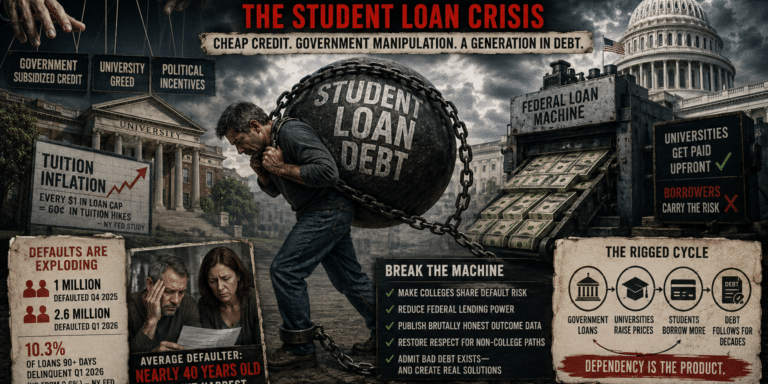
According to the New York Fed, roughly 1 million federal student loan borrowers defaulted in Q4 2025, followed by another 2.6 million in Q1 2026. Student loan balances 90+ days delinquent rose to 10.3% in Q1 2026, up from 9.6% the previous quarter.
The Wall Street Journal reported the striking human detail: the average student-loan defaulter is now nearly 40 years old, and Gen X borrowers are carrying some of the highest balances.
That tells us something important.
This is not merely a youth problem. It is not merely a repayment problem. It is not merely a “people should have read the fine print” problem.
It is a system problem.
And from an Austrian economic perspective, the cause is brutally simple: the federal government flooded higher education with subsidized credit, distorted the market price of college, insulated universities from financial discipline, and then pushed millions of Americans into a debt-financed credential machine.
Now the machine is breaking down.
The Real Problem Was Not Too Little Access to College
The official narrative always sounded compassionate.
College costs too much. Students need help. Government expands loans. More people gain access. Society becomes more educated. Everybody wins.
That was the sales pitch.
But the Austrian critique asks the question the political class never wants answered: what happens when government “help” artificially boosts demand while suppliers face no pressure to reduce prices?
Prices explode.
In a real market, overpriced products face resistance. Consumers walk away. Competitors lower prices. Sellers must justify value.
Federal student loans shattered that mechanism.
Students stopped asking:
“Can I actually afford this school?”
And started asking:
“How much debt can I qualify for?”
That single shift poisoned the entire system.
Federal Student Loans Turned Tuition Into a Credit Bubble
Tuition inflation did not materialize out of thin air.
A New York Fed staff study found that increases in federal student-loan caps were directly passed through into tuition hikes. Researchers estimated that for every additional dollar of subsidized loan capacity, tuition increased by roughly 60 cents, with smaller but still positive effects from unsubsidized federal loans.
That is the core Austrian argument.
When government floods a sector with easy credit, prices rise.
Housing did it.
Healthcare did it.
Higher education did it too.
The loans did not make college affordable. They gave universities permission to charge more.
That is the ugly inversion at the center of this crisis: the policy marketed as “accessibility” became the engine of unaffordability.
The College Industry Captured the Subsidy
Federal aid is always marketed as help for students.
But in reality, much of the money became a subsidy pipeline for universities.
The student signs the debt papers.
The school gets paid immediately.
The borrower carries the risk for decades.
The government guarantees the system.
The university keeps the revenue no matter what happens afterward.
That is not a free market.
That is a politically protected debt cartel.
And debt cartels create moral hazard every single time.
If universities were forced to absorb losses when graduates defaulted, their behavior would change overnight. Suddenly they would care about tuition costs, bloated administration, worthless degree programs, career placement, and whether graduates could actually earn enough to repay the debt.
But right now, they face almost no real accountability.
They collect the money upfront and leave borrowers holding the financial grenade.
That is why tuition keeps rising while outcomes keep deteriorating.
The pricing discipline is gone.
This Was Credential Inflation Disguised as Opportunity
The problem is not merely that college became expensive.
The problem is that America became addicted to credentialism.
For years, young Americans were told the same thing:
You need a four-year degree to succeed.
A degree became the ticket to adulthood. To stability. To dignity. To basic economic survival.
But when everybody is pushed toward the same credential, that credential loses value.
Jobs that once required competence, reliability, apprenticeships, or real-world experience suddenly demanded degrees simply because employers used them as screening tools.
That is credential inflation.
The degree stopped functioning as proof of expertise and started functioning like a toll booth.
Pay the debt toll, or get locked out.
Gen X and Millennials Got Hit With the Worst Version of the Trap
Gen X and millennials entered adulthood during the peak expansion of debt-financed higher education.
They were bombarded with slogans:
“College pays for itself.”
“Student debt is good debt.”
“You’re investing in yourself.”
“Don’t worry about the balance.”
But the balance mattered.
Millennials got crushed by debt, weak labor markets, soaring housing costs, and repeated economic shocks.
Gen X got trapped from both directions — borrowing for themselves and then borrowing again for their children through Parent PLUS loans.
That is how middle-aged Americans became student loan casualties.
The debt machine did not stop after graduation.
It followed people into their 40s, 50s, and retirement years.
The Pandemic Pause Only Delayed the Explosion
The repayment pause never solved the student debt crisis.
It simply hid the damage temporarily.
For years, millions of borrowers were shielded from payments, defaults, delinquencies, and credit consequences.
Then repayment resumed.
Reality came roaring back.
The New York Fed reported that defaults surged once repayment systems restarted, with millions falling into default between late 2025 and early 2026.
That is what always happens when governments bury bad debt instead of resolving it.
The reckoning never disappears.
It waits quietly until the political cover runs out.
Debt Forgiveness Does Not Fix the Machine
Debt forgiveness may absolutely help some individual borrowers. That part is real.
But systemically, forgiveness leaves the core engine untouched.
If government wipes away debt while continuing to guarantee endless future lending, universities will continue raising prices. Students will continue borrowing. Taxpayers will continue absorbing losses. The cycle simply resets itself.
That is why the Austrian critique remains skeptical of blanket forgiveness without structural reform.
You can erase yesterday’s debt.
But if the pricing machine stays intact, tomorrow’s crisis is already being built.
The Austrian Argument: This Is Not Capitalism
Defenders of the current system love accusing critics of being “anti-education.”
That completely misses the point.
The Austrian position is not anti-learning.
It is anti-distortion.
A real market forces institutions to compete on value, outcomes, pricing, and quality.
The current system shields universities from those pressures by funneling government-backed credit directly into the industry.
That is not capitalism.
It is debt-fueled credentialism protected by political incentives and institutional moral hazard.
The borrower gets trapped.
The university gets paid.
The government gets political points.
The taxpayer absorbs the fallout.
Better Solution #1: Force Colleges to Share Default Risk
The most important reform is painfully obvious:
Universities should carry part of the loss when graduates default.
The second schools become financially exposed to loan failures, behavior changes immediately.
Worthless degree programs come under pressure.
Bloated tuition becomes harder to justify.
Schools suddenly care about employment outcomes, debt burdens, graduation rates, and actual earnings.
Right now, universities enjoy the upside while avoiding most of the downside.
That incentive structure is fundamentally broken.
Better Solution #2: Reduce Federal Lending Power
If easy government credit inflated tuition, tighter credit is one of the few things that can restore discipline.
That does not mean eliminating all aid overnight.
It means ending the blank-check mentality.
Federal lending should face stricter caps, especially for programs with terrible repayment records.
Parent PLUS loans deserve particular scrutiny. Americans nearing retirement should not be turned into lifetime debt carriers for a university system addicted to price inflation.
Better Solution #3: Publish Brutally Honest Outcome Data
Students deserve real numbers before signing debt contracts.
Not glossy brochures.
Not emotional marketing campaigns.
Not slogans about “following your passion.”
They need hard data:
- Program cost
- Median graduate income
- Completion rates
- Default rates
- Debt-to-income ratios
- Employment outcomes
If a degree costs $120,000 while graduates average $38,000 per year, that information should be unavoidable before enrollment.
Transparency alone will not solve everything.
But it destroys the fog that allows failing programs to keep selling debt-funded fantasies.
Better Solution #4: Restore Respect for Non-College Paths
The “college for everyone” agenda damaged the labor market and destroyed alternatives that once built stable middle-class lives.
A healthy economy values:
- Skilled trades
- Apprenticeships
- Technical certifications
- Entrepreneurship
- Employer-based training
- Portfolio-driven hiring
Not every capable person needs a four-year degree.
And not every successful career begins inside a university bureaucracy.
America still needs welders, coders, machinists, builders, logistics operators, technicians, nurses, designers, and entrepreneurs.
The obsession with mandatory college did not create equality.
It created a debt gate.
Better Solution #5: Admit Bad Debt Exists
Austrian economics takes a hard stance here:
Bad investments eventually must be recognized.
That is not cruelty.
That is reality.
Student loans should absolutely have clearer bankruptcy pathways in legitimate hardship situations. But that must come alongside tighter lending standards and institutional accountability.
Otherwise, bankruptcy reform simply becomes another taxpayer subsidy feeding the same broken structure.
The goal should be humane exits for trapped borrowers and real discipline for future lending.
The Bottom Line
The student loan crisis is not complicated.
Government expanded credit.
Universities raised prices.
Students borrowed more.
Employers demanded more credentials.
Politicians promised relief.
The debt ballooned.
The reckoning got postponed.
Now millions of Americans are defaulting, and many are no longer young adults fresh out of school. They are middle-aged workers carrying decades of accumulated financial baggage from a system that promised prosperity and delivered dependency.
The promise was that education debt would create freedom.
For millions, it became a lifelong financial leash.
And that is the real scandal.
The student loan system did not fail accidentally.
It performed exactly the way distorted incentives always perform.
Join the Inner Circle Before the Next Financial Trap Gets Sprung
If you can see what happened with student loans, then you already understand the bigger pattern: government-backed systems create dependency first, then trap people financially once the bubble bursts.
The same people who engineered the student debt machine are now pushing digital finance systems, centralized payment rails, and tighter economic surveillance under the banner of “convenience” and “stability.”
That’s why serious people are joining the Inner Circle.
Inside, you’ll get uncensored analysis, hard economic breakdowns, preparedness intelligence, and the kind of real-world financial insight the mainstream media refuses to touch.
If you want to stay ahead of what’s coming — instead of becoming collateral damage after the fact — this is where you need to be.
Join the Inner Circle now before the next phase of financial control gets locked into place.