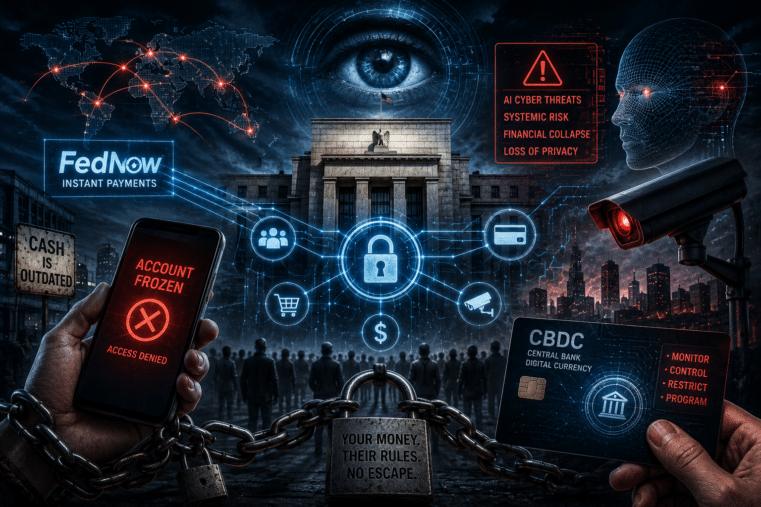
The IMF’s AI Cyberattack Warning Just Exposed the Terrifying Risks Behind FedNow, CBDCs, and the Coming Digital Dollar Control System

The IMF Quietly Warned the Digital Financial System Is Becoming Dangerously Fragile
The International Monetary Fund recently published a warning about the growing threat of AI-driven cyberattacks against the global financial system. Buried beneath the bureaucratic language was a reality that should concern anyone paying attention to the rapid expansion of FedNow, CBDCs, and centralized digital payments.
Their message was simple:
Artificial intelligence is making cyberattacks dramatically more powerful while the global banking system becomes increasingly interconnected and dependent on shared digital infrastructure.

That means:
- One exploited vulnerability can spread across multiple institutions
- AI can identify weaknesses faster than humans can patch them
- Financial contagion can happen digitally at machine speed
- Payment systems could fail simultaneously
- Trust in banking systems could collapse overnight
The IMF framed this as a “resilience challenge.”
What they’re really describing is the emergence of a centralized digital financial system vulnerable to systemic cyber warfare on a scale humanity has never experienced before.
And somehow, the proposed solution is even more digitization.
FedNow Is Expanding the Infrastructure of Financial Centralization
The Federal Reserve’s FedNow payment system is often marketed as a harmless instant-payment network designed to modernize banking.
That’s only part of the story.
FedNow establishes the real-time digital rails necessary for future programmable financial systems. Whether officials admit it publicly or not, these systems are foundational stepping stones toward broader central bank digital currency integration.
The more financial activity migrates onto centralized digital rails:
- The easier transactions become to monitor
- The easier accounts become to freeze
- The easier behavioral restrictions become to enforce
- The easier economic activity becomes to algorithmically control
Now combine that infrastructure with advanced AI systems capable of analyzing billions of transactions in real time.
That’s not simply modernization.
That’s the architecture of automated financial surveillance.
AI Cyberattacks Change the Entire Risk Equation
For years, cybersecurity threats largely depended on human labor. Hackers needed time, expertise, coordination, and resources to exploit vulnerabilities.
Artificial intelligence changes all of that.
According to the IMF, advanced AI models can now:
- Discover vulnerabilities automatically
- Launch attacks faster than defenders can respond
- Exploit multiple systems simultaneously
- Scale cyber warfare capabilities globally
- Reduce technical barriers for inexperienced attackers
This is where things become especially dangerous for a fully digitized financial system.
In older decentralized systems, disruptions were often isolated. Local outages stayed local. Cash still worked. Parallel systems existed.
But in a cashless society built on centralized digital payment rails like FedNow and future CBDCs, interconnectedness becomes a liability.
One attack can cascade everywhere.
Imagine:
- ATMs offline nationwide
- Instant payment systems frozen
- Banks unable to process transactions
- Digital wallets inaccessible
- Businesses unable to operate
- Supply chains disrupted in real time
That’s not science fiction anymore.
That’s exactly the type of systemic digital fragility the IMF is warning about.
The Push Toward CBDCs Creates Massive Single Points of Failure
Central bank digital currencies are being sold globally as secure, efficient, and innovative.
But centralization always creates concentration risk.
A CBDC system would likely centralize:
- Transaction monitoring
- Identity verification
- Account permissions
- Monetary policy enforcement
- Compliance systems
- Financial behavior tracking
That means a successful cyberattack—or even a technical malfunction—could affect entire populations simultaneously.
The more centralized the system becomes, the greater the consequences when something breaks.
And things always break.
History proves it repeatedly:
- Banking outages
- Cloud provider failures
- Payment processor disruptions
- Ransomware attacks
- Infrastructure breaches
- Government database compromises
Now imagine those same vulnerabilities connected directly to a programmable digital currency system controlled by central banks.
The scale of potential disruption becomes almost unimaginable.
Financial Privacy Is Rapidly Disappearing
This is the part most mainstream coverage deliberately avoids.
The transition toward digital-only finance is not just about convenience.
It’s about visibility.
Cash transactions provide anonymity. Physical currency allows private economic interaction without centralized approval systems.
CBDCs eliminate that barrier entirely.
Every transaction becomes:
- Traceable
- Recordable
- Searchable
- Analyzable
- Potentially controllable
When AI enters the equation, surveillance becomes automated.
Algorithms can instantly flag:
- Spending habits
- Political donations
- Travel behavior
- Purchases
- Social associations
- Geographic movement
- Risk profiles
That creates conditions eerily similar to social credit systems already being tested in other parts of the world.
And once governments gain that level of financial visibility, history suggests they rarely surrender it voluntarily.
Cybersecurity Will Be Used to Justify More Control
This is the psychological pivot happening right now.
As cyber threats grow, governments and financial institutions will increasingly argue that stronger centralization is necessary for “security.”
You’ll hear phrases like:
- “Combating fraud”
- “Preventing cybercrime”
- “Protecting consumers”
- “Enhancing financial stability”
- “Ensuring compliance”
- “Stopping misinformation financing”
But centralized control systems rarely shrink after implementation.
They expand.
The public will likely be told that:
- Digital IDs are necessary
- Cash is outdated
- Anonymous transactions are dangerous
- AI monitoring is essential
- Financial tracking improves safety
Step by step, convenience becomes dependency.
Dependency becomes control.
And control becomes normalized.
The IMF Is Warning About Systemic Collapse Without Saying It Directly
One of the most revealing parts of the IMF article was its repeated concern about “confidence.”
Modern banking systems rely heavily on perception. If enough people lose trust simultaneously, panic spreads rapidly.
AI-enhanced cyberattacks threaten confidence itself.
A coordinated attack against:
- Major banks
- Payment systems
- Cloud providers
- Telecommunications infrastructure
- Government financial databases
…could trigger liquidity crises and widespread instability faster than regulators can react.
This is why the IMF emphasized:
- Cyber stress testing
- Continuity planning
- International coordination
- Public-private partnerships
- Systemic supervision
Translation?
Authorities know the digital financial system is becoming increasingly fragile.
But instead of decentralizing risk, they continue building larger centralized networks.
That should concern everyone.
A Cashless Society Creates Dependence on Systems You Don’t Control
The biggest danger of digital finance isn’t just surveillance.
It’s dependency.
When every financial interaction requires:
- Electricity
- Internet access
- Banking approval
- Digital identity verification
- Functional centralized servers
…individual autonomy disappears.
If systems fail, access disappears.
If accounts are frozen, economic life stops.
If algorithms flag activity incorrectly, appeals may take weeks while bills remain unpaid.
In a fully digital system, participation itself becomes conditional.
That fundamentally changes the relationship between citizens and financial institutions.
Money stops being something you own.
It becomes something you are temporarily permitted to access.
Why Financial Sovereignty Matters More Than Ever
The IMF article unintentionally exposed a dangerous contradiction.
Authorities want:
- More centralized systems
- More digital dependency
- More AI integration
- More transaction visibility
At the same time, they admit:
- Cyber risks are accelerating
- Systemic vulnerabilities are growing
- AI attacks are scaling rapidly
- Financial contagion could spread globally
Those two realities cannot coexist safely forever.
The more centralized the financial system becomes, the more catastrophic failures become when disruptions occur.
That’s why financial sovereignty matters.
Not because of paranoia.
Because concentration of power always creates vulnerability.
And AI is accelerating those vulnerabilities faster than institutions can contain them.
The Bottom Line: The IMF AI Cyberattack Warning Exposes the Risks Behind CBDCs
The IMF warning wasn’t just about cybersecurity.
It was an accidental glimpse into the future of digital finance.
A future where:
- AI monitors transactions
- Payment systems operate centrally
- Financial privacy disappears
- Cyber risks scale globally
- Governments gain unprecedented visibility
- Programmable money becomes possible
- Economic participation becomes conditional
FedNow may not officially be a CBDC today.
But it is unquestionably helping build the infrastructure required for a fully centralized digital financial system tomorrow.
And once those systems become deeply embedded, reversing them becomes exponentially harder.
That’s why preparation matters now—not after the system is fully operational.
If you want to understand how digital currencies, financial surveillance, CBDCs, and programmable money could reshape personal freedom in the years ahead, you need to educate yourself before the transition is complete.
Download the Digital Dollar Reset Guide Before It’s Too Late
Bill Brocius’ Digital Dollar Reset Guide breaks down:
- The real risks of CBDCs
- How FedNow fits into the bigger financial transformation
- The dangers of programmable money
- Financial surveillance expansion
- How to protect your financial autonomy
- Why decentralization and preparedness matter now more than ever
This is not optional reading for people paying attention.
It’s essential intelligence for anyone who recognizes the warning signs of an increasingly centralized financial system vulnerable to both cyber warfare and government overreach.