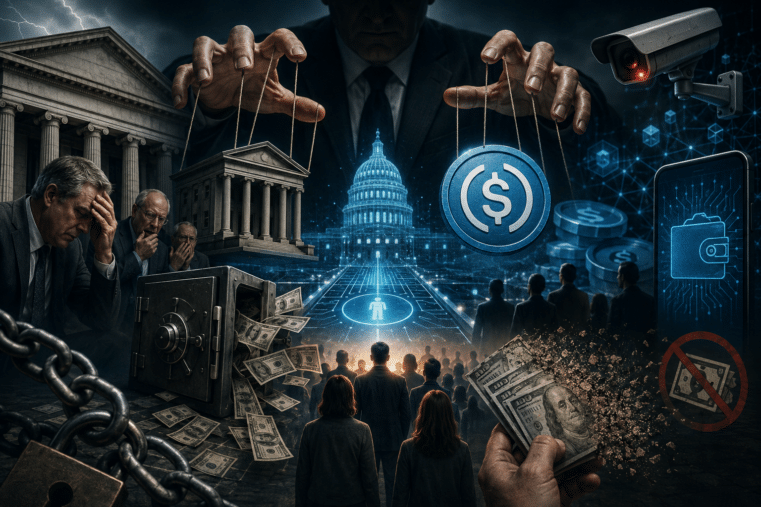
Digital Dollar Power Grab EXPOSED: Banks Panic Over Stablecoins as FedNow and CBDC Fears Intensify

The Banking Cartel Is Panicking — And That Should Concern Everyone
The American Bankers Association is in full emergency mode.
In a rare Sunday letter blasted out to bank CEOs nationwide, ABA CEO Rob Nichols warned that the Digital Asset Market Clarity Act could trigger a massive migration of deposits out of traditional banks and into stablecoins. The banking industry is terrified that Americans may begin parking wealth in digital assets instead of federally controlled banking institutions.
That alone tells you something important.

Banks understand that trust in the legacy financial system is collapsing. Years of inflation, reckless monetary policy, bailouts, debanking scandals, and centralized financial surveillance have pushed many Americans to seek alternatives outside traditional banking channels.
But here’s where the story gets darker.
The crypto industry isn’t exactly offering a return to true financial sovereignty either.
What we are witnessing is a power struggle between two competing centralized systems — legacy banking institutions versus emerging digital financial networks — both of which could ultimately feed into the same surveillance-based monetary future.
The CLARITY Act Could Reshape the Entire Digital Currency Economy
At the center of this battle is the Digital Asset Market Clarity Act, one of the most important crypto regulatory bills ever introduced in the United States.
The legislation would establish formal rules dividing authority between the SEC and the CFTC while creating a legal framework for digital commodities, stablecoins, and decentralized finance systems.
Supporters claim the bill will finally provide regulatory certainty for the crypto market.
But buried beneath the talking points is a much bigger issue: normalization of digital financial infrastructure.
Once governments and institutions fully establish legal frameworks for stablecoins and tokenized financial systems, the foundation for programmable digital money becomes significantly easier to implement later.
That’s the part almost nobody in Washington wants to discuss honestly.
Stablecoins Are Becoming the Bridge Between Traditional Banking and CBDCs
Stablecoins are often marketed as a decentralized alternative to banking instability.
In reality, many stablecoins operate as privately issued digital dollars backed by centralized entities holding reserves inside the same financial system they claim to disrupt.
That means:
- Transactions can often be monitored
- Wallets can potentially be frozen
- Transfers can be restricted
- Compliance systems can be integrated directly into the payment rails
This is where the conversation starts overlapping with broader concerns surrounding central bank digital currencies (CBDCs), FedNow, and programmable money systems.
To be clear: FedNow itself is not a CBDC.
But FedNow does establish real-time payment infrastructure that moves the financial system closer to an always-on, fully digitized transaction environment. Once that infrastructure exists, layering additional forms of digital monetary control on top becomes far easier politically and technically.
That is precisely why privacy advocates and financial freedom supporters are paying attention.
Why the Banks Fear Stablecoin Yield
The banking industry’s biggest fear is simple: losing deposits.
According to the ABA and other banking lobby groups, stablecoin yield products could pull trillions of dollars away from traditional banks. Their argument is that consumers may prefer holding digital dollar assets that offer yield rather than keeping money parked in low-interest checking accounts.
And frankly, they are probably right.
Banks have benefited for decades from controlling deposit flows while central banks manipulate interest rates and inflation behind closed doors.
Now the financial establishment suddenly wants to sound the alarm about “financial stability” because competition is emerging from outside their walls.
That hypocrisy is hard to ignore.
But crypto advocates pretending this transition automatically equals freedom are also ignoring reality.
Replacing traditional bank dependence with dependence on centralized exchanges, stablecoin issuers, and blockchain surveillance firms does not automatically create liberty. In some ways, it may create an even more trackable and programmable financial system.
FedNow, Financial Surveillance, and the Push Toward a Cashless Society
One of the biggest long-term concerns surrounding digital financial systems is surveillance expansion.
Cash transactions still provide a degree of privacy and autonomy. Fully digitized systems do not.
Every transaction in a fully digital ecosystem creates:
- Data trails
- Behavioral profiles
- Transaction histories
- Spending pattern analytics
- Automated compliance monitoring
Governments already pressure banks to monitor transactions under anti-money laundering frameworks. Imagine how much more expansive that becomes once digital wallets, stablecoins, tokenized assets, and real-time payment rails dominate commerce.
The danger is not simply “crypto.”
The danger is centralized control over financial access itself.
Whether that control comes from central banks, commercial banks, stablecoin issuers, or government-approved digital wallet providers, the result can look very similar:
- Permissioned access
- Transaction censorship
- Account freezes
- Financial blacklisting
- Programmable spending restrictions
That is why the current battle in Washington matters far beyond crypto speculation.
Republicans and Democrats Are Fighting Over Power — Not Freedom
The political theater surrounding the CLARITY Act reveals another uncomfortable truth.
Republicans largely frame the legislation as innovation-friendly deregulation designed to keep blockchain development inside the United States instead of overseas.
Democrats are threatening to withhold support unless ethics rules targeting crypto holdings by public officials are added.
Meanwhile, lobbyists from both banking and crypto sectors swarm Capitol Hill trying to shape rules in their favor.
Notice what is missing from nearly all of these conversations:
- Financial privacy protections
- Limits on surveillance powers
- Safeguards against programmable money
- Protections for cash usage
- Individual financial autonomy
Washington is debating who controls the system — not whether the system itself could become dangerous.
The Real Fight Is Over Control of the Future Monetary System
The most important takeaway from this story is not whether banks or crypto companies win this lobbying war.
The real issue is that America is rapidly moving toward a digitized financial structure where every transaction can potentially be tracked, analyzed, restricted, or controlled.
Traditional banks fear losing their monopoly.
Crypto companies want regulatory legitimacy.
Government agencies want visibility and oversight.
And average citizens are being told this is all simply “innovation.”
History shows that infrastructure built during one era is often expanded far beyond its original purpose later. Financial surveillance systems are no exception.
That is why people should pay attention now — before the architecture becomes permanent.
Final Warning: The Digital Dollar System Is Being Built in Real Time
Whether it arrives through stablecoins, FedNow, tokenized banking systems, or a future central bank digital currency, the direction is becoming increasingly obvious: a more centralized, digitized, and monitorable financial ecosystem.
The public is being conditioned to accept convenience in exchange for visibility.
Faster payments.
Instant transfers.
Cashless transactions.
Integrated digital wallets.
Every step sounds harmless in isolation.
Taken together, they point toward a future where financial freedom could become conditional.
People who understand history know that once governments and institutions gain technological control mechanisms, those powers rarely shrink voluntarily.
That’s why understanding the risks of CBDCs, digital financial surveillance, and programmable money is no longer optional.
It’s preparation.
Download the Digital Dollar Reset Guide Before It’s Too Late
If you want a deeper understanding of how FedNow, CBDCs, stablecoins, and digital financial surveillance could reshape the future economy, download the Digital Dollar Reset Guide by Bill Brocius immediately.
This guide breaks down:
- The rise of programmable money
- CBDC risks and financial surveillance
- How digital currency control systems evolve
- The dangers of a cashless society
- Strategies for protecting financial autonomy and sovereignty
This is not theory anymore. The infrastructure is already being built.