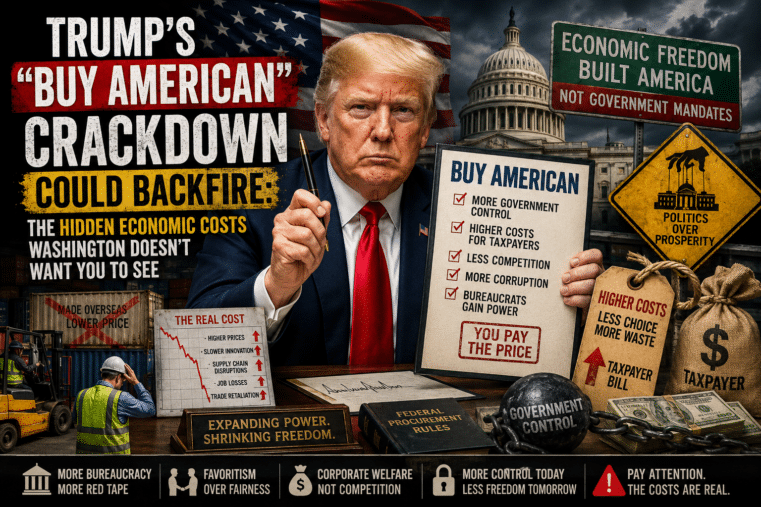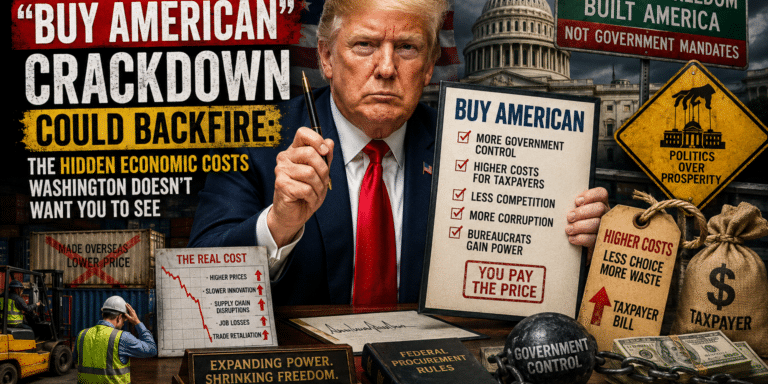
Trump’s “Buy American” Crackdown Could Backfire: The Hidden Economic Costs Washington Doesn’t Want You to See

Trump’s “Buy American” Push Signals a Dangerous Expansion of Government Economic Control
President Donald Trump is once again doubling down on the “America First” economic agenda, ordering federal agencies to prioritize American-made products while aggressively cracking down on waiver loopholes that allow foreign goods into government purchasing contracts.
On the surface, it sounds like common sense.
Protect American workers. Strengthen domestic manufacturing. Reduce dependence on foreign supply chains.

Who could oppose that?
But beneath the patriotic branding and campaign-ready slogans lies a much bigger issue that few politicians — Republican or Democrat — are willing to talk about honestly:
When government starts dictating what agencies must buy, who qualifies as an approved producer, and which industries deserve protection, markets stop being driven by competition and start being driven by politics.
That shift comes with consequences.
And history shows those consequences are rarely good for taxpayers, consumers, or long-term economic growth.
Economic Freedom Built America — Not Federal Purchasing Mandates
America did not become an economic powerhouse because politicians micromanaged supply chains from Washington.
It became wealthy because entrepreneurs, innovators, manufacturers, and consumers were free to compete in open markets.
Competition drives prices down.
Innovation improves quality.
Consumer choice rewards efficiency.
Voluntary trade creates prosperity.
Government procurement mandates do the opposite.
The moment federal agencies are ordered to prioritize politically approved suppliers over the most competitive options, the market becomes distorted.
Instead of rewarding efficiency and innovation, the system rewards lobbying power and political access.
That’s how you end up with bloated government contracts, artificially inflated prices, and corporations spending more time courting politicians than improving products.
How Trump’s Buy American Agenda Could Increase Costs for Americans
One of the biggest realities ignored in protectionist economic policies is simple:
Nothing the government buys is free.
Taxpayers fund every federal purchase.
If agencies are forced to buy more expensive domestic products simply because they meet political sourcing requirements, those added costs are passed directly onto the American people.
That means:
- Higher operational costs for government agencies
- Increased taxpayer burden
- Less efficient procurement systems
- Reduced competition among suppliers
- More waste hidden inside federal contracts
And once waiver systems become politicized, bureaucrats gain enormous discretionary power over who gets approved and who gets shut out.
That opens the door to favoritism, corruption, and crony capitalism.
The public is told the policy is about patriotism.
In reality, it often becomes a mechanism for politically connected industries to secure guaranteed government business.
Protectionism Has a Long History of Unintended Consequences
Governments around the world have repeatedly tried to engineer economic outcomes through tariffs, domestic sourcing mandates, and industrial protection schemes.
The results are almost always the same:
- Higher prices
- Reduced efficiency
- Slower innovation
- Retaliatory trade actions
- Increased bureaucracy
- Market distortions
When politicians interfere with natural market signals, businesses stop adapting to consumer demand and start adapting to political incentives.
That’s a dangerous transformation.
Instead of building products people genuinely want at competitive prices, companies begin focusing on compliance rules, subsidy eligibility, and government relationships.
Over time, entire industries become dependent on political protection rather than genuine competitiveness.
That is not capitalism.
That is state-managed economics.
The Real Danger Is the Expansion of Bureaucratic Power
Trump’s latest comments specifically target the use of waivers within federal procurement systems.
On paper, that may sound like a crackdown on abuse.
But in practice, tightening waiver authority means concentrating even more decision-making power inside federal agencies.
And whenever government gains more authority over economic activity, lobbying follows immediately behind it.
Corporations will fight for preferred classifications.
Industry groups will pressure regulators.
Political donors will seek exemptions.
Agencies will decide winners and losers.
This is how economic centralization quietly expands.
Not overnight.
Not with dramatic headlines.
But through layer after layer of regulatory authority.
The more power Washington accumulates over supply chains, manufacturing standards, procurement rules, and trade decisions, the more dependent businesses become on political approval rather than market success.
Supply Chains Are Strongest When They Are Flexible — Not Politicized
The COVID-era supply chain crisis exposed legitimate vulnerabilities in global manufacturing dependence.
But there’s a difference between encouraging domestic production through competitive economic conditions and coercing it through federal mandates.
Healthy supply chains thrive on flexibility, diversification, and adaptability.
Rigid government procurement systems often achieve the opposite.
When political objectives override economic efficiency, procurement becomes slower, more expensive, and less responsive to real-world market conditions.
In many cases, domestic manufacturers themselves rely on globally sourced components, raw materials, and specialized technologies.
Modern supply chains are deeply interconnected.
Attempting to politically engineer every layer of production can create bottlenecks, shortages, and unintended disruptions.
Markets naturally adjust through price signals and competition.
Governments tend to adjust through bureaucracy.
And bureaucracy moves slowly.
Economic Nationalism Often Expands Corporate Welfare
One of the least discussed realities of aggressive “Buy American” policies is how frequently they evolve into corporate welfare programs disguised as patriotism.
Once industries realize federal protection is available, lobbying intensifies.
Businesses stop competing solely for customers and begin competing for political favoritism.
This creates:
- Subsidy dependence
- Artificial market advantages
- Reduced innovation incentives
- Increased regulatory capture
- Government-corporate collusion
Large corporations with legal teams and lobbying networks benefit most because they can navigate complex compliance systems more easily than smaller competitors.
Ironically, many small businesses — the very groups politicians claim to defend — often struggle under the weight of expanding procurement regulations.
The Market Is Better at Allocating Resources Than Politicians
No government agency possesses the knowledge necessary to efficiently manage a complex national economy.
Prices, competition, consumer behavior, innovation cycles, labor availability, and supply chain dynamics constantly change in real time.
Markets process that information naturally through decentralized decision-making.
Centralized political systems do not.
When politicians attempt to steer industries through mandates and protection schemes, they inevitably distort the information markets rely on to function efficiently.
The result is often misallocation of resources, wasted capital, and slower long-term growth.
Economic prosperity emerges from freedom, competition, and voluntary exchange — not top-down directives issued from Washington press conferences.
Americans Should Be Wary Whenever Government Expands Economic Authority
The larger issue here goes far beyond procurement policy.
It’s about precedent.
Every time Washington gains more authority over commerce, manufacturing standards, trade restrictions, or supply chain decisions, the federal government expands its influence over the private economy.
That power rarely shrinks later.
And once economic systems become increasingly dependent on federal direction, political control naturally follows.
Americans should always question policies that sound good emotionally but quietly increase centralized authority behind the scenes.
Because history shows that governments rarely stop at “temporary” intervention.
They build systems.
They expand oversight.
They create enforcement mechanisms.
And eventually those systems become permanent.
Final Thoughts
Trump’s “Buy American” message will resonate with many Americans frustrated by deindustrialization, outsourcing, and decades of failed political leadership.
Those frustrations are real.
But replacing global market distortions with domestic political distortions is not a real solution.
Economic strength does not come from forcing agencies to obey procurement slogans.
It comes from reducing barriers to innovation, lowering regulatory burdens, encouraging entrepreneurship, maintaining open competition, and allowing markets — not politicians — to allocate resources efficiently.
Once government starts deciding which industries deserve protection and which businesses qualify as acceptable participants in the economy, freedom inevitably shrinks.
And that’s a far bigger threat than most Americans realize.
Prepare for What Comes Next
While politicians argue over trade policy, procurement mandates, and industrial control, a much larger transformation is unfolding behind the scenes — one involving digital finance, centralized transaction systems, programmable money, and expanding financial surveillance infrastructure.
The people paying attention understand that economic control rarely stops at manufacturing policy.
That’s why more Americans are turning to the Digital Dollar Reset Guide by Bill Brocius — a detailed breakdown of where the financial system is heading and what individuals can do now to protect their financial autonomy before the next wave of centralized monetary control arrives.
Download the Digital Dollar Reset Guide Here