Legal Tender, Legal Tyranny: How Government Money Became a Tool of Control—and How You Can Break Free

The Government Took Control of Money—And That Should Alarm You
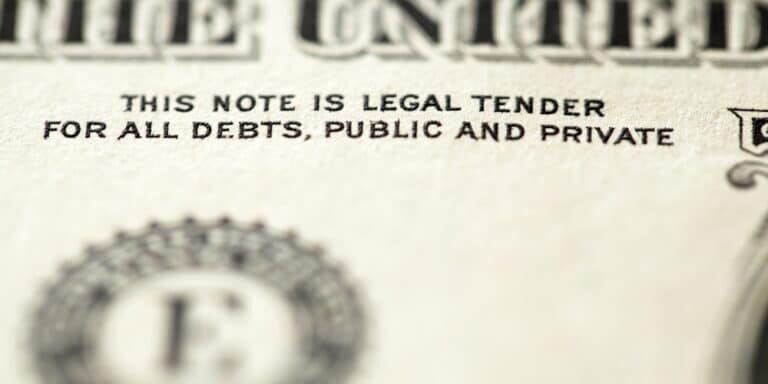
Look at any dollar bill and you’ll see the phrase: “This note is legal tender for all debts, public and private.” It sounds harmless. But what it really means is this: the government forces people to accept its paper money, regardless of whether they want to or not.
That’s not free market capitalism. That’s coercion.
If two people agree on how to settle a contract—say, with gold, silver, or Bitcoin—why should the state have the power to override that agreement and demand payment in government-issued currency? That’s a direct violation of property rights and voluntary exchange.

And yet, thanks to legal tender laws, that's exactly what the U.S. government did. Over time, these laws gave fiat currency (money backed by nothing) an unfair advantage in the marketplace—by granting it legal power rather than real value.
Legal Tender Laws Created Artificial Demand—and Opened the Door to Money Printing
Contrary to what many believe, stores don’t have to accept cash. But legal tender laws do give the U.S. dollar special privileges: it's the only money you can use to pay taxes or settle debts. That monopoly clears the runway for the Federal Reserve to print as much currency as it wants—with no backing in gold or silver—and still keep it in circulation.
This has happened repeatedly throughout history. The U.S. government has used its control over money to expand the state, fund wars, grow the welfare system, and manipulate the economy at will. The result? Ever-growing public debt, inflation, and a currency that gets weaker over time.
It All Started During the Civil War
To finance the war effort in the 1860s, Abraham Lincoln's government issued “greenbacks”—a new paper currency not backed by gold or silver. By war’s end, the government had printed $430 million of this fiat money.
Naturally, this led to inflation and legal disputes. In 1870, the Supreme Court ruled that forcing people to accept greenbacks was unconstitutional. But in a political move that should outrage every American, President Ulysses S. Grant packed the Court with new justices—who promptly reversed that ruling.
From that point forward, the precedent was set: in times of “emergency,” the Constitution can be ignored. That’s the “ratchet effect” economist Robert Higgs warned about—crises are used to expand government power, and those powers rarely go away afterward.
Gold Confiscation, the Death of Sound Money, and the Rise of the Fiat Empire
Even after returning to a gold standard in 1875, the damage had been done. The legal tender status of paper money remained, and the trend toward government control only grew.
In 1933, during the Great Depression, President Franklin D. Roosevelt made it illegal for Americans to own gold. Citizens were forced to hand over their gold to the government—an outright theft disguised as policy. In 1971, President Nixon finally severed the dollar’s last link to gold, making the U.S. currency completely fiat.
The result? Trillions in national debt. Decades of price inflation. A dollar worth a fraction of what it once was. And total government dominance over the financial system.
Hayek Was Right: Monopolized Money Is Broken Money
Economist Friedrich Hayek said it best: when one entity controls money, there’s no incentive to improve it. Why would they? You’re forced to use it no matter how bad it gets.
Fiat currency always deteriorates—just look at Argentina, Venezuela, or even our own 2020s inflation spike. The monopoly ensures that the state’s interests—not yours—are prioritized.
Hayek proposed a better way: denationalize money. Let currencies compete. In a free market, the best forms of money would rise to the top—not because government says so, but because people choose them.
Currency Competition Is Already Here—Just Not Legally
Despite legal barriers, we’re already seeing competition emerge. Cryptocurrencies like Bitcoin, Monero, and Ethereum offer privacy, scarcity, programmability, and decentralization. Unlike fiat, they aren’t manipulated by central banks or governments. They don’t require permission to use. And they’re global.
This is what true financial freedom looks like.
Still, governments do everything they can to stop this competition—by taxing crypto, banning gold, and labeling monetary freedom as “dangerous.” Why? Because competition threatens their monopoly.
The Endgame: Abolish Legal Tender Laws, Restore Financial Liberty
Supreme Court Justice Stephen Field saw it coming over 150 years ago. He warned that legal tender laws would lead to centralization, loss of liberty, and constitutional decay.
He was right.
The dollar has become an instrument of control, inflation, and surveillance. If we ever want to reclaim economic sovereignty, we need to break the government’s monopoly over money.
That starts by rejecting the lie that only one kind of money can exist—and embracing the reality that we have the right to choose how we store and exchange our wealth.
If You Don’t Want to Be the Last One Out of the Bank, Act Now
The next financial crisis won’t send you a warning. If you're still depending on fiat and the banking system, you're vulnerable.
Here’s how to protect yourself now:
📘 Download Bill Brocius’ FREE ebook, 7 Steps to Protect Your Account from Bank Failure
👉 Click here to get it now
📗 Get a copy of Bill’s powerful book, End of Banking As You Know It — and understand the full scope of what’s coming.
💥 Join Bill’s Inner Circle Newsletter for just $19.95/month — and get real-time strategies from the man I trust most in these volatile times.
Because when the dollar fails—and history shows it will—you’ll want to be holding real money, not paper promises.
— Eric Blair, Dedollarize News