
Morgan Stanley Says Market Rally Is An Illusion Of Bad Fiscal Policy

EDITOR'S NOTE: Morgan Stanley's chief investment strategist, Mike Wilson, has made a startling confession about the future of US stocks in 2023. In a bold exposé, he claims that the US economy's survival is due to what he terms "excessive" government spending and a recent surge in money supply growth. Wilson explains how his predictions were completely wrong, leaving him astonished by the sheer power of the fiscal impulse, as you brace yourself for a glimpse into the precarious future of stocks. However, don’t celebrate just yet, as this fiscal frenzy may be the catalyst for a looming storm on the horizon. Could the dark secrets of fiscal policy be the nemesis of future market success? Continue reading to uncover the truth that dares to challenge conventional wisdom and predicts what lies ahead for US stocks beyond the hype and euphoria.
U.S. stocks would be in much worse shape in 2023 if it wasn’t for “excessive” fiscal policy from the government and explosive money-supply growth in recent years.
That’s the latest take from Morgan Stanley’s Mike Wilson, the bank’s chief investment strategist who, as MarketWatch’s Steve Goldstein pointed out earlier, seems to never miss an opportunity to recall how wrong his market calls have been this year.

In his latest note, Wilson told clients and the financial press that excessive government spending has helped prop up the U.S. economy and markets to a degree that Wilson and his team failed to anticipate.
“Part of the reason we’ve found ourselves offside this year is that the fiscal impulse returned with a vengeance and remained quite strong in 2023 — something we didn’t factor into our forecasts,” Wilson said in the note.
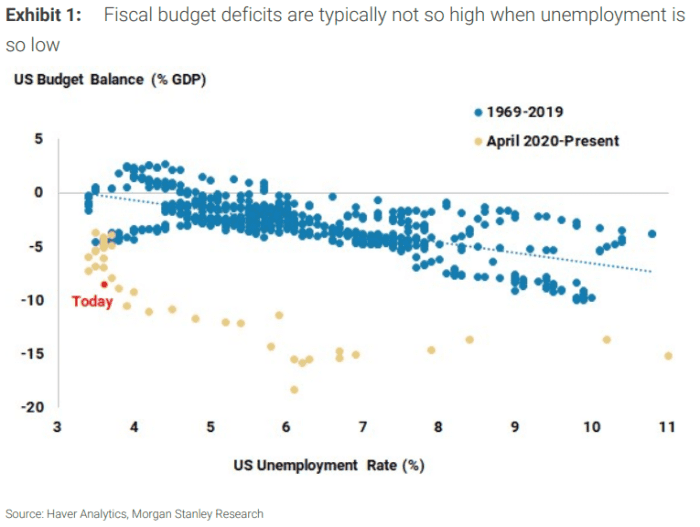
In an accompanying chart, Wilson noted that fiscal spending looks particularly excessive when compared with the U.S. unemployment rate, which fell to 3.5% in July, according to data from the Department of Labor released on Friday.
Source: MarketWatch
To be sure, Wilson was one of a select few on Wall Street to correctly anticipating last year’s inflation-driven selloff.