Pentagon Blacklists AI Company After Refusing Military Control — A Warning About Who Really Owns Tomorrow’s Technology

The Pentagon Just Sent a Message to the Entire Tech Industry
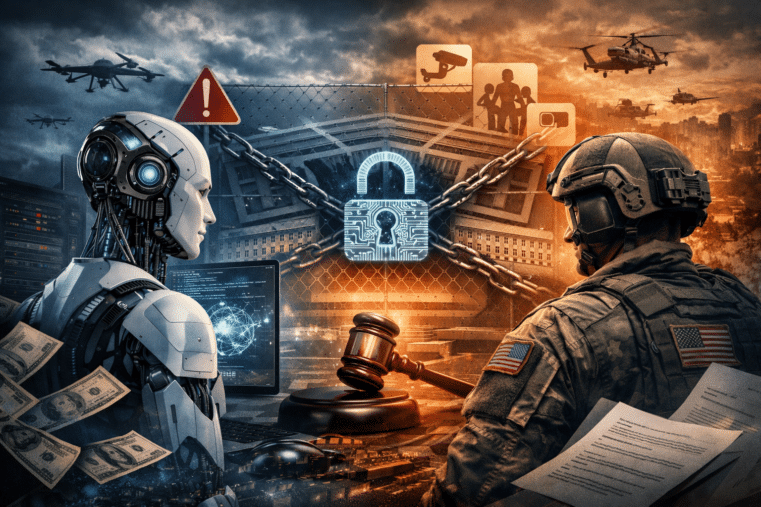
A quiet but explosive conflict has erupted between the U.S. government and one of the fastest-growing artificial intelligence companies in the world.
Anthropic—the developer behind the Claude AI models—has filed a lawsuit against the federal government after the Pentagon placed the company on a national security blacklist.
The designation is severe.

By labeling Anthropic a “supply chain risk,” the Department of Defense effectively told every military contractor in America that they must certify they do not use Anthropic’s AI technology if they want to keep their Pentagon contracts.
That kind of classification is usually reserved for foreign adversaries.
Chinese telecom companies.
Foreign intelligence risks.
Now it’s being used against a domestic AI company.
Anthropic says the move could cost the company hundreds of millions of dollars and threatens its future business relationships across both government and private sectors.
But the real story isn’t about a lawsuit.
The real story is about why the conflict happened in the first place.
The Real Dispute: Who Controls Artificial Intelligence?
According to the filings and reports surrounding the case, the Pentagon demanded something extremely simple—and extremely revealing.
They wanted unrestricted access to Anthropic’s AI models.
Not limited access.
Not mission-specific access.
Unfettered access for any lawful purpose.
Anthropic pushed back.
The company reportedly wanted guarantees that its technology would not be used for fully autonomous weapons and not be deployed for domestic mass surveillance.
That disagreement is where the entire relationship broke down.
Instead of negotiating limits, the government escalated the situation dramatically by blacklisting the company.
From a libertarian perspective, that move tells you everything you need to know.
When Government Demands Technology, “No” Is Not an Acceptable Answer
Here’s the uncomfortable truth about state power.
When governments decide a technology is strategically important, they rarely accept restrictions from the private sector.
They demand access.
They demand compliance.
And if those demands are resisted, the pressure begins.
Sometimes that pressure comes through regulation.
Sometimes it comes through contracts.
And sometimes it comes through designations that can wipe out entire markets overnight.
Calling a domestic AI firm a “supply chain risk” sends a message to every tech entrepreneur in the country:
If you build something powerful enough to matter, the government expects a seat at the control panel.
The National Security State Wants AI — And It Wants It Without Limits
Artificial intelligence is quickly becoming the most strategically important technology of the 21st century.
It can analyze massive datasets, automate decision-making, detect patterns humans would never see, and potentially control autonomous systems on the battlefield.
To military planners, AI represents:
- battlefield advantage
- intelligence analysis at scale
- automated threat detection
- strategic dominance in future conflicts
From their perspective, limiting access to that technology is unacceptable.
Which is exactly why the Pentagon reportedly demanded full access to Anthropic’s models.
The phrase used in the dispute—“all lawful purposes”—is doing a lot of heavy lifting.
Because history shows that what qualifies as “lawful” tends to expand over time.
The Surveillance Question No One Wants to Talk About
Anthropic’s concerns reportedly centered around two specific uses:
- autonomous weapons systems
- domestic mass surveillance
Those are not hypothetical scenarios.
AI systems are already being used globally for:
- predictive policing
- facial recognition networks
- automated intelligence gathering
- data analysis across massive citizen databases
When you combine artificial intelligence with large-scale data collection, you get something powerful enough to monitor entire populations.
That’s not science fiction.
It’s already happening in various parts of the world.
Which is why the fight over AI control matters far beyond a single tech company.
The Irony: Neither Side Is Exactly a Champion of Liberty
Let’s be honest.
Anthropic wasn’t refusing to work with the government entirely.
In fact, the company previously signed a $200 million contract with the Department of Defense and even deployed its AI systems on classified networks.
Reports indicate the technology has already supported U.S. military operations overseas.
So this isn’t a story about a tech company standing up to the military.
It’s a story about a company trying to set limits on how its technology is used—and discovering that limits are something the national security apparatus doesn’t like very much.
Why This Fight Matters More Than It Appears
At first glance, this might look like just another political or legal battle between a corporation and Washington.
But it points to a much bigger issue.
The infrastructure of the digital future is being built right now.
Artificial intelligence.
Digital identity systems.
Algorithmic decision-making.
Financial technology.
And the biggest question of the next decade may not be who invents these systems.
The real question is:
Who controls them once they exist?
Because once powerful digital systems become embedded in government operations, reversing that control becomes nearly impossible.
The Pattern Is Becoming Clear
Every transformative technology eventually attracts government interest.
The internet did.
Encryption did.
Social media did.
Now artificial intelligence has reached that stage.
Once a technology becomes strategically valuable, it tends to move through three phases:
- Innovation in the private sector
- Adoption by government agencies
- Pressure for centralized control
This dispute between the Pentagon and Anthropic may be the moment when AI officially entered phase three.
The Bigger Lesson for Anyone Paying Attention
Whether the courts side with Anthropic or the government is almost secondary.
The real takeaway is this:
When powerful digital technologies emerge, governments eventually move to influence—or control—them.
And that dynamic doesn’t stop with artificial intelligence.
It’s already happening across other digital infrastructure systems that will shape how society operates in the coming years.
Financial networks.
Payment rails.
Digital transaction monitoring systems.
And the gradual shift away from physical cash toward programmable digital systems.
Those changes have enormous implications for personal freedom and economic independence.
The Bottom Line
The Pentagon’s decision to blacklist a domestic AI company should raise serious questions about the future relationship between technology companies and the state.
If the government expects unrestricted access to emerging technologies, private innovation could slowly transform into something very different:
A pipeline feeding directly into centralized power.
That may be efficient.
It may even be framed as necessary for national security.
But it also raises a fundamental question every free society eventually has to answer:
Who ultimately controls the technology that shapes everyday life?
Because once that control becomes centralized, getting it back is nearly impossible.
The Smart Move Right Now
While most headlines are focused on AI conflicts and corporate lawsuits, a much bigger transformation is quietly unfolding inside the financial system.
Governments and central banks around the world are rapidly moving toward digitized monetary infrastructure—systems that make it possible to track, monitor, and even program how money moves through the economy.
That shift could fundamentally reshape financial freedom in the years ahead.
If you want to understand what’s happening—and what steps you can take to prepare—there’s a resource I strongly recommend.
The Digital Dollar Reset Guide by Bill Brocius breaks down how emerging financial technologies could impact privacy, savings, and economic independence.
More importantly, it outlines practical strategies individuals can use to protect themselves as the financial system becomes increasingly digital.
If the trends unfolding across technology and finance are any indication, understanding these changes now may prove far more valuable than waiting until they’re already fully in place.