Programmable Money: When Your Dollars Come With Strings Attached

The Illusion of Financial Control Is Fading Fast
For most of your life, money followed one basic principle: you earn it, you own it. Once it hit your account or your pocket, the choice of what to do with it—spend, save, hoard, or blow—was yours.
That’s no longer a safe assumption.
A new form of money is rising—programmable money—and it doesn’t just change the medium. It rewrites the rules. We’re entering an era where your dollars can carry built-in restrictions. Not warnings. Not suggestions. Hard-coded enforcement.

This shift is not theoretical. It’s already underway.
What “Programmable” Really Means
Forget science fiction. This doesn’t require a central bank digital currency or some “Mark of the Beast” scenario. All that’s needed is software layered onto our already digitized financial infrastructure.
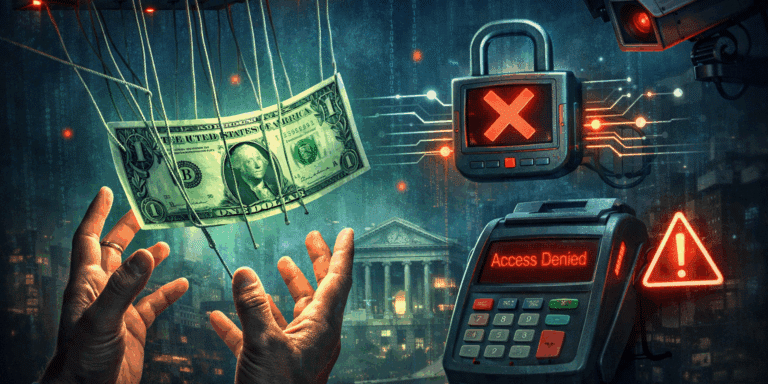
Programmable money means transactions can be automatically blocked, delayed, redirected, or denied based on rules you don’t control—and probably didn’t agree to.
The enforcement no longer comes from courts or institutions after the fact. It’s embedded directly into the currency itself. And that’s a profound shift.
From “You Shouldn’t” to “You Can’t”
This is the critical difference people keep missing. In the traditional financial system, there were rules around money—like tax laws or compliance checks. If you broke them, you might face consequences after the transaction.
Programmable money changes that. It bakes the restrictions into the transaction itself.
You’re no longer told, “You shouldn’t do this.” The system simply won’t let you.
Why Institutions Love It—And Why You Shouldn’t
From a bureaucrat’s perspective, it’s beautiful. Fraud prevention becomes automatic. Compliance is enforced without staff. Policy goals can be rolled out at machine speed. There’s no friction.
But efficiency is the mask authoritarianism wears when it’s trying to look helpful.
Once money is programmable, it stops being a neutral tool and becomes a policy weapon. A lever. A way to steer behavior in real time.
Money That Can Say “No” Isn’t Yours
Once your dollars can be told where they may go, who they may be sent to, or whether they expire—you’re not holding money. You’re holding conditional access.
Ownership is no longer guaranteed. It’s granted. And what’s granted can be revoked.
This is no longer about how much money you have—it’s about how much freedom your money has.
Automation Means No Appeals, No Exceptions
In a human-run system, you can sometimes explain your way through a block. A bank manager can override a denial. A court can issue a release.
Not so in an automated regime.
When the system enforces the rule instantly and indiscriminately, there's no one to argue with. No nuance. No second chances.
Just a red X where your green light used to be.
From Crisis Tool to Permanent Infrastructure
History tells us how this goes. Emergency powers don’t stay emergency powers. They become features.
It starts small—relief payments that expire if unused. COVID-era rent aid that can’t be spent on groceries. Restrictions to prevent “fraud.”
But the underlying capability remains. And when the next crisis hits—bank run, cyberattack, market crash—the full system will already be in place. Ready to enforce. Without asking.
It’s Not Just CBDCs—It’s the System Itself
Most people wrongly assume this threat only arrives with a Central Bank Digital Currency (CBDC). That’s false.
Programmability already exists in commercial banking systems, fintech platforms, government subsidy programs, and digital payment rails.
This transformation doesn’t need a new dollar. It just needs existing dollars connected to conditional code. And that’s already happening.
The Silent Shift from Ownership to Permission
Here’s where it hits hardest: the shift isn’t just technical—it’s psychological.
If your money can be frozen, redirected, or flagged at any moment, you don’t truly own it. You’re merely authorized to use it—until you aren’t.
It’s not a bank account anymore. It’s a leash.
And whether you feel that tug now or not, the tightening has begun.
The New Risk: Policy, Baked Into Code
Traditional financial risk revolves around inflation, interest rates, and market exposure.
But programmable money introduces a new category entirely: policy risk embedded directly into your cash.
This isn’t about whether your investment tanks. It’s about whether your own money obeys you—or someone else.
And too many people are asleep at the wheel.
The Only Assets That Don’t Need Permission
This is why people keep circling back to real, tangible, offline assets. Not because they’re trendy. Because they’re outside the system.
Assets that don’t require approval to be used:
- Physical gold and silver
- Cold storage cryptocurrency
- Land, tools, barterable goods
These aren’t about getting rich. They’re about staying independent. Staying liquid. Staying in control.
What Happens When Financial Freedom Isn’t the Default?
The big question isn’t whether this system will be abused. It’s what happens when the system defines your freedom by default.
Once programmable controls become normal, the burden shifts. You’re not assumed to be free—you’re permitted to be.
If that doesn’t chill your spine, you haven’t been paying attention.
Your Move: Don’t Wait to React. Prepare to Resist.
If you feel the walls closing in, you’re not imagining things. The time to act isn’t when the controls are live and irreversible—it’s before.
Here’s how to start:
✅ Join the Inner Circle—Stay Ahead of the Curve
Bill Brocius and I have been sounding the alarm for years. But warnings are worthless without preparation.
Inside Bill’s Inner Circle, you’ll get timely financial alerts, proven asset strategies, and uncensored insights that Wall Street, the Fed, and the media refuse to touch.
Just $19.95/month. No fluff. No gatekeepers.
👉 Join the Inner Circle now.
📥 Arm Yourself Before the Collapse
Don't wait for the next "bank holiday" or emergency press conference to find out your money's been locked.
Get physical. Get secure. Get educated.
Bill’s “Digital Dollar Reset Guide” walks you through the exact steps to stay liquid, mobile, and outside the programmable trap.
Your future self will thank you. Or curse you—depending on whether you act now.