Strait of Hormuz Crisis Sends Oil Soaring: Inflation Fears Return as Markets Reel and Gold Reasserts Its Role as Financial Insurance

A 1,200-Point Warning Shot
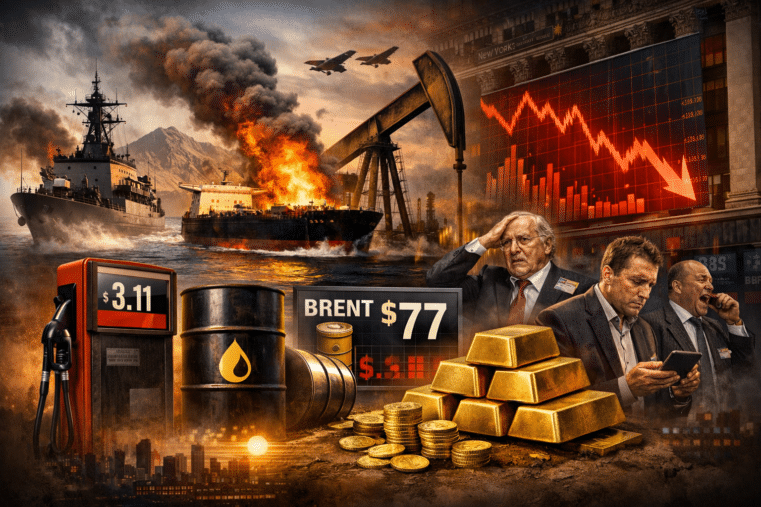
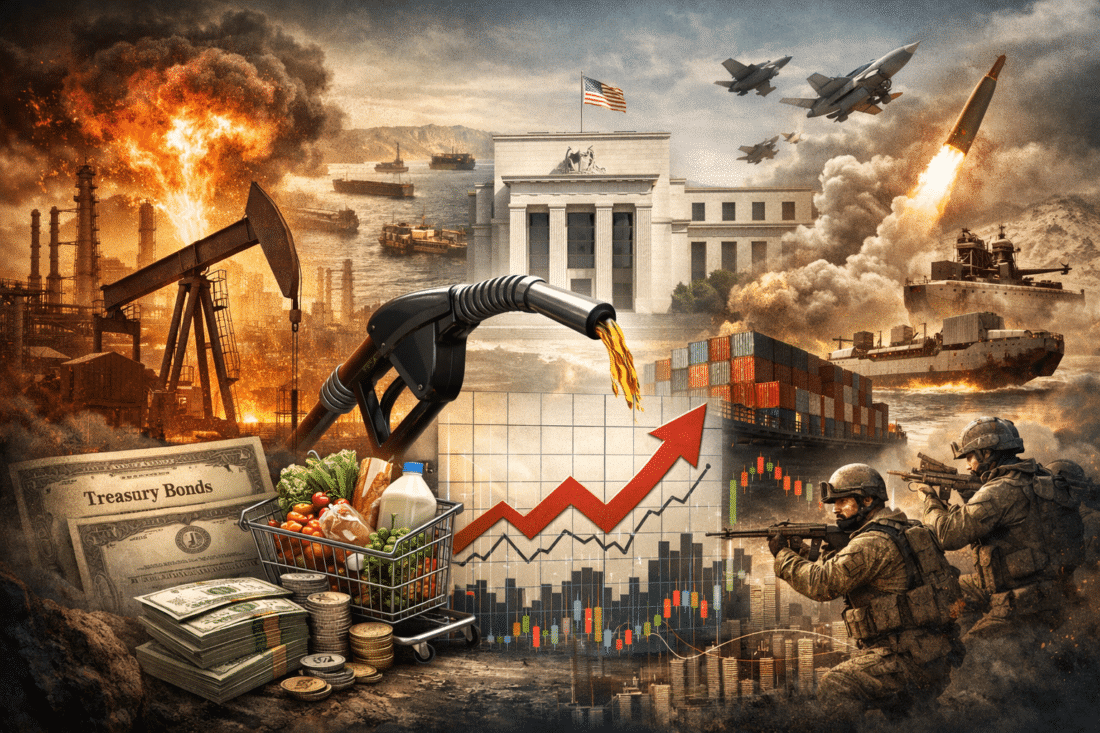
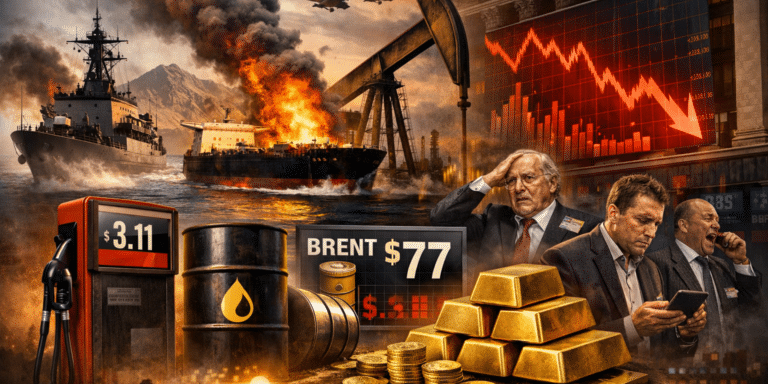
Wall Street tried to steady itself Tuesday after a brutal selloff triggered by Iran’s reported move to close the Strait of Hormuz. The Dow ultimately finished down 403 points, but that modest loss masks the real story: earlier in the session, it was down more than 1,200.
That kind of intraday volatility is not normal market noise. It’s a stress signal.
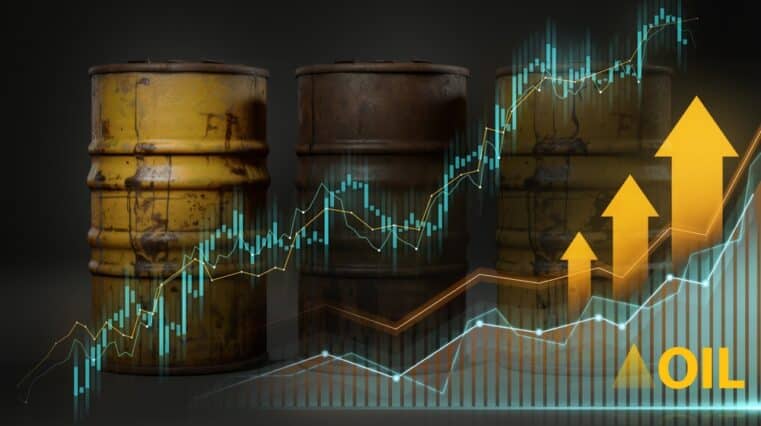
The Strait of Hormuz handles roughly 20% of global oil supply. Any disruption—even temporary—immediately raises the specter of higher energy prices, tighter global supply, and a fresh inflation wave. Brent crude jumped above $77 per barrel. Gasoline prices spiked to $3.11 per gallon nationally, according to AAA.

Markets are forward-looking. They’re not reacting to what is—they’re reacting to what could spiral.
Energy Shock = Inflation Risk, Again
Just weeks ago, inflation appeared to be cooling. The Bureau of Labor Statistics reported CPI easing to 2.4% in January—its tamest pace since last spring. Investors were positioning for potential Federal Reserve rate cuts later this year.
That optimism is now fragile.
History is unambiguous on this point:
- 1973 oil embargo → inflation surge and dollar instability
- 1979 Iranian revolution → stagflation crisis
- 2022 energy spike → CPI explosion and aggressive rate hikes
Energy is not just another input cost. It flows into transportation, manufacturing, food production, and consumer goods. Even modest oil increases can ripple outward. As one analyst cited in the report noted, a 5% oil rise typically adds about 0.1 percentage points to year-over-year inflation.
But if crude moves toward $100—and that becomes sustained—the impact compounds.
The danger isn’t a one-week spike.
It’s a prolonged disruption.
The Fed Is Now in a Policy Trap
Before the conflict escalated, Federal Reserve officials were signaling growing confidence that inflation was cooling enough to justify rate cuts later in the year.
Minneapolis Fed President Neel Kashkari admitted this week that his confidence has been shaken.
That’s a telling admission.
The Fed now faces a classic dilemma:
- Cut rates into an energy-driven inflation rebound?
- Or hold steady and risk choking off a slowing economy?
This is the monetary policy trap that defined the 1970s. Once energy shocks feed into expectations, central banks lose maneuverability. They become reactive rather than proactive.
Markets sense this instability.
The volatility index—the so-called “fear gauge”—spiked to its highest level since November. Investors are recalibrating.
And when confidence in monetary direction wavers, capital looks for stability elsewhere.
The Illusion of Insulation
Some analysts argue the United States is better positioned than in prior crises. Domestic oil and gas production is near record highs. The economy is less energy-intensive than it was decades ago.
That may be true structurally.
But global pricing still matters.
If Saudi refining capacity is disrupted, if LNG facilities in Qatar are struck, if tanker traffic slows dramatically, the global energy market tightens. Prices rise worldwide—even for major producers.
The United States may be insulated from physical shortages.
It is not insulated from global pricing dynamics.
And inflation doesn’t care where the barrel originated.
Gold’s Short-Term Dip Misses the Bigger Picture
Interestingly, gold futures fell 3.4% during the market chaos after having surged the prior session. That move likely reflected short-term liquidity repositioning—investors selling what they could amid volatility.
But step back.
Gold trading above $5,100 per ounce (as cited in the report) is not a trivial detail. That reflects a structural repricing over time.
Gold does not respond to daily headlines the way equities do. It responds to:
- Monetary instability
- Geopolitical uncertainty
- Currency debasement risk
- Loss of confidence in policy control
All four conditions are quietly aligning.
Physical gold is not a momentum trade. It is monetary insurance. It sits outside counterparty risk. It is not subject to earnings reports, policy meetings, or geopolitical speeches.
When energy chokepoints become battlefields, gold’s relevance doesn’t diminish—it strengthens.
Volatility Is the Message
The most important takeaway from this week isn’t whether oil settles at $80 or $95.
It’s the fragility exposed in the system.
One military escalation.
One threatened shipping lane.
One refinery disruption.
And global markets convulse.
That is not resilience. That is leverage.
We are operating in a highly financialized global structure dependent on stable trade flows, stable energy transit, and stable central bank guidance.
Remove one pillar—and tremors spread fast.
The Historical Pattern Investors Forget
Every major inflation cycle in modern history has had an energy component.
Every prolonged monetary crisis has included a confidence breakdown.
And every period of geopolitical escalation has tested financial markets’ assumption of stability.
In those moments, investors who held tangible assets—assets outside the financial system—were not scrambling.
They were positioned.
Physical gold has endured wars, currency collapses, and policy failures for one simple reason:
It does not rely on promises.
The Real Hedge Against Uncertainty
This is not about predicting oil prices next week.
It’s about recognizing structural vulnerability.
When:
- Major oil arteries are threatened
- Inflation risks re-emerge
- Central banks admit uncertainty
- Markets swing wildly
You don’t wait for headlines to stabilize.
You evaluate your exposure.
Holding a portion of wealth in physical gold is not a bet against the United States. It is not a rejection of markets. It is a hedge against the unknown—the kind of unknown that is suddenly front and center again.
A Final Word on Preparedness
While policymakers debate interest rates and geopolitical responses, individuals are left to manage their own financial resilience.
If you’re paying attention to the warning signs—rising volatility, inflation risks, fragile supply chains—you owe it to yourself to understand the broader transformation underway in the global monetary system.
Bill Brocius lays out exactly how these pressures connect to the accelerating push toward centralized monetary control and what it means for your financial autonomy in his Digital Dollar Reset Guide. It’s essential reading for anyone serious about protecting their purchasing power in an era of uncertainty.
You can download it here:
https://secure.dedollarizenews.com/reset/ddr-ebook/?utm_source=Dedollarize_News&utm_medium=ebook&utm_campaign=gsi&utm_term=static_ericblair&utm_content=digital_dollar_reset_guide
Because when oil routes become flashpoints and central bankers admit they’re unsure, waiting is not a strategy.
Preparation is.