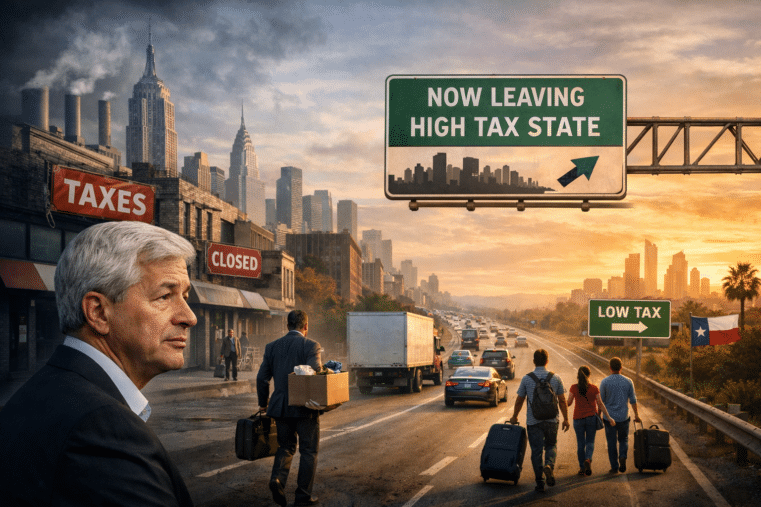
Tax Revolt in Motion: Jamie Dimon Warns of Mass Exodus as High-Tax Cities Push Businesses to the Breaking Point

The Market Is Voting—and It’s Walking Away
Jamie Dimon didn’t mince words: people and businesses are leaving.
"Our head count in Manhattan when I got to JPMorgan was 35,000 and now is 26,000. Our head count in Texas started at 11,000, now it's 33,000. That's what happens."
Jamie Dimon on why companies are leaving New York:
"Highest individual taxes, highest estate taxes, highest… pic.twitter.com/eDUdxAdp8F
— The Hill & Valley Forum (@HillValleyForum) April 2, 2026
Not because they want to—but because they have to.

In a functioning free market, capital flows where it’s treated best. That’s not ideology. That’s economic law. And right now, high-tax states like New York are learning that lesson the hard way.
When taxes climb and regulations stack up, the equation changes:
- Profit margins shrink
- Risk increases
- Incentives disappear
And when incentives disappear, so do the people who create value.
This isn’t a mystery. It’s predictable.
High Taxes Are Not a Moral Statement—They’re a Competitive Disadvantage
One of the most important points Dimon made is something politicians refuse to acknowledge:
This is not about loyalty. It’s about math.
You can dress it up in rhetoric about fairness or social responsibility, but at the end of the day, businesses operate on margins. When those margins get squeezed by excessive taxation, they don’t absorb the hit out of goodwill—they relocate.
Dimon spelled it out clearly: higher taxes reduce returns on capital and weaken competitiveness.
That’s not controversial. That’s basic economics.
But policymakers continue to ignore it.
The Silent Migration: It’s Not Just Companies—It’s People
Most headlines focus on corporations moving headquarters. But the real story is more subtle—and more dangerous for high-tax states.
Workers are leaving too.
Not in dramatic waves, but in steady, consistent trickles that add up over time. Skilled professionals, entrepreneurs, and high earners are quietly relocating to states where:
- Income taxes are lower (or nonexistent)
- Regulations are lighter
- Cost of living is manageable
Dimon called it exactly what it is: people “voting with their feet.”
And once that trend starts, it compounds.
Less talent leads to less innovation.
Less innovation leads to fewer businesses.
Fewer businesses lead to shrinking tax revenue.
And suddenly, the system starts feeding on itself.
JPMorgan’s Shift Tells the Real Story
Forget the headlines—watch what institutions actually do.
JPMorgan is still headquartered in New York. But its workforce tells a different story:
- New York headcount: down from 30,000 to 24,000
- Texas headcount: up from 26,000 to 32,000
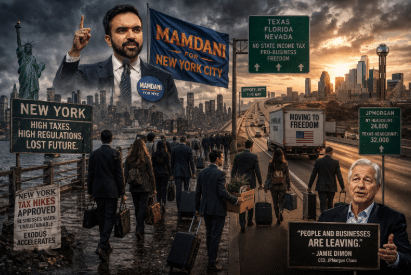
That’s not coincidence. That’s strategy.
Texas offers something New York increasingly does not: a pro-business environment where capital isn’t punished for existing.
Lower taxes. Fewer constraints. More flexibility.
In Austrian economics terms, this is the market correcting distortions created by policy.
History Is Repeating Itself—And No One in Power Is Paying Attention
Dimon referenced something most people have forgotten:
In the 1970s, nearly half of Fortune 500 companies left New York City.
Why?
Not because the city lacked talent. Not because it lacked infrastructure.
Because it became too expensive to operate.
We’re watching that same pattern unfold again—just faster this time.
And here’s the uncomfortable truth:
No city has a “divine right” to success.
Not New York. Not San Francisco. Not any of them.
When policy punishes productivity, decline isn’t a possibility—it’s an outcome.
Derek’s Take: This Is What Government Overreach Looks Like in Real Time
From an Austrian perspective, none of this is surprising.
When governments intervene too heavily—through taxation, regulation, and artificial constraints—they distort the natural signals of the market.
Prices stop reflecting reality.
Incentives get skewed.
Resources get misallocated.
And eventually, the system corrects itself.
That correction looks like what we’re seeing now:
- Capital flight
- Workforce migration
- Regional economic divergence
This isn’t a crisis caused by the free market.
It’s a correction caused by ignoring it.
The Bigger Picture: Competition Between States Is Heating Up
What’s happening isn’t just decline—it’s redistribution.
States like Texas and Florida aren’t winning by accident. They’re winning because they understand something fundamental:
If you want growth, you have to compete for it.
That means:
- Lowering barriers
- Reducing tax burdens
- Encouraging entrepreneurship
Meanwhile, high-tax states are doubling down on the very policies driving people away.
It’s not sustainable.
And the longer it continues, the harder it becomes to reverse.
Final Warning—and What Comes Next
What you’re seeing right now is more than a regional shift—it’s a signal.
When major financial leaders start openly acknowledging capital flight, it means the cracks are too big to ignore.
And while this migration is happening in the physical world—people and businesses relocating—it’s also happening at a deeper level inside the financial system itself.
New systems are being built. New rules are being written. And the same institutions that helped shape the current system are preparing for what comes next.
That’s why understanding where this is heading isn’t optional—it’s critical.
The Digital Dollar Reset Guide by Bill Brocius lays out what’s unfolding behind the scenes, including the expansion of systems like FedNow, the rise of central bank digital currencies, and the growing risks tied to programmable money and financial surveillance.
If you’re paying attention, the pattern is clear.
The question is whether you act on it.