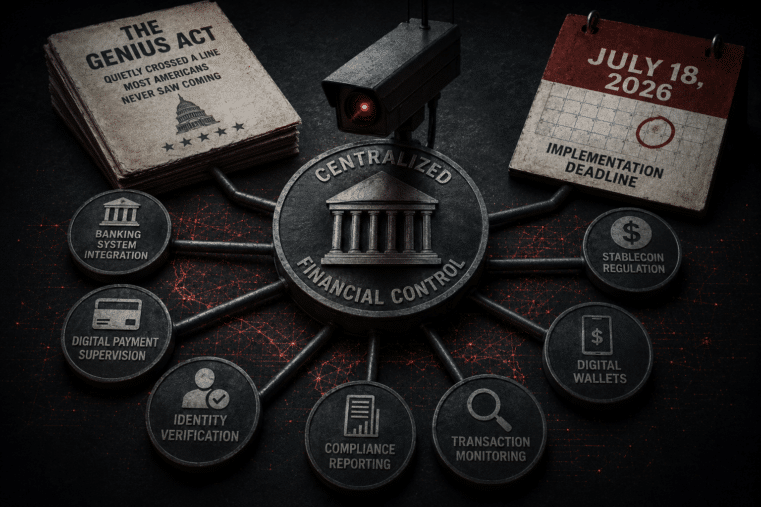

Digital Dollar Reset Accelerates as BRICS Surpasses 40% of Global GDP — The FedNow Era and CBDC Control System Are Closer Than You Think

The Global Power Shift Is No Longer Speculation—It’s Measurable
The latest confirmation that BRICS nations now account for over 40% of global GDP is not just another economic milestone—it’s a clear signal that the balance of financial power is moving away from the U.S.-dominated system.
This isn’t rhetoric. It’s structural.
For decades, the U.S. dollar has functioned as the backbone of global trade, reserves, and settlement. That dominance is now being challenged by a coalition of nations actively building alternative financial infrastructure—outside of Western control.

Russia, China, India, Brazil, South Africa—and an expanding list of Global South partners—are not waiting for permission. They are:
- Building independent trade corridors
- Financing infrastructure across Asia and Africa
- Expanding bilateral trade agreements that bypass the dollar
- Laying groundwork for alternative settlement systems
This is what de-dollarization actually looks like—not headlines, but systems.
Why This Matters: The Digital Dollar Reset Is Already Underway
As global demand for the U.S. dollar faces long-term pressure, policymakers are not standing still.
They’re adapting.
And that adaptation is unfolding through two key mechanisms:
The FedNow Payment System
The FedNow payment system is already live, enabling instant settlement between financial institutions. On the surface, it’s about speed and efficiency.
But structurally, it introduces:
- Real-time transaction visibility
- Centralized processing pathways
- The technical rails required for programmable money
This is not the end state—it’s the foundation.
Central Bank Digital Currency (CBDC) Development
While the U.S. has not formally launched a CBDC, the direction is clear. Globally, central banks are accelerating digital currency pilots at an unprecedented pace.
Why?
Because as global monetary power fragments, control becomes more important—not less.
CBDCs enable:
- Transaction-level monitoring
- Policy enforcement at the currency level
- Programmable restrictions on how money is used
This is where financial surveillance moves from possibility to infrastructure.
BRICS Expansion Signals a Fragmented Monetary Future
Maxim Oreshkin’s statement that the current financial system shift is “inevitable” should not be dismissed.

It aligns with observable trends:
- Trade between Global South nations is increasing rapidly
- Logistics and supply chains are being restructured outside Western routes
- New financial corridors are forming that reduce reliance on traditional banking systems
This is not just economic diversification—it’s systemic decoupling.
And when systems decouple, volatility follows.
What Happens When the Dollar Loses Its Central Role?
Let’s be clear—this is not about the dollar disappearing overnight.
It’s about erosion.
Gradual at first. Then sudden.
As global demand shifts:
- Treasury demand weakens
- Monetary policy becomes more constrained
- Inflation management becomes more difficult
- Confidence becomes more fragile
Historically, reserve currency transitions are not smooth. They are disruptive.
And in today’s environment—layered with debt, geopolitical tension, and digital transformation—the risks are amplified.
The Convergence: De-Dollarization Meets Digital Control
Here’s the part most people miss:
These two trends—global de-dollarization and domestic digital currency development—are not separate.
They are converging.
As external demand for the dollar weakens, internal control mechanisms strengthen.
That’s the tradeoff.
- Less global dominance
- More domestic oversight
This is how governments maintain stability during periods of transition.
Through control.
Financial Surveillance and Programmable Money Are Not Theories
Around the world, we are already seeing early versions of this system:
- Transaction monitoring frameworks expanding
- Digital ID systems linking financial access
- Pilot programs testing programmable currency features
This is the architecture of a new financial system—one where access, usage, and mobility of money can be influenced in real time.
Not hypothetically. Technically.
What This Means for You: Exposure vs. Preparedness
Most people will not react until the system forces them to.
By then, options narrow.
The question is simple:
Are you positioned inside a system that is becoming more centralized and programmable…
or are you preparing for a world where financial autonomy requires strategy?
Because this transition—this Digital Dollar Reset—is not a single event.
It’s a process already unfolding.
My Response: This Is the Window to Act—Not Watch
The data is clear. The trajectory is visible. The infrastructure is being built in real time.
Ignoring it doesn’t reduce the risk—it increases your exposure.
This is the phase where informed individuals move early, understand the system, and position themselves accordingly.
Not reactively.
Strategically.
Download the Digital Dollar Reset Guide Before the System Fully Locks In
If you recognize what’s happening—the rise of BRICS, the acceleration of de-dollarization, the rollout of FedNow, and the looming expansion of CBDCs—then the next step is not more information.
It’s preparation.
The Digital Dollar Reset Guide breaks down:
- How the financial system is evolving right now
- Where the risks are increasing
- What practical steps you can take to protect your financial autonomy
- How to navigate a system shifting toward digital currency control
This is not optional reading—it’s essential intelligence for anyone who refuses to remain exposed as the financial reset accelerates.