Tax the Rich? Or Tax the American Dream?

The Slogan Is Simple. The Damage Is Not.
“Tax the rich.”
It fits on a bumper sticker.
It trends on social media.
It wins applause at progressive rallies and faculty lounges.
And even if the people pushing it aren’t running the federal government right now, the danger is real: this idea is popular enough that it can become law the moment the political winds shift.

Because once a slogan becomes a movement, it doesn’t stay a slogan for long.
But here’s the uncomfortable truth: when you target capital, you’re not just targeting billionaires.
You’re targeting the engine that drives wages, jobs, and upward mobility.
Capital builds plants.
Capital funds expansion.
Capital buys the equipment that makes workers more productive.
And productivity is what raises paychecks.
You can’t weaken the engine and expect the car to go faster.
Productivity, Not Politics, Raises Wages
Take two workers. Same effort. Same hours.
One has modern tools, advanced equipment, access to capital.
The other does not.
Who earns more?
The answer isn’t political. It’s practical.
The worker backed by capital produces more—and earns more.
That’s not a theory cooked up in a think tank. That’s how every thriving economy works.
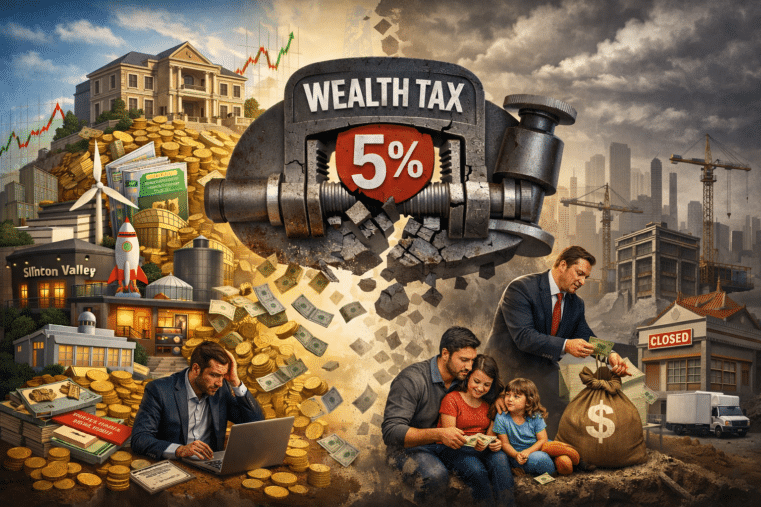
So when progressive Democrats float aggressive wealth taxes—3% here, 4% there—under the banner of fairness, they’re also quietly eroding the capital base that fuels innovation and job growth.
Less reinvestment means:
- Slower business expansion
- Fewer new ventures
- Weaker productivity growth
- Pressure on future wages
The activists may call it justice.
Working families will feel it as opportunity lost.
Redistribution Makes Headlines. Growth Builds Prosperity.
There’s always a dramatic example—confiscate a massive fortune, distribute it widely, declare victory.
It sounds bold.
But once you dismantle the businesses and investment networks behind that wealth, what happens next?
Companies scale back.
Investments pause.
Jobs disappear or stagnate.
A one-time redistribution check doesn’t replace long-term economic vitality.
Prosperity isn’t built by carving up existing wealth.
It’s built by creating more of it.
The Real Power Play Behind the Moral Language
Here’s what rarely gets said out loud.
When progressives push these taxes, it’s not just about revenue. It’s about leverage.
The more money that runs through government channels, the more power the political class gains to:
- Pick winners and losers
- Hand out subsidies and carve-outs
- Reward allies and punish enemies
And once that machinery exists, it doesn’t shrink easily. It grows. It always grows.
That’s how you get an economy where success depends less on serving customers and more on navigating political favor.
A republic can’t thrive when the rules tilt toward the connected.
Southern States Know What Happens When Investment Dries Up
In the South, we’ve lived through economic transitions. We’ve seen towns struggle when factories close. We’ve watched communities rebuild when investment returns.
Capital matters.
Savings matter.
Entrepreneurship matters.
You don’t revive rural America by discouraging long-term investment. You don’t strengthen middle-class families by making future capital formation less attractive.
Strong communities require:
- Stable property rights
- Predictable tax systems
- Encouragement of reinvestment
- Regulatory balance
That’s not ideology. That’s experience.
Democracy Thrives on Growth, Not Resentment
Democracy isn’t strengthened by dividing citizens into categories to be penalized based on political fashion.
It’s strengthened by broad opportunity.
When growth slows and redistribution expands, politics becomes more zero-sum. Groups compete harder for slices of a pie that isn’t growing. Trust falls. Conflict rises.
If we want a stable republic, we should focus on policies that expand opportunity—not ones that risk shrinking it.
The Real Debate
This isn’t about defending excess.
It’s about asking one clear question:
Do we want an economy that rewards long-term investment and productivity?
Or one that increasingly channels economic power through political institutions?
Slogans are easy.
Sustainable prosperity is harder.
But it’s worth defending.
If you want unfiltered analysis on where these ideas are heading—and what they mean for your state, your business, and your family—join the Inner Circle today.
Special Offer: Just $19.95/month (normally $39.95)
Stay informed. Stay ready. And don’t let slogans decide your future.