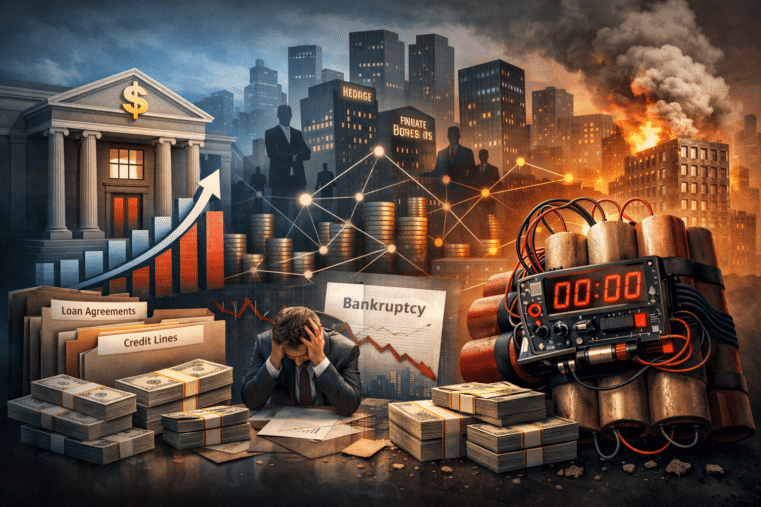
The $4.2 Trillion Time Bomb in America’s Banking System

The Calm Headlines Hide a Dangerous Reality
At first glance, America’s banking system looks healthy.
The latest industry data from the FDIC paints a reassuring picture:
- Deposits rising for six straight quarters
- Loans growing nearly 6% year-over-year
- Bank balance sheets expanding
On paper, everything looks steady.

But dig one layer deeper and a different story emerges.
A massive and rapidly expanding category of lending is now sitting on bank balance sheets. It’s not traditional mortgages. Not small business loans. Not consumer credit.
It’s loans to non-bank financial institutions—the sprawling network often called the shadow banking system.
And the scale is staggering.
The Fastest Growing Risk in Banking
Loans from banks to non-depository financial institutions surged to $1.4 trillion by the end of 2025.
That’s a 35% increase in just one year.
But that’s only the beginning.
Banks have also extended enormous unused credit lines to these same institutions.
Estimated undrawn commitments:
$2.8 trillion.
Add the two together and the total exposure becomes clear:
- $1.4 trillion already lent
- $2.8 trillion still available to draw
Total potential exposure: roughly $4.2 trillion.
In plain English: for every dollar already loaned out, two more dollars are waiting in reserve.
And if stress hits the system, those lines can be drawn almost instantly.
What Exactly Is the “Shadow Banking System”?
Most Americans have never heard the term.
But the shadow banking system plays a huge role in modern finance.
These are financial firms that behave like banks—but operate outside the traditional regulatory framework.
They include:
- Private equity firms
- Private credit funds
- Direct lenders
- Non-bank mortgage companies
- Speculative investment vehicles
These institutions borrow money from banks. Then they lend or invest that money in higher-risk ventures.
When markets are booming, the system looks brilliant.
When conditions tighten, the risks become obvious.
Early Cracks Are Already Appearing
Several recent developments are raising eyebrows across financial markets.
A UK mortgage lender tied to major Wall Street firms recently collapsed, leaving hundreds of millions in missing collateral.
Investigators are examining allegations of double-pledged collateral—the same assets promised to multiple lenders.
Similar issues have surfaced in previous corporate failures.
When collateral problems appear in complex financial structures, confidence erodes quickly.
And confidence is the oxygen of the financial system.
The Private Credit Boom Is Under Pressure
Private credit—one of the fastest-growing sectors in finance—may be approaching a stress test.
Corporate bankruptcies in the United States surged in 2025 to their highest level in 15 years.
Many of those failures involved companies backed by private equity.
Analysts are watching closely because private credit investors are deeply exposed to these firms.
Some projections suggest default rates in certain private credit sectors could rise sharply if economic conditions weaken.
Even a moderate increase in defaults would ripple through lenders.
And remember who funds many of those lenders.
Banks.
When the Shadow System Falters, Banks Feel It
For years, policymakers suggested the shadow banking world was separate from traditional banks.
In reality, the two systems are tightly connected.
Banks provide:
- Credit lines
- Structured financing
- Warehouse loans
- Liquidity support
If a non-bank borrower suddenly draws on a credit line and cannot repay it, the bank absorbs the loss.
Multiply that risk across hundreds of institutions and the numbers add up quickly.
That’s why regulators—including the Federal Reserve—have warned about the rapid growth of this sector.
History shows that when one category of bank assets expands far faster than the broader economy, it often signals rising systemic risk.
A Familiar Pattern From Financial History
Veterans of financial markets recognize the pattern.
Periods of booming asset prices often encourage more leverage.
More leverage fuels more speculation.
For a time, everything appears stable.
Until it isn’t.
The late 1920s.
The housing bubble of the 2000s.
Even parts of the tech boom.
Each period carried the same message from the financial establishment:
“Things are different this time.”
Then reality arrived.
Why This Matters for Ordinary Americans
Most people will never trade private credit or analyze bank balance sheets.
But history shows that when financial systems experience stress, the effects rarely stay contained.
They move outward:
- Credit becomes tighter
- Markets grow volatile
- Economic growth slows
And when financial institutions stumble, policymakers often face difficult decisions about how to stabilize the system.
That’s why understanding emerging risks matters.
Not to panic—but to stay informed.
The Big Question Facing 2026
The numbers alone don’t guarantee a crisis.
But they do raise an important question.
Can a financial system absorb trillions of dollars in exposure to lightly regulated lenders if economic conditions suddenly change?
Markets are only beginning to wrestle with that question.
Bank stocks already showed signs of volatility earlier this year.
Investors are watching closely.
Because if stress spreads through private credit markets, the shadow banking system may turn out to be far less separate from traditional banking than many assumed.
And that could become one of the defining financial stories of the coming years.
Stay Ahead of the Financial Storm
The financial world is changing fast. Risks are building beneath the surface of markets that many Americans never see.
If you want deeper analysis of banking risks, financial policy, and the economic forces shaping the future of the country, you need information that goes beyond the headlines.
Join the DeDollarize News Inner Circle for insider insights and uncensored financial analysis.