Time to Take Sound Money to the Federal Level: Why Gold and Silver Are the Real Solution

By Bill Brocius, author of "End of Banking As You Know It"
The idea of "Sound Money"—using gold and silver as actual currency—has been gaining steam across the United States for over a decade. Since Utah first removed restrictions on gold and silver as legal tender back in 2011, more than 40 states have followed suit, and New Jersey recently became the 45th state to repeal sales taxes on gold and silver, as of January 2025. Now, the movement is pushing to take this momentum to the federal level, and with Representative Alex Mooney (R) of West Virginia introducing the Monetary Metals Tax Neutrality Act (HR 8279), we are at a tipping point.
But why should you care about this? Because this bill could fundamentally reshape the future of money in America. It challenges the current dominance of Federal Reserve notes and opens the door for Americans to use gold and silver as everyday currency without fear of unfair taxation. This is a critical development, especially as our paper currency is increasingly backed by nothing more than the "full faith and credit" of a government running up trillions in debt.

A $5 Bill and a $5 Gold Eagle: Why the System Is Broken
Here’s the argument at the heart of Mooney’s bill: A $5 Federal Reserve note (what we all know as a five-dollar bill) is treated the same as a $5 Gold Eagle because both are considered legal tender under the law. But here’s where the system falls apart: If the value of your $5 bill increases in purchasing power, you don’t owe taxes on that appreciation. However, if the $5 Gold Eagle appreciates in value (which, as gold prices rise, it often does), you’re hit with capital gains taxes if you decide to spend it or sell it.
This makes no sense. Both the $5 bill and the $5 Gold Eagle are supposed to be legal tender, but only the gold coin is subject to additional taxes if its value goes up. Why? Because gold is classified as a "collectible" under the tax code, not as currency. This misclassification is a huge hurdle to making gold and silver practical for everyday transactions, and it's the very issue that Mooney’s bill seeks to fix.
Think about it—if we’re going to treat gold and silver as money, we shouldn’t be punishing people with taxes just because the value of gold rises over time. After all, if the Federal Reserve’s dollar loses value through inflation, no one gets a tax break. But when gold holds its value (or even rises), suddenly the government wants a cut? That’s not just illogical—it’s unfair.
Gold Is Backed by the Treasury—The Dollar Is Backed by Promises
The difference between gold and Federal Reserve notes goes beyond tax treatment. Let’s look at what’s really behind these forms of money. Gold, when used as currency, is backed by a tangible asset—the actual gold held in your hand or account. This gold is typically stored and secured by institutions or private vaults, and its value is recognized globally. It’s real money, as solid as it gets.
On the other hand, Federal Reserve notes—our paper dollars—are backed by the full faith and credit of the U.S. government. That’s just a fancy way of saying they are IOUs, supported by the Federal Reserve, a private central bank that issues currency not tied to any tangible asset. As the government prints more money and increases debt, the value of each dollar declines through inflation. So, essentially, what backs your dollars? Nothing more than promises, which become shakier every time the Fed cranks out more cash.
This difference is crucial, especially in uncertain economic times. With gold, you have something real. With dollars, you’re banking on the hope that the system doesn’t collapse under the weight of $35.7 trillion in national debt and unrelenting inflation.
The Rising Value of Gold and Silver: What the Numbers Say
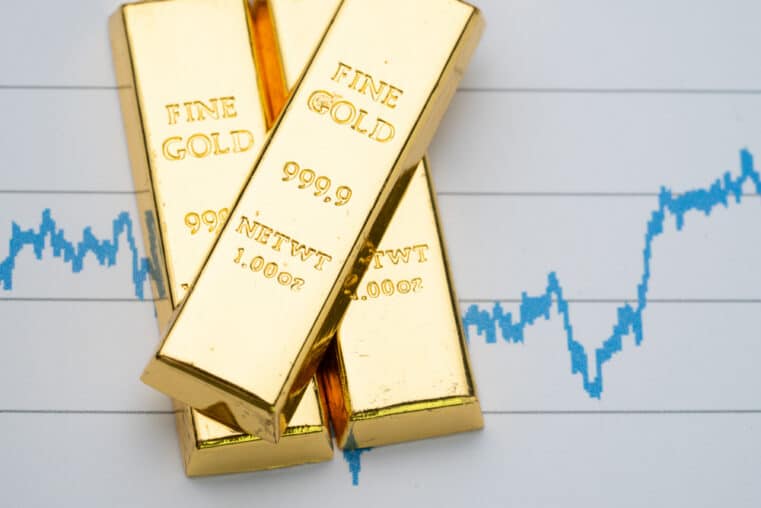
Despite daily market fluctuations, gold and silver have proven to be incredibly resilient over time. As of October 23, 2024, the price of gold dipped slightly, down $27.43, marking a 1.00% drop for the day. But this is just short-term noise. Let’s take a look at the bigger picture:
- In the last 30 days, gold is up $87.84 (a 3.30% increase).
- In the last 6 months, gold surged by $429.82 (18.56%).
- Over the past year, gold has risen by $773.23, a remarkable 39.20% increase.
- Looking over the past 5 years, gold is up $1,247.01, a robust 83.20% gain.
- Over the last 20 years, gold has skyrocketed by $2,322.07, translating to a massive 547.85% growth.
Silver shows similar strength. Today, silver is down $1.14, but long-term gains are significant:
- In the last 30 days, silver has risen by $2.69 (8.36%).
- Over 6 months, silver prices jumped by $7.65 (28.14%).
- In the past year, silver is up by $11.89, an impressive 51.83%.
- Over the past 5 years, silver prices have gained $17.10 (96.40%).
- Over 20 years, silver has appreciated by $27.53, a 376.61% increase.
These numbers paint a clear picture: while paper currencies lose value over time, gold and silver hold and even increase in purchasing power. If gold and silver are allowed to circulate as legal tender without the tax penalties currently imposed, Americans will finally have an alternative to the dollar that doesn’t slowly lose its value over time.
A Movement Gaining Ground: States Taking Action
The states are already leading the charge in adopting Sound Money principles. New Jersey recently became the 45th state to repeal sales tax on gold and silver bullion, joining states like Alabama, Kentucky, and Utah, all of which have removed barriers to using gold and silver in transactions. This trend is rapidly expanding, and as more states act, the push for federal recognition grows stronger.
By eliminating these tax barriers, states are encouraging the use of precious metals as money—just as the Constitution intended. And by doing so, they are undermining the Federal Reserve’s monopoly on currency, giving people the freedom to opt out of the inflating dollar.
The Bigger Picture: Capital Gains and the Harris Tax Proposal
As if the tax burden on gold and silver weren’t bad enough, Vice President Kamala Harris has proposed a Billionaire Minimum Tax that could further complicate the landscape. This proposal targets unrealized capital gains, meaning investors would owe taxes on the theoretical increase in the value of their assets, even if they haven’t sold them. This would apply to people with net wealth above $100 million, but the principle it introduces is alarming: taxing gains before they’re even realized.
If such a policy were extended to gold and silver, it would discourage Americans from investing in hard assets, undermining their ability to protect wealth from inflation. As more states adopt Sound Money principles, this kind of federal overreach becomes even more important to push back against. Sound Money legislation at the federal level would protect Americans from these kinds of punitive tax policies, allowing them to use gold and silver freely—without being punished for their choice to preserve value.
Why This Matters Now
With the Monetary Metals Tax Neutrality Act gaining support, we’re at a critical juncture. The difference between relying on the Federal Reserve’s fiat currency and adopting gold and silver as money couldn’t be starker. One is a system built on debt and promises, while the other is anchored in tangible assets that have held value for thousands of years.
As more states remove the barriers to using gold and silver, it’s time for the federal government to follow suit. And if the Monetary Metals Tax Neutrality Act is passed, it will finally be possible for Americans to transact in gold and silver without the threat of unjust taxation.
This is a line in the sand—and we need to be on the right side of it. Protect yourself from the coming changes in the financial system. Download my free guide, 7 Steps to Protect Yourself from Bank Failure, and learn how to secure your wealth in these uncertain times.