

US Debt at Record Highs: A Fiscal Powder Keg

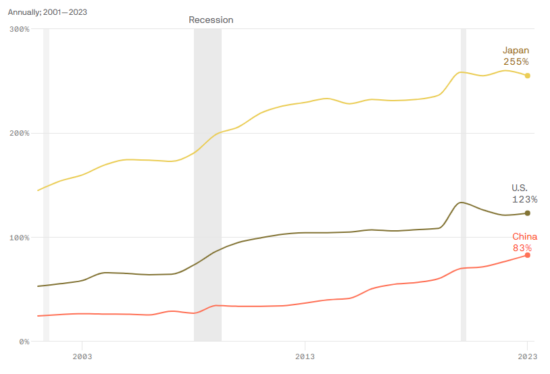
Debt as share of GDP for select economies
Source: International Monetary Fund; Chart: Deena Zaidi/Axios Visuals
The world's richest economy is piling on more debt, with no end in sight as the stakes get higher.
Why it matters: The U.S. public debt surged during the pandemic and recently passed $34 trillion — a record even when accounting for inflation, according to recent data.
- Public borrowing is expected to set records this year in many of the world's major economies.
Between the lines: As Washington bickers, the long-term solvency of entitlement programs such as Medicare and Social Security remains an open question.

- Another fight over the debt ceiling looms early next year. An agreement reached to raise it last May expires in January 2025.
By the numbers: In the last century, the U.S. federal debt has risen from an inflation-adjusted $403 billion in 1923 to $33.17 trillion in 2023.
- The U.S. debt-to-GDP ratio surpassed 100% in 2013 and currently stands at 123%, according to the International Monetary Fund (IMF).
Zoom in: The U.S. has plenty of company. Virtually every other major government across the world has aggressively tapped into global debt markets.
- Japan has the highest debt-to-GDP ratio at 255%. Its national debt has floated above 100% of its GDP for more than two decades.
- China's national debt is above 80 percent of its GDP, according to IMF data.
This article originally appeared on Axios