Will Trump Fund This War With Inflation—And Is This the Setup for a Digital Dollar Reset?

Inflation Is Rising Again—Right on Cue
The latest data isn’t subtle.
- CPI just hit 3.3% year-over-year
- Monthly inflation posted its biggest jump since 2022
- Energy prices are surging—gasoline alone up nearly 19%
And even when you strip out volatile categories, inflation isn’t behaving. It’s sticky. Persistent. Refusing to fall back to that clean 2% target everyone keeps promising.
That’s the backdrop.

Now add war to the equation.
War Spending Doesn’t Ask Permission
Wars don’t wait for balanced budgets.
They don’t pause for debt concerns or inflation targets. They demand resources—fast, massive, and continuous.
And right now, the U.S. is stepping into another expensive, open-ended commitment.
So the obvious question becomes unavoidable:
How does the government actually pay for it?
The Three Options—And the One Nobody Talks About
There are only three ways to finance this:
- Raise taxes
- Borrow more
- Expand the money supply
You’ll hear plenty about the first two.
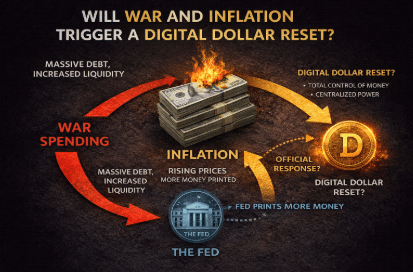
But the third one?
That’s the quiet mechanism that does the heavy lifting.
Because inflation doesn’t show up as a policy decision. It doesn’t require a vote. But it redistributes wealth just the same—slowly, steadily, and often invisibly.
The Fed Isn’t Fighting Inflation Like You Think
Officially, the Federal Reserve is still “committed” to price stability.
But actions matter more than words.
- Rates were cut before inflation was fully under control
- Inflation never truly returned to target
- Liquidity is quietly flowing back into the system
That tells you something important:
The priority isn’t just controlling inflation.
It’s maintaining system stability—especially when government financing needs increase.
And war has a way of increasing those needs dramatically.
Energy Prices Are the Wild Card
Now factor in oil.
We’re looking at a major global energy disruption—something markets are already trying to downplay.
But energy inflation spreads everywhere:
- Transportation costs
- Manufacturing inputs
- Food prices
- Consumer goods
This isn’t isolated.
It’s systemic.
And when energy costs rise alongside increased money supply? That’s when inflation stops being “temporary” and starts becoming embedded.
So Where Does the Dollar Fit Into All This?
Here’s where things get more interesting—and more uncomfortable.
The current system depends on confidence in the dollar.
But that confidence is tied to:
- Stable purchasing power
- Manageable inflation
- Trust in monetary policy
When inflation persists…
When debt expands…
When war spending accelerates…
That confidence starts to erode at the margins.
Not all at once. But gradually.
And historically, when systems reach that point, they don’t just “fix” themselves.
They evolve.
Enter the Quiet Shift Toward Digital Control
While all of this is happening—war, inflation, debt expansion—there’s another layer moving in parallel:
- The rollout of FedNow
- Increased discussion around central bank digital currencies (CBDCs)
- Growing infrastructure for real-time transaction monitoring
These aren’t isolated developments.
They’re part of a broader shift toward a more centralized, programmable financial system.
And here’s the key connection:
The more unstable the current system becomes, the stronger the case for replacing or restructuring it.
Crisis Has Always Been the Catalyst
Major financial shifts don’t happen in calm environments.
They happen during:
- Inflationary periods
- Economic instability
- Wartime financing pressure
That’s when new systems get introduced—not as options, but as “solutions.”
Faster payments. More control. More oversight.
Framed as modernization.
But rooted in necessity.
Is This Leading Toward a Reset?
No one is going to announce a “reset” on live television.
That’s not how this works.
Instead, it happens gradually:
- Inflation becomes normalized
- Debt expands beyond sustainable levels
- New systems are introduced to “improve efficiency”
Until one day, the financial landscape looks completely different than it did before.
More digital.
More centralized.
More controlled.
So… Will Inflation Fund the War? Or Something Bigger?
Maybe inflation is just a short-term tool.
Maybe it’s a temporary bridge.
Or maybe it’s part of a larger transition—one where the current system is stretched to its limits, creating the conditions for something new to take its place.
That’s the real question.
And it’s one worth paying attention to.
Final Thought: Watch the Direction, Not the Headlines
You’ll hear explanations for inflation:
- Supply shocks
- Geopolitics
- External disruptions
Some of that will be true.
But the bigger picture is about direction:
- More liquidity
- More centralized systems
- More financial oversight
Those trends don’t reverse easily.
They build.
Get Prepared Before the Shift Becomes Obvious
If you’re starting to see how these pieces connect—war spending, inflation pressure, and the quiet rollout of systems like FedNow—then you’re already ahead of most people.
But awareness isn’t enough.
You need a clear understanding of where this is heading and how to protect yourself before the system fully shifts.
Download the Digital Dollar Reset Guide by Bill Brocius now.
This isn’t optional. It’s essential intelligence for navigating what’s coming next.