Digital Dollar Shock: BRICS Resource Domination Exposed as FedNow & CBDC Push Signals Loss of Financial Freedom Before the Reset Hits

The Real Power Shift Isn’t Financial—It’s Physical
Let’s get straight to it: the global balance of power is no longer dictated by paper wealth, stock markets, or debt-fueled economies.
It’s dictated by who controls the real-world commodities that make modern life possible.
And right now, that control is shifting—fast.

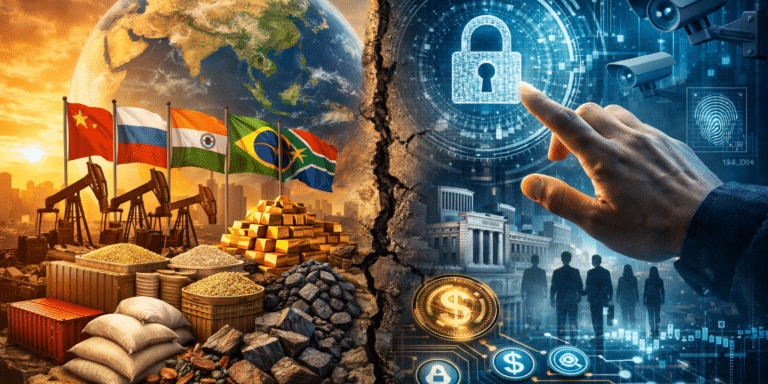
The BRICS alliance, now expanded to 11 nations, holds a commanding position across critical resources:
- 90% of global rare earth processing
- 45% of global oil reserves
- 50% of global gold production
- 42% of global food production
- 40% of industrial output, freshwater, and key commodities
This isn’t theoretical. This is infrastructure-level dominance.
Meanwhile, Western economies—especially the United States—are increasingly dependent on global supply chains they don’t control.
That’s not just a vulnerability.
It’s a leverage point.
4.4 Billion vs. Less Than 1 Billion: The Population Imbalance No One Is Addressing
Here’s the number that should stop you cold:
- BRICS population: 4.4 billion (55% of the world)
- G7 population: under 10% of the world
That’s not just a demographic statistic—it’s an economic weapon.
More population means:
- Larger domestic markets
- Massive labor pools
- Self-sustaining production ecosystems
- Internal demand that reduces reliance on external trade
In contrast, Western economies rely heavily on:
- Imported labor
- Outsourced manufacturing
- Foreign resource dependency
This imbalance means BRICS nations can increasingly operate independently of Western systems, while the West cannot do the same in reverse.
That’s how decoupling begins.
Resource Control = Financial Control
Here’s where this becomes directly relevant to you.
When a bloc controls:
- Energy
- Food
- Water
- Industrial metals
- Strategic minerals
They don’t just control supply chains.
They control pricing, access, and ultimately economic stability.
And when that power consolidates outside the Western financial system, it undermines the dominance of the U.S. dollar.
This is the foundation of the Digital Dollar Reset.
Because once global trade begins shifting away from dollar dependency, central banks don’t just sit back and watch.
They respond.
Enter FedNow and the Rise of Programmable Money
The rollout of the FedNow payment system isn’t happening in a vacuum.
It’s part of a broader shift toward:
- Real-time transaction monitoring
- Centralized payment infrastructure
- Increased visibility into financial behavior
Pair that with the ongoing development of central bank digital currencies (CBDCs), and you’re looking at something far more consequential:
Programmable money.
This isn’t speculation—it’s already being tested globally.
Programmable currency enables:
- Transaction-level control
- Spending restrictions
- Automated compliance enforcement
- Real-time financial surveillance
Now ask yourself:
Why would governments accelerate this shift right as global resource power moves away from their control?
Because when you lose external leverage…
You tighten internal control.
The Quiet Expansion of Financial Surveillance
As commodity power shifts to BRICS, Western governments face a hard reality:
They can’t outproduce or out-resource their competitors.
But they can:
- Monitor
- Regulate
- Restrict
- Digitize
Your financial life.
This is where government financial surveillance expands under the justification of:
- Stability
- Security
- Efficiency
But in practice, it creates a system where:
- Every transaction is tracked
- Access can be limited
- Financial autonomy is reduced
This is the tradeoff being introduced—quietly.
Why the U.S. Advantage Is No Longer Guaranteed
For decades, the U.S. maintained dominance through:
- Dollar reserve status
- Military strength
- Financial system control
But none of those replace:
- Oil in the ground
- Food production capacity
- Rare earth supply chains
- Freshwater reserves
And that’s the uncomfortable truth:
You cannot print commodities.
As BRICS consolidates control over these resources, the traditional pillars of U.S. power face increasing pressure.
That doesn’t mean collapse tomorrow.
But it does mean uncertainty ahead—and a narrowing margin for error.
The Convergence: Resource Dominance Meets Digital Control
This is the moment most people miss.
Two trends are happening at the same time:
- BRICS is gaining control over physical resources
- Western systems are digitizing financial control mechanisms
That convergence leads to one outcome:
A restructured global financial system where:
- Resource-backed trade gains influence
- Digital currencies enforce internal controls
- Financial freedom becomes conditional
This isn’t a conspiracy.
It’s a strategic response to shifting power.
What This Means for You
You don’t need to predict the exact timeline.
You just need to recognize the direction:
- More centralized control
- Less financial privacy
- Increased dependency on digital systems
- Reduced autonomy over your own money
The risk isn’t immediate collapse.
It’s gradual restriction.
And by the time it’s obvious, your options may already be limited.
The Bottom Line: Awareness Isn’t Enough Anymore
The BRICS nations now hold the population, resources, and production capacity to reshape global trade.
At the same time, the West is accelerating toward a digitized financial system built on surveillance and control.
That combination should concern anyone paying attention.
Because once these systems are fully in place, opting out becomes significantly harder.
Take Action Before the System Locks In
If you understand what’s unfolding, the next step is simple:
Prepare.
Not react—prepare.
That means understanding:
- How the Digital Dollar Reset could impact your savings
- What CBDC risks mean for your financial autonomy
- How to navigate a system built around programmable money and surveillance
I’ve laid this out clearly in a step-by-step format inside my guide.
Download The Digital Dollar Reset Guide Now
This isn’t about fear.
It’s about positioning yourself before the rules change.
Because they are already starting to.