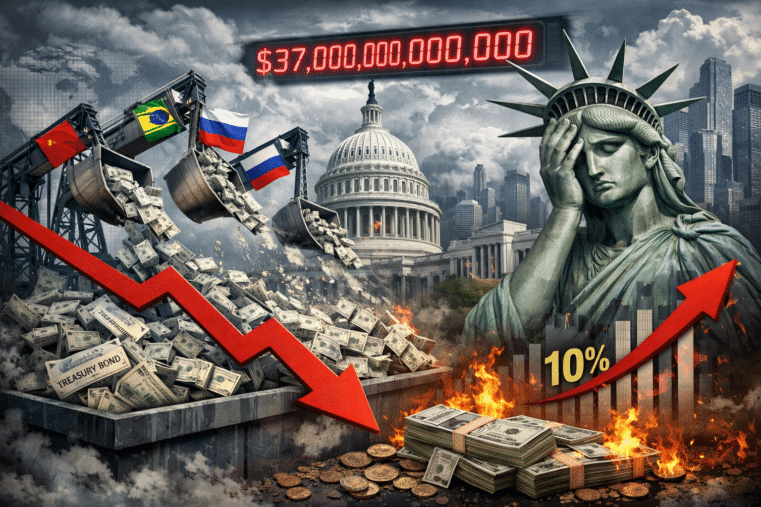
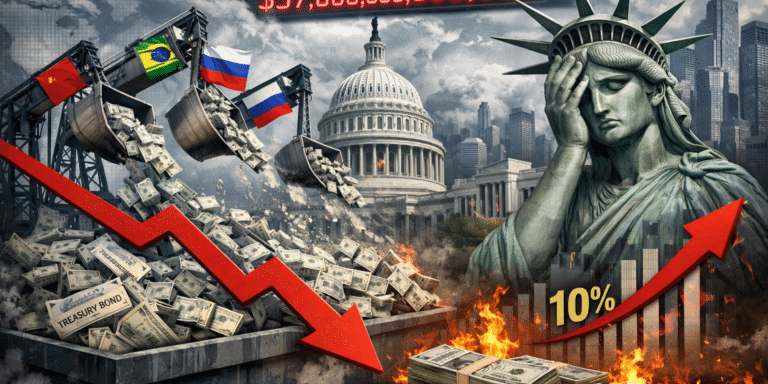
Foreign Nations Are Dumping Treasuries as U.S. Debt Surges Past $37 Trillion

America’s Borrowing Machine Is Accelerating
The U.S. Treasury is preparing to borrow $578 billion in the first quarter of 2026 alone.
To put that into perspective, the government borrowed $308 billion in February by itself, which works out to roughly $50 billion per week over recent months.
At the same time, the national debt has surpassed $37 trillion, and the debt-to-GDP ratio has reached around 123%, levels not seen since the aftermath of World War II.

Washington isn’t just borrowing to fund new spending—it’s also borrowing to pay interest on existing debt and roll over older bonds.
And that’s where the real problem begins.
Because the global buyers who historically helped finance America’s deficits appear to be quietly stepping back.
BRICS Nations Are Cutting Treasury Holdings
New Treasury International Capital (TIC) data shows a noticeable shift.
Over the past year:
- China reduced its Treasury holdings by $75.5 billion
- India cut $36.2 billion
- Brazil sold roughly $32.9 billion
Combined, these three BRICS economies trimmed about $144.6 billion in U.S. government debt.
Even more concerning, reports indicate Chinese regulators have advised domestic banks to limit their exposure to U.S. Treasuries due to volatility and geopolitical risks.
In other words, this isn’t just portfolio rebalancing.
It looks increasingly like strategic diversification away from the U.S. debt market.
Financial analysts are beginning to acknowledge the shift. ING’s global markets team described BRICS countries as “quietly leaving the Treasury market.”
That should get your attention.
The Dangerous Supply and Demand Problem
The Treasury market works like any other market.
Prices depend on supply and demand.
Right now, two forces are moving in opposite directions:
Supply is exploding.
Washington is issuing hundreds of billions in new Treasuries every quarter to fund deficits.
Demand may be weakening.
Some of the world’s largest buyers are reducing exposure.
When supply rises and demand falls, something has to adjust.
Usually, that means interest rates move higher to attract new buyers.
And that’s exactly what we’re seeing.
Treasury Yields Are Already Climbing
The 10-year Treasury yield recently moved above 4.2%, continuing a steady climb.
Higher yields mean the government must pay more interest on new debt.
And that cost adds up quickly.
Today, roughly one-fifth of federal tax revenue is already going toward interest payments.
Think about that.
Before funding the military… Social Security… infrastructure… or healthcare…
A massive portion of government revenue is already going just to service past borrowing.
If interest rates rise further, those payments could balloon dramatically.
Why This Matters for Everyday Americans
Many people assume the national debt is just an abstract political talking point.
It isn’t.
When Treasury yields rise, the effects ripple through the entire economy.
Higher Treasury yields typically lead to:
- Higher mortgage rates
- Higher credit card interest
- Higher auto loan costs
- Higher business borrowing costs
That can slow economic growth and put pressure on households already struggling with inflation.
And if investors become less willing to finance U.S. deficits, policymakers may face difficult choices:
- Raise taxes
- Cut spending
- Borrow even more
- Or rely on the Federal Reserve to step in
None of those options are painless.
The Dollar Question
Another issue lurking beneath the surface is confidence in the U.S. dollar.
For decades, the dollar’s dominance has allowed the United States to borrow at relatively low interest rates because global investors considered Treasuries the ultimate safe asset.
But that assumption is now being debated more openly.
Analysts at ING recently warned that risks surrounding the dollar remain “on the downside” for 2026 due to fiscal instability, political uncertainty, and rising debt levels.
At the same time, BRICS nations are exploring ways to expand trade and financial systems that rely less on the U.S. dollar.
Whether those efforts succeed quickly or not, the direction of travel is becoming clearer.
The Real Risk Few Are Talking About
The biggest danger isn’t that the U.S. suddenly runs out of buyers tomorrow.
The Treasury market is still enormous and highly liquid.
The real risk is gradual erosion of demand.
If global investors slowly diversify away from Treasuries while Washington keeps issuing record amounts of debt, the result could be:
- Persistently higher interest rates
- Rising fiscal stress
- Greater financial volatility
History shows that debt problems often develop quietly for years—until they suddenly accelerate.
What Smart Americans Are Doing Now
The point of understanding these trends isn’t panic.
It’s preparation.
When the financial system faces structural pressures, the people who fare best are those who stay informed and take steps early.
That’s exactly why I created the Inner Circle.
Inside, I share deeper analysis on the financial risks building inside the banking system, the dollar, and the global monetary order—along with practical strategies to help protect your wealth.
Members of the Inner Circle also join a growing community of readers who are paying attention to the warning signs before they become headlines.
Learn How To Protect Your Future
For $19.95 a month, you’ll gain access to exclusive insights and research designed to help you stay ahead of the financial shifts unfolding right now.
Because when it comes to protecting your money, the worst strategy is waiting until everyone else realizes what’s happening.