Government Cheese and the Rot Beneath the Surface: A Symbol of Failed Interventionism

The Government Cheese Disaster: An Explainer
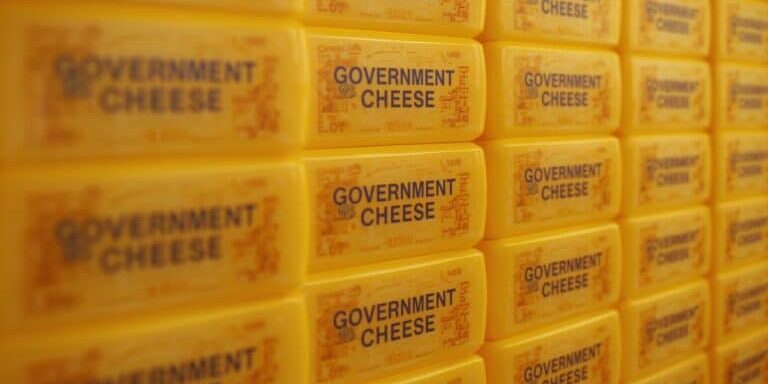
Let’s strip away the dairy jokes and pop culture nostalgia for a moment. The U.S. government hoards over 1.4 billion pounds of cheese in storage facilities—warehouses and underground “cheese caves”—largely thanks to policy decisions made over 40 years ago. If that sentence alone doesn’t make your free-market instincts twitch, you haven’t been paying attention.
How Did This Happen?
1. The Dairy Crisis of the 1970s
Milk shortages led to rising prices, and in typical Keynesian fashion, the Carter administration decided that the “solution” was to subsidize dairy producers—funneling billions into the industry with the promise to buy up unsold product.
2. Predictable Overproduction
With the government guaranteeing purchases, farmers no longer had to worry about actual market demand. Unsurprisingly, they ramped up production. But milk spoils quickly, so the feds began converting it into more shelf-stable forms: cheese, powdered milk, and butter.

3. Storage and the Cheese Glut
With no one to sell to, and no price mechanism to slow production, the government found itself sitting on mountains of dairy products. In 1981, President Reagan’s agriculture secretary stood before reporters holding a moldy five-pound block of cheese and admitted: “We can’t sell it, and we’re looking to give some of it away.”
What Did They Do With It?
They gave it away—to food banks, community centers, and welfare programs—under the Temporary Emergency Food Assistance Program (TEFAP). This wasn’t a humanitarian gesture born out of compassion. It was an act of desperation to clear out stockpiles created by market distortion.
This is the exact kind of scenario that Henry Hazlitt warned about in Economics in One Lesson, and that Ludwig von Mises detailed in Economic Policy: Thoughts for Today and Tomorrow. When you tamper with prices and production incentives, you create not just inefficiencies, but unintended long-term consequences that impact everyone.
Why It Matters Today
The cheese hasn’t disappeared. The policies behind it haven’t either. This is just one example in a long and rotting chain of government failures:
- Corn subsidies led to high-fructose corn syrup saturating our food supply.
- Seed oil subsidies turned industrial waste into dietary “guidelines.”
- Fiat money policies created fiat food—cheap, low-nutrient calories to paper over inflation.
- Lobbyist-controlled policy replaced genuine market signals with bureaucratic mandates.
Just as fiat currency loses value through inflation, fiat food undermines health, liberty, and truth in the same way. What we’re witnessing is the predictable rot of centralized economic planning, wrapped in the language of “safety nets” and “public welfare,” but always serving one master: entrenched corporate interests.
Cheese as Sound Money? A Teaching Moment
The article cleverly opens by comparing cheese to sound money—durable, divisible, portable, and with intrinsic value. Indeed, in pre-modern societies, cheese sometimes acted as a medium of exchange or tax payment. But unlike gold or silver, cheese decays. That’s what makes it a perfect metaphor for state intervention: even when it starts with value, it spoils when hoarded and mishandled.
Mises understood this clearly: every step away from a true free market is a step toward planned economies, with outcomes that serve political stability over individual prosperity.
What You Can Do About It
If you think this is just about cheese, you’re missing the point. This is about your money, food, and freedom being slowly eroded by a system that rewards failure and punishes self-reliance.
1. Educate Yourself
Download Bill Brocius’ free guide, 7 Steps to Protect Your Account from Bank Failure. Learn the real risks facing your financial accounts—and how to act before another institution collapses.
2. Get the Full Picture
Read Bill’s book, The End of Banking As You Know It, and understand the structural weaknesses that most financial commentators refuse to discuss.
3. Join the Inner Circle
Subscribe to the Inner Circle Newsletter for just $19.95/month to receive uncensored, deeply researched insight from Bill Brocius himself—someone who has predicted and documented these failures long before they hit the headlines.
Final Thought
Government cheese isn’t funny. It’s not just an embarrassing policy footnote. It’s a warning—and like all warnings, it comes with a choice: Laugh it off, or wake up and protect yourself.
—
Eric Blair
Dedollarize News
Fighting for economic liberty in an age of decay.