ISO 20022 Is Upon Us: The Quiet Financial Shift No One Thought to Question

A New Era Began — And No One Told You
November 2025 came and went with no press conference, no celebration, no vote. But beneath the surface, an irreversible change occurred. That was the month banks, central clearinghouses, and financial institutions worldwide completed their migration to ISO 20022, a standardized, machine-readable format for all high-value payments.
At first glance, it’s easy to dismiss. "Just a messaging protocol,” they say. A technical upgrade. Nothing for the public to worry about. But that framing is strategic.
Because once you understand what ISO 20022 really does — how it changes what money is allowed to carry, how it embeds surveillance and programmability into every transaction — you realize this wasn’t just a software upgrade. It was a complete overhaul of monetary architecture, and the public was never given a say.

What ISO 20022 Actually Does
For decades, global payments operated on limited messaging rails. Transactions moved with bare-bones information: a name, an account number, a dollar amount, maybe a reference code.
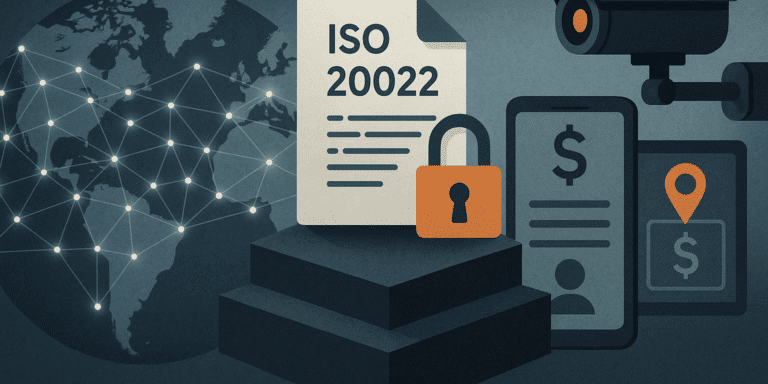
Now, with ISO 20022, the data payload expands dramatically. Every transaction can include:
- Full identity details for both sender and receiver
- Purpose codes and transaction classifications
- Device and merchant metadata
- Geolocation tags, remittance notes, and AI-ready structured fields
In short, payments are no longer just money — they’re rich data objects. And once data is structured, it can be sorted, analyzed, filtered, and — eventually — controlled.

That’s not theory. That’s function by design.
The payment networks of the world — SWIFT, Fedwire, CHIPS, SEPA, TARGET2, and FedNow — have already integrated ISO 20022. The old SWIFT MT system, which powered global banking for half a century, is being decommissioned. The financial nervous system now speaks a single language — and that language is built for programmability.
The Hidden Alignment with the Control Grid
So why now? Why this level of coordination across the globe? The answer is simple: the infrastructure had to be ready for what’s coming next.
Governments and central banks have spent the last few years openly experimenting with Central Bank Digital Currencies (CBDCs), digital IDs, programmable payments, and algorithmic risk scoring. All of these initiatives require one foundational ingredient: structured, standardized financial data.
ISO 20022 is the keystone. Without it, the system can’t scale. With it, the infrastructure for real-time monitoring, dynamic controls, and automated enforcement snaps into place.
What this means in practical terms is that a transaction isn’t just a transfer — it becomes a piece of behavioral metadata. Where you spent, how often, on what, and with whom. Payments become a proxy for your social graph, your political footprint, and your economic reliability score.
And once it’s all machine-readable, decisions about what’s “allowed” can be handled algorithmically — no court order needed.
Surveillance, Control, and the End of Assumed Privacy
For decades, privacy in finance existed not because of laws, but because of technical limitations. The old systems simply didn’t have the bandwidth to carry deep surveillance payloads. ISO 20022 changes that overnight.
Now, with every transaction containing full identity structures, geolocation, merchant tags, and behavioral context, surveillance becomes structural. You no longer need to subpoena the bank or audit the merchant. The transaction itself is the dossier.
This also opens the door to programmable restrictions. CBDCs — which are already in pilot or production in dozens of countries — become vastly more powerful once integrated with ISO 20022. Time limits on spending, carbon budgets, restricted categories, or geo-fenced access — all become easily enforceable with the metadata ISO 20022 enables.
And as AI models are trained on this flood of financial metadata, automated de-banking becomes not just possible, but predictable. A flagged merchant code, a controversial donation, a pattern of “non-compliant” behavior — any of these can trigger account freezes or transaction blocks.
This is financial exclusion at machine speed.
The Quiet War on Alternatives
This new infrastructure doesn’t need to outlaw alternatives — it just needs to marginalize them.
Cash is becoming harder to justify when the entire financial system demands structured metadata. Precious metals and self-custodied crypto may remain legal, but they’ll increasingly be treated as opaque, high-risk, or outside the default rails.
Banks are already nudging customers away from cash withdrawals. Payment processors flag crypto transactions. Compliance frameworks rate gold dealers as “high alert.”
What’s legal doesn’t need to be banned — it can simply be made impractical.
And in a world where ISO 20022 sets the rules of engagement, anything that doesn’t conform to its data schema becomes an outlier — and then a liability.
This Was Never About Efficiency — It’s About Leverage
To be clear, ISO 20022 is brilliant engineering. It enables faster settlements, cleaner compliance, and more reliable data transfers. But don’t confuse utility with neutrality.
The same structured data that speeds up aid distribution can also enable real-time spending controls. The same transparency that catches fraud can be used to map political dissent. The same automation that improves security can be used to lock you out of the system.
We’ve built a financial nervous system that can be used to either empower people — or manage them like livestock. And the codebase doesn’t care which.
What matters now is who governs it, and what rules are written into the rails.
It’s Not Too Late — But You Must Move First
The banks have flipped the switch. The data flows are live. The decision tree is already being coded.
But that doesn’t mean you’re powerless.
Here’s where you start:
- Download my free guide — 7 Steps to Protect Your Account from Bank Failure — and learn the practical steps to shield your savings and maintain access to your funds.
- Join my Inner Circle — where I release uncensored briefings on where this is headed next, including strategies for cash preservation, alternative payment systems, and financial escape hatches. Click here to join for $19.95/month.
The system didn’t ask for your permission to change. But it will enforce compliance — unless you’re prepared.
November 22: A Hinge Moment for Financial Freedom
There were no headlines. No press releases. No votes.
But historians may look back on November 22, 2025 as the moment the free market economy became a programmable control grid. When every transaction became a surveillance opportunity. And when financial freedom became something you had to fight to maintain.
The rails are live. The rules are shifting. And the clock is ticking.
Stay alert.
Stay sovereign.
— Bill Brocius